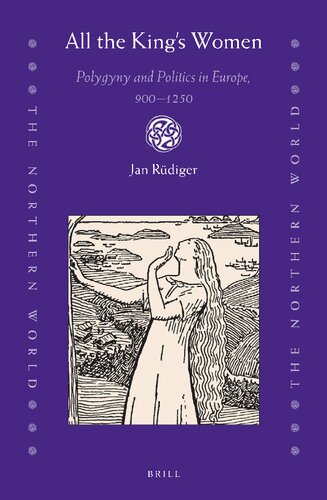
All the King’s Women: Polygyny and Politics in Europe, 900–1250
Book information
Description
Polygyny, in Europe? The grand narrative of Western history is the development of monogamous marriage, culminating in the central Middle Ages. Other kinds of relationships have often, perhaps too lightly, been dismissed as ‘just lust’. In this book, Jan Rüdiger investigates the plurality of man-woman relationships in medieval Scandinavia and analyses the social and political ‘uses’ of elite polygyny. By way of comparison the findings from the North are then applied to England, France, and the Iberian Peninsula, in order to propose a new overall image of elite polygyny, including marriage, in the medieval West. All the King’s Women: Polygyny and Politics in Europe, 900–1250 Contents Acknowledgements Abbreviations Introduction 1 Libido and Satyriasis 2 Scholarship 3 'Polygyny' 4 Structure 5 'Aspects' of Polygyny 6 Objective 7 Postscript 2020 King Harald Fairhair's Women: a Word on the Sources 1 “…And Then He Took Her to Bed” 2 "Concubine or Wife?" 3 On Sources 4 Scholarship on the Sagas 1 The Generative Aspect 1 Thorns, Pigs, and Two Dreams 2 Royal Blood 3 Danish Particularism polygyny in the Chronicles 4 Practices of the Valdemar Era 5 Dissenting Voices Sven Aggesen and Saxo Grammaticus 6 The 'Generative Aspect' of Polygyny 7 Harald, the All-Father 8 The 'Good' Bastard King 9 The Mill Maid's Tale 10 Suitability 11 Co-optative Kinship 12 Twofold Legitimacy Sverrir of Norway 13 Married, Crowned, Unsuccessful 14 Low-Born and Successful 15 Polygyny as a Guarantor of Parity 16 Polygyny without Women? 2 The Habitual Aspect 1 Models 2 Polygyny and Historiography the Oddaverjar 3 A Song of Praise 4 "Very Susceptible to Love" Jón Loptsson's Women 5 A Lovers' Saga? 6 Portrait of a Competitor 7 Were There Wives? 8 'Retrospective Marriage' 9 A Vocable for the Ineffable Elja 10 The Brother-in-Laws' Confrontation 11 What Was at Stake I: Bishop Þorlák 12 What Was at Stake II: Jón Loptsson 13 Resource Polygyny 14 Women and Plunder 15 From Canterbury to Camelot 3 The Agonistic Aspect 1 Snorri Takes a Bath 2 Mannjafnað—“Comparison of Men” 3 Social Rhetoric the Contest for Borghild í Dali 4 Women in Mannjafnað 5 Renegotiating Status Loss I: Saint Olav's Lover 6 The Women's Agon 4 The Expressive Aspect 1 Political Relations? 2 What Ælfgifu Means 3 Polygyny as a Semantic System 4 Domestic and Foreign Policy: Harald Hardrada's Women 5 A Successful Takeover: Harald Hardrada and Þóra Þorbergsdóttir (1047) 6 The Near-Failure of a Party Formation: Eindriði Einarsson and Sigríð Erlingsdóttir (c.1023) 7 An 'Unproductive' Communication: Valdemar the Great and Helena Guttormsdatter (c.1200) 8 Renegotiating Status Loss II: the Bridal Journey of Óláf Haraldsson (c.1017) 9 A Woman in Reserve: the Icelander's Booty and the Orkney Alliance (c.980) 10 A Family on the Rise: Sigurð Haraldsson's Woman (c.1150) 11 A New Party: the Daughters of Saxi í Vík (from c.1095) 12 "And He Will Take Your Daughters...": Magnús the Good and Margrét Þrándsdóttir (c.1040) 13 Danish Encounters 14 The Emperor's Daughter and the Elbe Frontier: Erik Ejegod and Queen Bothild (c.1100) 15 The Cheese and the Anchor: Harald Hardrada's Booty (1047) 5 The Performative Aspect 1 "Castles and Maidens" 2 Abishag at the Court of Hákon Hákonarson 3 Northern European Hierogamy? 4 Hákon Hlaðajarl 5 Death in the Pigsty 6 Jarl Hákon and His Patron Goddess 7 Perpetual Hierogamy 6 The Comparative View: Western Europe 1 In the Heartland of Medieval Studies 2 Scholarship 3 Sources 4 Figurations of Polygyny: Arthurian Literature 5 Strategies of Representation under the Spell of Monogamism 6 The Invisible Women 7 In Comparison: the Generative Aspect 8 In Comparison: the Habitual Aspect 9 In Comparison: the Agonistic Aspect 10 In Comparison: the Expressive Aspect 11 In Comparison: the Performative Aspect 12 Polygyny as Political Principle: Normandy 13 The Spoils of the Conqueror: Rollo and Poppa 14 Mother of the Nation: Gunnor 15 The Henchman’s Daughter: Herleve 7 The Comparative View: Southern Europe 1 "Unbearable Heat" 2 Concubinage at the Highest Level: James I and Aurembiaix of Urgell (1228) 3 Ornamental Mediterraneanness: Christian Princes and Moorish Maids 4 Iberian Renunciation—Llibre dels Feits and Primera Crónica General (c.1250) 5 Ornamental Europeanness: Polygyny in Andalusia 6 Paritarian Polygyny—Autocratic Abstinence Polygyny and Europe: By Way of a Conclusion Appendix Bibliography Primary Sources Secondary Sources Index
Similar books
All the Kings Women: Polygyny and Politics in Europe, 900–1250
2020 · PDF

Aristokraten und Poeten: Die Grammatik einer Mentalität im tolosanischen Hochmittelalter
2001 · PDF

Der König und seine Frauen: Polygynie und politische Kultur in Europa (9.-13. Jahrhundert)
2015 · PDF

Der König und seine Frauen: Polygynie und politische Kultur in Europa (9.-13. Jahrhundert)
2015 · EPUB

Aristokraten und Poeten. Die Grammatik einer Mentalität im tolosanischen Hochmittelalter
2001 · PDF

All the Kings Women: Polygyny and Politics in Europe, 900-1250
2020 · PDF

Der König und seine Frauen: Polygynie und politische Kultur in Europa (9.-13. Jahrhundert)
2015 · PDF

MySQL® Notes for Professionals book
2018 · PDF