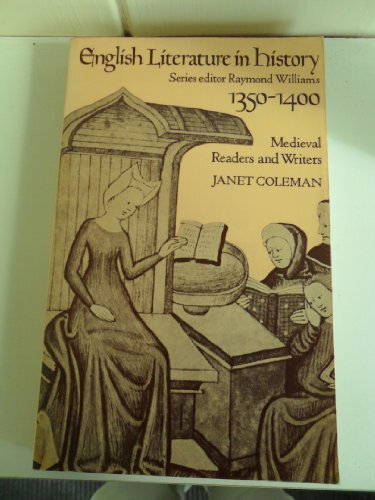
Medieval Readers and Writers, 1350-1400
Book information
Description
Published in Great Britain in 1981 by Hutchinson & Co. (Publishers) Ltd in the series 'English Literature in History', edited by Raymond Williams. Published in the United States of America in 1981 by Columbia University Press. For the poet John Gower, in many ways the central figure of Dr Coleman's scintillating interpretation of late fourteenth-century English literature, it was axiomatic that 'of them that writen ous tofore, The books remain, and we therefore be taught by what was written then'. But precisely what later generations may safely learn from the literary production of past societies notoriously seems very much less certain in the late twentieth century than at any time since the author of the 'Confessio Amantis' began his book 'for Engelonde's sake'. As Raymond Williams points out in his introduction to Dr Coleman's work, the rapid evolution of 'literature' and 'history' as increasingly autonomous yet often artificial genres of academic discipline can have a peculiarly insidious effect in polarising the relationship between two cognate fields of enquiry. Despite the recent vogue for interdisciplinary studies there is indeed an ever-increasing danger of 'a widespread retreat from the problems'. Needless to say, it is a good deal easier to diagnose the illness than to find its remedy. All the more welcome is Raymond Williams's decision to sponsor a collection of studies designed to break the barrier by an intensive examination of literary works and traditions within the context of a precise period of time. Thanks to the author's unfailing verve and intelligence, proves an admirable object-lesson in the many virtues, as well as the occasional vice, of such an approach. Rarely concerned with the literary qualities of the many works of poetry and prose she discusses, Dr. Coleman concedes for instance that neither the homiletic romances nor the poems of social unrest and protest of the late fourteenth century produce much in the way of a striking phrase or an aesthetically memorable juxtaposition of image and sound'. What does interest her, and accordingly makes her book so exceptionally stimulating to the ecclesiastical historian, is the way in which the diversified literary forms of late fourteenth-century England play 'an ancillary role' to their moral and religious message. Editor’s introduction Raymond Williams 9 1. Introduction 13 2. Vernacular literacy and lay education 18 3. The literature of social unrest 58 4. Memory, preaching and the literature of a society in transition 157 5. Theology, non-scholastic literature and poetry 232 6. Conclusion 271 Notes and references 281 Index 329
Similar books

Ιστορία της πολιτικής σκέψης. Από το Μεσαίωνα μέχρι την Αναγέννηση
2006 · PDF

Ιστορία της πολιτικής σκέψης. Από την αρχαία Ελλάδα μέχρι τους πρώτους χριστιανικούς χρόνους
2005 · PDF
Medieval readers and writers, 1350-1400
1981 · PDF

Ιστορία της πολιτικής σκέψης T.2ος Απο το Μεσαίωνα μέχρι την Αναγέννηση
2006 · PDF

The Blackwell Encyclopaedia of Political Thought
1991 · EPUB

A History of Political Thought: From the Middle Ages to the Renaissance
2000 · DJVU

History of Political Thought
2000 · PDF

Ancient and Medieval Memories: Studies in the Reconstruction of the Past
2005 · DJVU