Amoral Communities: Collective Crimes in Time of War
Book information
Description
In Amoral Communities, Mila Dragojević examines how conditions conducive to atrocities against civilians are created during wartime in some communities. She identifies the exclusion of moderates and the production of borders as the main processes. In these places, political and ethnic identities become linked and targeted violence against civilians becomes both tolerated and justified by the respective authorities as a necessary sacrifice for a greater political goal. Dragojević augments the literature on genocide and civil wars by demonstrating how violence can be used as a political strategy, and how communities, as well as individuals, remember episodes of violence against civilians. The communities on which she focuses are Croatia in the 1990s and Uganda and Guatemala in the 1980s. In each case Dragojević considers how people who have lived peacefully as neighbors for many years are suddenly transformed into enemies, yet intracommunal violence is not ubiquitous throughout the conflict zone; rather, it is specific to particular regions or villages within those zones. Reporting on the varying wartime experiences of individuals, she adds depth, emotion, and objectivity to the historical and socioeconomic conditions that shaped each conflict. Furthermore, as Amoral Communities describes, the exclusion of moderates and the production of borders limit individuals' freedom to express their views, work to prevent the possible defection of members of an in-group, and facilitate identification of individuals who are purportedly a threat. Even before mass killings begin, Dragojević finds, these and similar changes will have transformed particular villages or regions into amoral communities, places where the definition of crime changes and violence is justified as a form of self-defense by perpetrators. Contents Illustrations Preface Abbreviations Introduction: Civilians in Wars 1. The Making of Amoral Communities 2. Evidence of Amoral Communities 3. The Exclusion of Moderates 4. The Production of Borders 5. Memories and Violence 6. Violence against Civilians as a Political Strategy Conclusion: Preventing Collective Crimes Appendix: An Excerpt from the Field Notes by Helga Paškvan Notes References Index
Similar books

The Politics of Social Ties: Immigrants in an Ethnic Homeland
2016 · EPUB
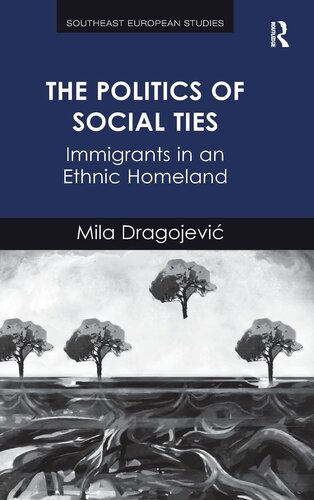
The Politics of Social Ties: Immigrants in an Ethnic Homeland (Southeast European Studies)
2014 · PDF

Amoral Communities: Collective Crimes in Time of War
2019 · PDF

The Politics of Social Ties: Immigrants in an Ethnic Homeland
2014 · PDF

MySQL® Notes for Professionals book
2018 · PDF

MrExcel 2022: Boosting Excel
2022 · PDF

MrExcel 2022: Boosting Excel
2022 · PDF

Session C11: Ancient Cultural Landscapes in South Europe – their Ecological Setting and Evolution, Session C22: Gardeners from South America, Session S04: Agro-Pastoralism and Early Metallurgy Sessions, Session WS29: The Idea of Enclosure in Recent Iberian Prehistory, Session C88: Rhytmes et causalites des dynamiques de l'anthropisation en Europe entre 6500 ET 500 BC: Hypotheses socio-culturelles et/ou climatiques: Proceedings of the XV UISPP World Congress (Lisbon 4-9 September 2006) / Actes du XV Congrès Mondial (Lisbonne 4-9 Septembre 2006) Vol.36
2010 · PDF