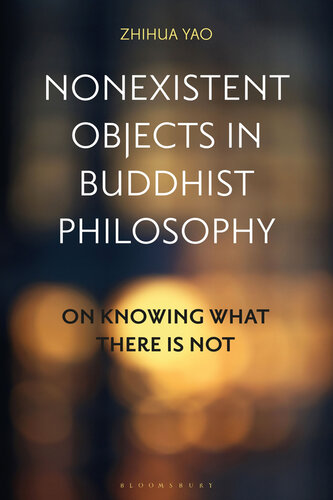
Nonexistent Objects in Buddhist Philosophy: On Knowing What There is Not
Book information
Description
Can we know what there is not? This book examines the historical development of the concept of the cognition of nonexistent objects in several major Buddhist philosophical schools. Beginning with a study of the historical development of the concept in Mahasamghika, Darstantika, Yogacara and Sautrantika, it evaluates how successfully they have argued against the extreme view of their main opponent the Sarvastivadins and established their view that one can know what there is not. It also includes thematic studies on the epistemological issues of nonexistence, discussing making sense of empty terms, controversies over negative judgments, and a proper classification of the conceptions of nothing or nonexistence. Taking a comparative approach to these topics, this book considers contemporary Western philosophers such as Husserl, Heidegger, Meinong and Russell alongside representative figures of the Buddhist Pramana School. Based on first-hand study of primary sources in Sanskrit, Chinese and Tibetan, Nonexistent Objects in Buddhist Philosophy makes available the rich discussions and debates on the epistemological issues of nonexistence in Buddhist philosophy to students and researchers in Asian and comparative philosophy. CONTENTS ACKNOWLEDGMENTS PART ONE 1 Mahāsāṃghika 2 Dārṣṭāntika 3 Yogācāra 4 Vasubandhu PART TWO 5 Non-cognition 6 Empty Terms 7 Negative Judgments 8 Typology of Nothing NOTES REFERENCES INDEX
Similar books

Nonexistent Objects in Buddhist Philosophy: On Knowing What There is Not
2020 · PDF
Nonexistent Objects in Buddhist Philosophy: On Knowing What There is Not
2020 · EPUB

Brahman and Dao: Comparative Studies of Indian and Chinese Philosophy and Religion
EPUB

The Buddhist Theory of Self-Cognition
2009 · PDF

MySQL® Notes for Professionals book
2018 · PDF

MrExcel 2022: Boosting Excel
2022 · PDF

MrExcel 2022: Boosting Excel
2022 · PDF

Session C11: Ancient Cultural Landscapes in South Europe – their Ecological Setting and Evolution, Session C22: Gardeners from South America, Session S04: Agro-Pastoralism and Early Metallurgy Sessions, Session WS29: The Idea of Enclosure in Recent Iberian Prehistory, Session C88: Rhytmes et causalites des dynamiques de l'anthropisation en Europe entre 6500 ET 500 BC: Hypotheses socio-culturelles et/ou climatiques: Proceedings of the XV UISPP World Congress (Lisbon 4-9 September 2006) / Actes du XV Congrès Mondial (Lisbonne 4-9 Septembre 2006) Vol.36
2010 · PDF