Peasants Making History: Living In an English Region 1200-1540
Book information
Description
Peasants have been despised, underrated, or disregarded in the past. Historians and archaeologists are now giving them a more positive assessment, and in Peasants Making History, Christopher Dyer sets a new agenda for this kind of study. Using as his example the peasants of the west midlands of England, Dyer examines peasant society in relation to their social superiors (their lords), their neighbours, and their households, and finds them making decisions and taking options to improve their lives. In their management of farming, both cultivation of fields and keeping of livestock, they made a series of modifications and some dramatic changes, not just reacting to shifts in circumstances but also devising creative initiatives. Peasants played an active role in the development of towns, both by migrating into urban settings, but also by trading actively in urban markets. Industry in the countryside was not imposed on the rural population, but often the result of peasant enterprise and flexibility. If we examine peasant attitudes and mentalities, we find them engaging in political life, making a major contribution to religion, recognizing the need to conserve the environment, and balancing the interests of individuals with those of the communities in which they lived. Many features of our world have medieval roots, and peasants played an important part in the development of the rural landscape, participation of ordinary people in government, parish church buildings, towns, and social welfare. The evidence to support this peasant-centred view has to be recovered by imaginative interpretation, and by using every type of source, including the testimony of archaeology and landscape. Cover Peasants Making History: Living in an English Region 1200–1540 Copyright Contents List of figures List of tables Preface Notes on boundaries and measures Measures Abbreviations 1: Introduction 2: Peasants and landscapes The west-midlandregion Human impacts on the land Lords and landscapes Peasants and the making of the landscape Peasants, lords, and the changing landscape after 1350 Conclusion 3: Peasant society: Landholding and status Holding land before 1349 Changing circumstances: Entry fines Landholding 1349–1540 Serfdom, 1200–1540 Conclusion 4: Peasants changing society Migration Social mobility Poverty Village community Conclusion 5: Family and household The size and composition of the household Space for households The character of family life Conclusions 6: Peasants and their crops Fields and their regulation Changing agriculture: Managing the fields Crops and their use Arable husbandry Farming methods and techniques Conclusion on husbandry and techniques Arable and pasture: Managing change Conclusion 7: Peasant farming: Livestock and pasture Horses Cattle Sheep Goats Pigs Poultry Bees Animal husbandry on the peasant holding Animal welfare Marketing animals and animal products Conclusion 8: Peasants and towns Origins of towns Peasant migration into towns Occupations and commerce: Peasant influence on towns Peasant consumption and towns Peasants and changing fortunes of towns Peasants and money Town and country: Cultural connections Conclusion 9: Peasants and industry The role of lords in creating industry Urban entrepreneurs and rural industry Poverty and industry Industry within peasant society Conclusion 10: Peasant outlook, values, perceptions, and attitudes Piers Plowman Peasants and the state Peasants and lords Peasants and religion Peasants and the environment Individuals and communities Conclusion Conclusion Glossary Bibliography Primary printed sources Secondary sources Index
Similar books

Everyday Life in Medieval England
2000 · PDF
Making a Living in the Middle Ages: The People of Britain 850†“1520
2003 · PDF

Changing Approaches to Local History: Warwickshire History and its Historians
2022 · PDF

An Age of Transition?: Economy and Society in England in the Later Middle Ages
2005 · PDF

Deserted Villages Revisited
2010 · PDF
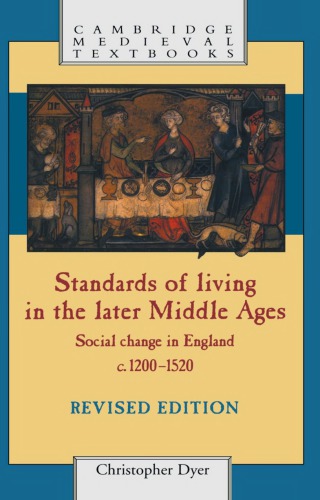
Standards of Living in the Later Middle Ages: Social Change in England c. 1200-1520
1998 · PDF

Dartmoor’s Alluring Uplands: Transhumance and Pastoral Management in the Middle Ages
2012 · PDF

A Country Merchant, 1495-1520: Trading and Farming at the End of the Middle Ages
2012 · PDF