Introduction to statistics in psychology [with SPSS]
Book information
Description
1. Why statistics?Part 1: Descriptive statistics 2. Some basics: Variability and measurement3. Describing variables: Tables and diagrams 4. Describing variables numerically: Averages, variation and spread 5. Shapes of Distributions of Scores6. Standard deviation and z-scores: The standard unit of measurement in statistics7. Relationships between two or more variables: Diagrams and tables8. Correlation coefficients: Pearson correlation and Spearman's rho9. Regression: Prediction with precisionPart 2: Significance testing 10. Samples and populations: Generalising and inferring11. Statistical significance for the correlation coefficient: A practical introduction to statistical inference12. Standard error: The standard deviation of the means of samples13. The t-test: Comparing two samples of correlated/related scores14. The t-test: Comparing two samples of unrelated/uncorrelated scores15. Chi-square: Differences between samples of frequency data16. Probability17. Reporting significance levels succinctly18. One-tailed versus two-tailed significance testing19. Ranking tests: Nonparametric statisticsPart 3: Introduction to analysis of variance 20. The variance ratio test: The F-ratio to compare two variances21. Analysis of variance (ANOVA): Introduction to the one-way unrelated or uncorrelated ANOVA22. Analysis of variance for correlated scores or repeated measures23. Two-way analysis of variance for unrelated/uncorrelated scores: Two studies for the price of one? 24. Multiple comparisons in ANOVA: Just where do the differences lie?25. Mixed-design ANOVA: Related and unrelated variables together26. Analysis of covariance (ANCOVA): Controlling for additional variables27. Multivariate Analysis of Variance (MANOVA)28. Discriminant (Function) analysis especially in MANOVA29. Statistics and the analysis of experimentsPart 4: More advanced correlational statistics 30. Partial correlation: Spurious correlation, third or confounding variables, suppressor variables 31. Factor analysis: Simplifying complex data32. Multiple regression and multiple correlation33. Path analysis34. The analysis of a questionnaire/survey projectPart 5: Assorted advanced techniques 35. The size of effects in statistical analysis: Do my findings matter?36. Meta-analysis: Combining and exploring statistical findings from previous research37. Reliability in scales and measurement: Consistency and agreement38. Confidence intervals39. The influence of moderator variables on relationships between two variables40. Statistical power analysis: getting the sample size rightPart 6: Advanced qualitative or nominal techniques41. Log-Linear Methods: The analysis of complex contingency tables42. Multinomial logistic regression: Distinguishing between several different categories or groups43. Binomial Logistic Regression AppendicesAppendix A: Testing for excessively skewed distributionsAppendix B1: Large sample formulae for the nonparametric testsAppendix B2: Nonparametric tests for three or more groupsAppendix C: Extended table of significance for the Pearson correlation coefficientAppendix D: Table of significance for the Spearman correlation coefficientAppendix E: Extended table of significance for the t-testAppendix F: Table of significance for Chi-squareAppendix G: Extended table of significance for the sign testAppendix H: Table of significance for the Wilcoxon Matched Pairs TestAppendix I: Table of significance for the Mann-Whitney U-testAppendix J: Table of significance values for the F-distributionAppendix K: Table of significant values oft when making multiple t-testsGlossaryReferencesIndex
Similar books

Understanding statistics in psychology with SPSS
2017 · PDF
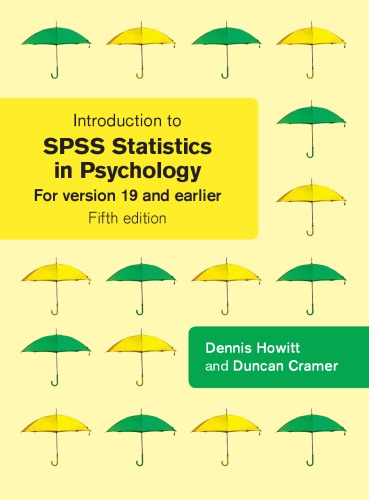
Introduction to SPSS in Psychology: for version 19 and earlier
2011 · PDF

Introduction to research methods in psychology
2011 · PDF

Burner 90 Days: From Mush To Muscles (German Edition)
2020 · AZW

The Rational Bible: Numbers
2020 · MOBI

Sweet Surrender: How Cultural Mandates Shape Christian Marriage
2013 · EPUB

Colloquial Romanian
2023 · EPUB

MICROSOFT 365 FOR BEGINNERS 2024: MASTERING PRODUCTIVITY TOOLS FOR WORK AND BEYOND
2024 · EPUB