Compelling God: Theories of Prayer in Anglo-Saxon England
Book information
Description
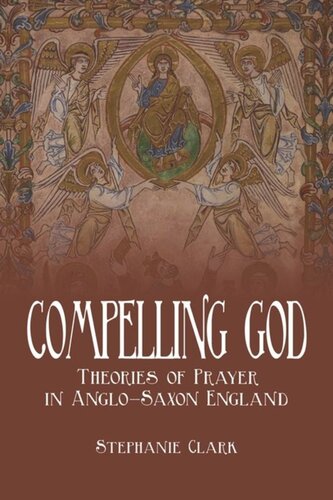
While prayer is generally understood as "communion with God" modern forms of spirituality prefer "communion" that is non-petitionary and wordless. This preference has unduly influenced modern scholarship on historic methods of prayer particularly concerning Anglo-Saxon spirituality. In "Compelling God," Stephanie Clark examines the relationship between prayer, gift giving, the self, and community in Anglo-Saxon England. Clark’s analysis of the works of Bede, Ælfric, and Alfred utilizes anthropologic and economic theories of exchange in order to reveal the ritualized, gift-giving relationship with God that Anglo-Saxon prayer espoused. Anglo-Saxon prayer therefore should be considered not merely within the usual context of contemplation, rumination, and meditation but also within the context of gift exchange, offering, and sacrifice. "Compelling God" allows us to see how practices of prayer were at the centre of social connections through which Anglo-Saxons conceptualized a sense of their own personal and communal identity. Acknowledgments Introduction 1. The Anglo-Saxon Inheritance 2. "Gratiam pro gratia": Bede on Prayer 3. Does Prayer Work? The Prayers of King Alfred 4. Ælfric and the Community of Prayer Conclusion Bibliography Index
Similar books
Compelling God: Theories of Prayer in Anglo-Saxon England
2018 · PDF

Compelling God: Theories of Prayer in Anglo-Saxon England
2018 · PDF

Food Processing: Principles and Applications
2014 · PDF

The Sensory Evaluation of Dairy Products
2009 · PDF

Handbook of food products manufacturing
2007 · PDF

The history of the church, from Our Lord's incarnation, to the twelfth year of the Emperor Mauricius Tiberius, or the year of Christ 594 As it was written in Greek by Eusebius Pamphilus, Bishop of Caesarea in Palestine; Socrates Scholasticus, Native of Constantinople; and Evagrius Scholasticus Born at Epiphania in Syria Secunda. Made English from that edition of these Historians, which Valesius published at Paris in the Years 1659, 1668, and 1673. Also, the Life of Constantine in four books, written by Eusebius Pamphilus; with Constantine's Oration to the Convention of the Saints, and Eusebius's Speech in Praise of Constantine, spoken at his Tricennalia. Valesius's Annotations on these Authors are done into English, and set at their proper Places in the Margin; as likewise a Translation of His Account of their Lives and Writings. With Two indexes; the One, of the Principal Matters that occur in the Text; the Other, of those contained in the Notes
AZW3

The Emergence of the Chief Data Officer: And a Look Into Analytics (Harness the Power of Data within Your Marketing Strategy Book 1)
2015 · AZW3

Focus Factor: How to Use Your Mental Power
2017 · AZW3