Linear and Quasilinear Parabolic Problems: Volume I: Abstract Linear Theory
Book information
Description
In this treatise we present the semigroup approach to quasilinear evolution equa of parabolic type that has been developed over the last ten years, approxi tions mately. It emphasizes the dynamic viewpoint and is sufficiently general and flexible to encompass a great variety of concrete systems of partial differential equations occurring in science, some of those being of rather 'nonstandard' type. In partic ular, to date it is the only general method that applies to noncoercive systems. Although we are interested in nonlinear problems, our method is based on the theory of linear holomorphic semigroups. This distinguishes it from the theory of nonlinear contraction semigroups whose basis is a nonlinear version of the Hille Yosida theorem: the Crandall-Liggett theorem. The latter theory is well-known and well-documented in the literature. Even though it is a powerful technique having found many applications, it is limited in its scope by the fact that, in concrete applications, it is closely tied to the maximum principle. Thus the theory of nonlinear contraction semigroups does not apply to systems, in general, since they do not allow for a maximum principle. For these reasons we do not include that theory.
Similar books

An Introduction to Difference Equations
1996 · PDF

Time-Varying Discrete Linear Systems: Input-Output Operators. Riccati Equations. Disturbance Attenuation
1994 · PDF

Applied Functional Analysis: Main Principles and Their Applications
1995 · DJVU

Optimization Techniques: Proceedings of the 9th IFIP Conference on Optimization Techniques Warsaw, September 4–8, 1979
1980 · PDF

Advances in Nonlinear Parameter Optimization
1982 · PDF

Optimization Techniques: Proceedings of the 9th IFIP Conference on Optimization Techniques Warsaw, September 4–8, 1979
1980 · PDF
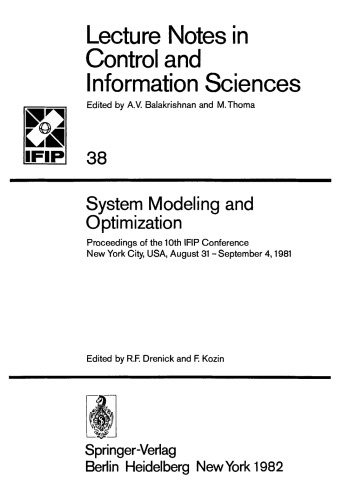
System Modeling and Optimization: Proceedings of the 10th IFIP Conference New York City, USA, August 31 – September 4, 1981
1982 · PDF

Extensions of Linear-Quadratic Control Theory
1980 · PDF