Language Identification Using Excitation Source Features
Book information
Description
This book discusses the contribution of excitation source information in discriminating language. The authors focus on the excitation source component of speech for enhancement of language identification (LID) performance. Language specific features are extracted using two different modes: (i) Implicit processing of linear prediction (LP) residual and (ii) Explicit parameterization of linear prediction residual. The book discusses how in implicit processing approach, excitation source features are derived from LP residual, Hilbert envelope (magnitude) of LP residual and Phase of LP residual; and in explicit parameterization approach, LP residual signal is processed in spectral domain to extract the relevant language specific features. The authors further extract source features from these modes, which are combined for enhancing the performance of LID systems. The proposed excitation source features are also investigated for LID in background noisy environments. Each chapter of this book provides the motivation for exploring the specific feature for LID task, and subsequently discuss the methods to extract those features and finally suggest appropriate models to capture the language specific knowledge from the proposed features. Finally, the book discuss about various combinations of spectral and source features, and the desired models to enhance the performance of LID systems.
Similar books

Language Identification Using Spectral and Prosodic Features
2015 · PDF

Non-Linguistic Analysis of Call Center Conversations
2015 · PDF

Computational and Conversational Discourse: Burning Issues — An Interdisciplinary Account
1996 · PDF

Phonetic Search Methods for Large Speech Databases
2013 · PDF

Advances in Non-Linear Modeling for Speech Processing
2012 · PDF

Cross-Word Modeling for Arabic Speech Recognition
2012 · PDF

Forensic Speaker Recognition: Law Enforcement and Counter-Terrorism
2012 · PDF
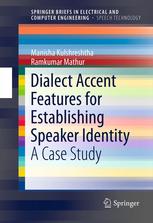
Dialect Accent Features for Establishing Speaker Identity: A Case Study
2012 · PDF