Numerical Methods in Computational Finance: A Partial Differential Equation (PDE/FDM) Approach
Book information
Description
This book is a detailed and step-by-step introduction to the mathematical foundations of ordinary and partial differential equations, their approximation by the finite difference method and applications to computational finance. The book is structured so that it can be read by beginners, novices and expert users. Part A Mathematical Foundation for One-Factor Problems Chapters 1 to 7 introduce the mathematical and numerical analysis concepts that are needed to understand the finite difference method and its application to computational finance. Part B Mathematical Foundation for Two-Factor Problems Chapters 8 to 13 discuss a number of rigorous mathematical techniques relating to elliptic and parabolic partial differential equations in two space variables. In particular, we develop strategies to preprocess and modify a PDE before we approximate it by the finite difference method, thus avoiding ad-hoc and heuristic tricks. Part C The Foundations of the Finite Difference Method (FDM) Chapters 14 to 17 introduce the mathematical background to the finite difference method for initial boundary value problems for parabolic PDEs. It encapsulates all the background information to construct stable and accurate finite difference schemes. Part D Advanced Finite Difference Schemes for Two-Factor Problems Chapters 18 to 22 introduce a number of modern finite difference methods to approximate the solution of two factor partial differential equations. This is the only book we know of that discusses these methods in any detail. Part E Test Cases in Computational Finance Chapters 23 to 26 are concerned with applications based on previous chapters. We discuss finite difference schemes for a wide range of one-factor and two-factor problems. This book is suitable as an entry-level introduction as well as a detailed treatment of modern methods as used by industry quants and MSc/MFE students in finance. The topics have applications to numerical analysis, science and engineering. Contents Preface Who Should Read this Book? Part A: Mathematical Foundation for One-Factor Problems 1. Real Analysis Foundations for this Book 2. Ordinary Differential Equations (ODEs), Part 1 3. Ordinary Differential Equations (ODEs), Part 2 4. An Introduction to Finite Dimensional Vector Spaces 5. Guide to Matrix Theory and Numerical Linear Algebra 6. Numerical Solutions of Boundary Value Problems 7. Black–Scholes Finite Differences for the Impatient Part B: Mathematical Foundation for Two-Factor Problems 8. Classifying and Transforming Partial Differential Equations 9. Transforming Partial Differential Equations to a Bounded Domain 10. Boundary Value Problems for Elliptic and Parabolic Partial Differential Equations 11. Fichera Theory, Energy Inequalities and Integral Relations 12. An Introduction to Time-Dependent Partial Differential Equations 13. Stochastics Representations of PDEs and Applications Part C: The Foundations of the Finite Difference Method (FDM) 14. Mathematical and Numerical Foundations of the Finite Difference Method, Part I 15. Mathematical and Numerical Foundations of the Finite Difference Method, Part II 16. Sensitivity Analysis, Option Greeks and Parameter Optimisation, Part I 17. Advanced Topics in Sensitivity Analysis Part D: Advanced Finite Difference Schemes for Two-Factor Problems 18. Splitting Methods, Part I 19. The Alternating Direction Explicit (ADE) Method 20. The Method of Lines (MOL), Splitting and the Matrix Exponential 21. Free and Moving Boundary Value Problems 22. Splitting Methods, Part II Part E: Test Cases in Computational Finance 23. Multi-Asset Options 24. Asian (Average Value) Options 25. Interest Rate Models 26. Epilogue Models Follow-Up Chapters 1 to 25 Bibliography Index
Similar books

Financial Instrument Pricing Using C++
2004 · PDF

C# for Financial Markets (The Wiley Finance Series)
2013 · PDF

Financial Instrument Pricing Using C++
2018 · PDF
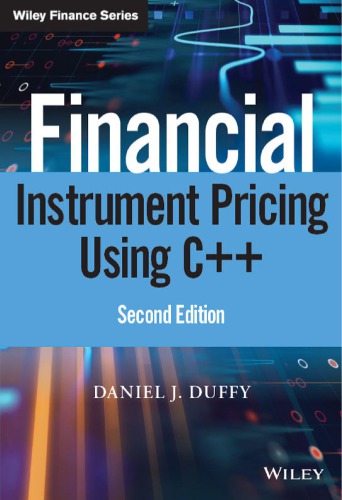
Financial instrument pricing using C++
2018 · PDF

Finite Difference Methods in Financial Engineering
2006 · DJVU

Financial Instrument Pricing Using C++
2004 · PDF

C# for Financial Markets
2013 · PDF

Monte Carlo Frameworks: Building Customisable High-performance C++ Applications
2009 · PDF