Financial Instrument Pricing Using C++
Book information
Description
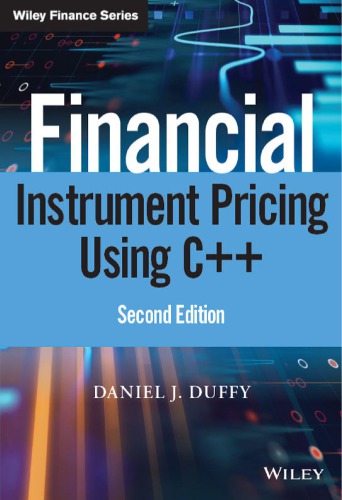
One of the best languages for the development of financial engineering and instrument pricing applications is C++. This book has several features that allow developers to write robust, flexible and extensible software systems. The book is an ANSI/ISO standard, fully object-oriented and interfaces with many third-party applications. It has support for templates and generic programming, massive reusability using templates (?write once?) and support for legacy C applications. In this book, author Daniel J. Duffy brings C++ to the next level by applying it to the design and implementation of classes, libraries and applications for option and derivative pricing models. He employs modern software engineering techniques to produce industrial-strength applications: Using the Standard Template Library (STL) in finance Creating your own template classes and functions Reusable data structures for vectors, matrices and tensors Classes for numerical analysis (numerical linear algebra ?) Solving the Black Scholes equations, exact and approximate solutions Implementing the Finite Difference Method in C++ Integration with the ?Gang of Four? Design Patterns Interfacing with Excel (output and Add-Ins) Financial engineering and XML Cash flow and yield curves Included with the book is a CD containing the source code in the Datasim Financial Toolkit. You can use this to get up to speed with your C++ applications by reusing existing classes and libraries. 'Unique... Let's all give a warm welcome to modern pricing tools.' -- Paul Wilmott, mathematician, author and fund manager Financial Instrument Pricing Using C++ Contents 1 Executive Overview of this Book 1.1 What is this book? 1.2 What’s special about this book? 1.3 Who is this book for? 1.4 Software requirements 1.5 The structure of this book 1.6 Pedagogical approach 1.7 What this book is not 1.8 Source code on the CD PART I TEMPLATE PROGRAMMING IN C++ 2 A Gentle Introduction to Templates in C++ 2.1 Introduction and objectives 2.2 Motivation and background 2.3 Defining a template 2.3.1 An example 2.4 Template instantiation 2.5 Function templates 2.5.1 An example 2.6 Default values and typedefs 2.7 Guidelines when implementing templates 2.8 Conclusions and summary 3 An Introduction to the Standard Template Library 3.1 Introduction and objectives 3.1.1 Why use STL? 3.2 A Bird’s-eye view of STL 3.3 Sequence containers 3.3.1 Programming lists 3.3.2 Vectors and arrays in STL 3.4 Associative containers 3.4.1 Sets in STL 3.4.2 Maps in STL 3.5 Iterators in STL 3.5.1 What kinds of iterators? 3.6 Algorithms 3.7 Using STL for financial instruments 3.8 Conclusions and summary 4 STL for Financial Engineering Applications 4.1 Introduction and objectives 4.2 Clever data structures 4.2.1 A simple output mechanism 4.3 Set theory and STL 4.4 Useful algorithms 4.5 STL adaptor containers 4.6 Conclusions and summary 5 The Property Pattern in Financial Engineering 5.1 Introduction and objectives 5.2 The Property pattern 5.2.1 Requirements for a Property pattern 5.3 An example 5.4 Extending the Property pattern: property sets and property lists 5.4.1 An example 5.5 Properties and exotic options 5.5.1 Example: Executive options 5.6 Conclusions and summary PART II BUILDING BLOCK CLASSES 6 Arrays, Vectors and Matrices 6.1 Introduction and objectives 6.2 Motivation and background 6.3 A layered approach 6.4 The Array and Matrix classes in detail 6.4.1 Simple print functions 6.4.2 Array example 6.4.3 Matrix example 6.5 The Vector and NumericMatrix classes in detail 6.5.1 Vector example 6.5.2 NumericMatrix example 6.6 Associative arrays and matrices 6.7 Conclusions and summary 7 Arrays and Matrix Properties 7.1 Introduction and objectives 7.2 An overview of the functionality 7.3 Software requirements 7.3.1 Accuracy 7.3.2 Efficiency 7.3.3 Reliability 7.3.4 Understandability 7.4 The core processes 7.4.1 Interactions between matrices and vectors 7.4.2 Some examples 7.5 Other function categories 7.5.1 Measures of central tendency 7.5.2 Measures of dispersion 7.5.3 Moments, skewness, kurtosis 7.5.4 Inequalities 7.6 Using the functions 7.6.1 Calculating historical volatility 7.6.2 Variance of return of a portfolio 7.7 An introduction to exception handling 7.7.1 Try, throw and catch: A bit like tennis 7.8 Conclusions and summary 8 Numerical Linear Algebra 8.1 Introduction and objectives 8.2 An introduction to numerical linear algebra 8.2.1 Direct methods 8.2.2 Iterative methods 8.3 Tridiagonal systems 8.3.1 LU decomposition 8.3.2 Godunov’s Double Sweep method 8.3.3 Designing and implementing tridiagonal schemes 8.4 Block tridiagonal systems 8.5 What requirements should our matrix satisfy? 8.5.1 Positive-definite matrices and diagonal dominance 8.5.2 M-Matrices 8.6 Conclusions and summary 9 Modelling Functions in C++ 9.1 Introduction and objectives 9.2 Function pointers in C++ 9.3 Function objects in STL 9.3.1 Comparison functions 9.3.2 STL and financial engineering 9.4 Some function types 9.4.1 Applications in numerical analysis and financial engineering 9.4.2 An example: Functions in option pricing 9.5 Creating your own function classes 9.6 Arrays of functions 9.7 Vector functions 9.8 Real-valued functions 9.9 Vector-valued functions 9.10 Conclusions and summary 10 C++ Classes for Statistical Distributions 10.1 Introduction and objectives 10.2 Discrete and continuous probability distribution functions 10.3 Continuous distributions 10.3.1 Uniform (rectangular) distribution 10.3.2 Normal distribution 10.3.3 Lognormal distribution 10.3.4 Gamma distribution and its specialisations 10.4 Discrete distributions 10.4.1 Poisson distribution 10.4.2 Binomial and Bernoulli distributions 10.4.3 Pascal and geometric distributions 10.5 Tests 10.5.1 Continuous distributions 10.5.2 Discrete distributions 10.6 Conclusions and summary PART III ORDINARY AND STOCHASTIC DIFFERENTIAL EQUATIONS 11 Numerical Solution of Initial Value Problems: Fundamentals 11.1 Introduction and objectives 11.2 A model problem 11.2.1 Qualitative properties of the solution 11.3 Discretisation 11.4 Common schemes 11.5 Some theoretical issues 11.6 Fitting: Special schemes for difficult problems 11.7 Non-linear scalar problems and predictor–corrector methods 11.8 Extrapolation techniques 11.9 C++ design and implementation 11.10 Generalisations 11.11 Conclusions and summary 12 Stochastic Processes and Stochastic Differential Equations 12.1 Introduction and objectives 12.2 Random variables and random processes 12.2.1 Random variables 12.2.2 Generating random variables 12.2.3 Random (stochastic) processes 12.3 An introduction to stochastic differential equations 12.4 Some finite difference schemes 12.4.1 Improving the accuracy: Richardson extrapolation 12.5 Which scheme to use? 12.6 Systems of SDEs 12.7 Conclusions and summary 13 Two-Point Boundary Value Problems 13.1 Introduction and objectives 13.2 Description of problem 13.3 (Traditional) centred-difference schemes 13.3.1 Does the discrete system have a solution? 13.3.2 Extrapolation 13.4 Approximation of the boundary conditions 13.4.1 Linearity boundary condition 13.5 Exponentially fitted schemes and convection–diffusion 13.6 Approximating the derivatives 13.7 Design issues 13.8 Conclusions and summary 14 Matrix Iterative Methods 14.1 Introduction and objectives 14.2 Iterative methods 14.3 The Jacobi method 14.4 Gauss–Seidel method 14.5 Successive overrelaxation (SOR) 14.6 Other methods 14.6.1 The conjugate gradient method 14.6.2 Block SOR 14.6.3 Solving sparse systems of equations 14.7 The linear complementarity problem 14.8 Implementation 14.9 Conclusions and summary PART IV PROGRAMMING THE BLACK–SCHOLES ENVIRONMENT 15 An Overview of Computational Finance 15.1 Introduction and objectives 15.2 The development life cycle 15.3 Partial differential equations 15.4 Numerical approximation of PDEs 15.5 The class of finite difference schemes 15.6 Special schemes for special problems 15.7 Implementation issues and the choice of programming language 15.8 Origins and application areas 15.9 Conclusions and summary 16 Finite Difference Schemes for Black–Scholes 16.1 Introduction and objectives 16.2 Model problem: The one-dimensional heat equation 16.3 The Black–Scholes equation 16.4 Initial conditions and exotic options payoffs 16.4.1 Payoff functions in options modelling 16.5 Implementation 16.6 Method of lines: A whirlwind introduction 16.7 Conclusions and summary 17 Implicit Finite Difference Schemes for Black–Scholes 17.1 Introduction and objectives 17.2 Fully implicit method 17.3 An introduction to the Crank–Nicolson method 17.4 A critique of Crank–Nicolson 17.4.1 How are derivatives approximated? 17.4.2 Boundary conditions 17.4.3 Initial conditions 17.4.4 Proving stability 17.5 Is there hope? the Keller scheme 17.5.1 The advantages of the Box scheme 17.6 Conclusions and summary 18 Special Schemes for Plain and Exotic Options 18.1 Introduction and objectives 18.2 Motivating exponentially fitted schemes 18.2.1 A new class of robust difference schemes 18.3 Exponentially fitted schemes for parabolic problems 18.3.1 The fitted scheme in more detail: Main results 18.4 What happens when the volatility goes to zero? 18.4.1 Graceful degradation 18.5 Exponential fitting with explicit time 18.5.1 An explicit time-marching scheme 18.6 Exponential fitting and exotic options 18.7 Some final remarks 19 My First Finite Difference Solver 19.1 Introduction and objectives 19.2 Modelling partial differential equations in C++ 19.2.1 Function classes in C++ 19.2.2 Function classes for partial differential equations 19.3 Finite difference schemes as C++ classes, Part I 19.4 Finite difference schemes as C++ classes, Part II 19.5 Initialisation issues 19.5.1 Functions and parameters 19.5.2 The main program 19.6 Interfacing with Excel 19.7 Conclusions and summary 20 An Introduction to ADI and Splitting Schemes 20.1 Introduction and objectives 20.2 A model problem 20.3 Motivation and history 20.4 Basic ADI scheme for the heat equation 20.4.1 Three-dimensional heat equation 20.5 Basic splitting scheme for the heat equation 20.5.1 Three-dimensional heat equation 20.6 Approximating cross-derivatives 20.7 Handling boundary conditions 20.8 Algorithms and design issues 20.9 Conclusions and summary 21 Numerical Approximation of Two-Factor Derivative Models 21.1 Introduction and objectives 21.2 Two-factor models in financial engineering 21.2.1 Asian options 21.2.2 Convertible bonds with random interest rates 21.2.3 Options with two underlying assets 21.2.4 Basket options 21.2.5 Fixed-income applications 21.3 Finite difference approximations 21.4 ADI schemes for Asian options 21.4.1 Upwinding 21.5 Splitting schemes 21.6 Conclusions and summary PART V DESIGN PATTERNS 22 A C++ Application for Displaying Numeric Data 22.1 Introduction and objectives 22.2 Input mechanisms 22.3 Conversion and processing mechanisms 22.4 Output and display mechanisms 22.4.1 Ensuring that Excel is started only once 22.5 Putting it all together 22.6 Output 22.7 Other functionality 22.7.1 Accessing cell data 22.7.2 Cell data for functions 22.7.3 Using Excel with finite difference schemes 22.8 Using Excel and property sets 22.9 Extensions and the road to design patterns 22.10 Conclusions and summary 23 Object Creational Patterns 23.1 Introduction and objectives 23.2 The Singleton pattern 23.2.1 The templated Singleton solution 23.2.2 An extended example 23.2.3 Applications to financial engineering 23.3 The Prototype pattern 23.3.1 The Prototype pattern: Solution 23.3.2 Applications to financial engineering 23.4 Factory Method pattern (virtual constructor) 23.4.1 An extended example 23.5 Abstract Factory pattern 23.5.1 The abstract factory: solution 23.5.2 An extended example 23.6 Applications to financial engineering 23.7 Conclusions and summary 24 Object Structural Patterns 24.1 Introduction and objectives 24.2 Kinds of structural relationships between classes 24.2.1 Aggregation 24.2.2 Association 24.2.3 Generalisation/specialisation 24.3 Whole–Part pattern 24.4 The Composite pattern 24.5 The Façade pattern 24.6 The Bridge pattern 24.6.1 An example of the Bridge pattern 24.7 Conclusions and summary 25 Object Behavioural Patterns 25.1 Introduction and objectives 25.2 Kinds of behavioural patterns 25.3 Iterator pattern 25.3.1 Iterating in composites 25.3.2 Iterating in property sets 25.4 The Visitor pattern 25.4.1 Visitors and the Extensible Markup Language (XML) 25.5 Notification patterns 25.6 Conclusions and summary PART VI DESIGN AND DEPLOYMENT ISSUES 26 An Introduction to the Extensible Markup Language 26.1 Introduction and objectives 26.1.1 What’s the big deal with XML? 26.2 A short history of XML 26.3 The XML structure 26.3.1 XML files 26.3.2 XML syntax 26.3.3 Attributes in XML 26.4 Document Type Definition 26.4.1 DTD syntax 26.4.2 Validation issues 26.4.3 Limitations of DTDs 26.5 Extensible Stylesheet Language Transformation (XSLT) 26.5.1 Namespaces in XML 26.5.2 Main concepts in XSL 26.6 An application of XML: Financial products Markup Language 26.6.1 Product architecture overview 26.6.2 Example: Equity derivative options product architecture 26.7 Conclusions and summary 27 Advanced XML and Programming Interface 27.1 Introduction and objectives 27.2 XML Schema 27.2.1 Element declaration 27.2.2 User-defined simple and complex types 27.2.3 Multiplicity issues 27.2.4 An example 27.2.5 Comparing DTDs and the XML Schema 27.2.6 XML Schemas and FpML 27.3 Accessing XML data: The Document Object Model 27.3.1 DOM in a programming environment 27.4 DOM and C++: The essentials 27.5 DOM, entities and property sets 27.5.1 XML readers and writers 27.5.2 Examples and applications 27.6 XML structures for plain and barrier options 27.7 Conclusions and summary 28 Interfacing C++ and Excel 28.1 Introduction and objectives 28.2 Object model in Excel: An overview 28.3 Under the bonnet: Technical details of C++ interfacing to Excel 28.3.1 Startup 28.3.2 Creating charts and cell values 28.3.3 Interoperability with the SimplePropertySet 28.4 Implementing the core process 28.4.1 Registration: Getting basic input 28.4.2 Calculations 28.4.3 Displaying the results of the calculations 28.4.4 The application (main program) 28.5 Extensions 28.6 Application areas 28.7 Conclusions and summary 29 Advanced Excel Interfacing 29.1 Introduction and objectives 29.2 Status report and new requirements 29.3 A gentle introduction to Excel add-ins 29.3.1 What kinds of add-ins are there? 29.4 Automation add-in in detail 29.4.1 Functions with two parameters 29.4.2 Functions that accept a range 29.4.3 Using the Vector template class 29.5 Creating a COM add-in 29.6 Future trends 29.7 Conclusions and summary 30 An Extended Application: Option Strategies and Portfolios 30.1 Introduction and objectives 30.2 Spreads 30.3 Combinations: Straddles and strangles 30.4 Designing and implementing spreads 30.5 Delta hedging 30.6 An example 30.7 Tips and guidelines Appendices A1 My C++ refresher A2 Dates and other temporal types References Index
Similar books

Numerical Methods in Computational Finance: A Partial Differential Equation (PDE/FDM) Approach
2022 · PDF

C# for Financial Markets (The Wiley Finance Series)
2013 · PDF

Financial Instrument Pricing Using C++
2018 · PDF
Financial instrument pricing using C++
2018 · PDF

Finite Difference Methods in Financial Engineering
2006 · DJVU

Financial Instrument Pricing Using C++
2004 · PDF

C# for Financial Markets
2013 · PDF

Monte Carlo Frameworks: Building Customisable High-performance C++ Applications
2009 · PDF