Verb Citation in the Classical Newari Dictionary
Book information
Description
In: Bonifacio Sibayan & Leonard E. Newell, eds. Papers from the First Asia International Lexicography Conference, Manila, Philippines, 1992. LSP Special Monograph Issue, 35. Manila: Linguistic Society of the Philippines, 1994. pp. 225-239A dictionary entry of any lexical item represents a native speaker's knowledge of the lexical organization of that entry. This could be referred to as a "macro-entry" which includes its basic form, syntactic coding, various definable senses (and subsenses), collocational properties and patterning of examples to illustrate its possible usage(s) in specific contexts. An entry in this sense would not only define the ordering of the parts but also make explicit the syntactic-semantic potentials of the entry. This inter-dependency between syntax and semantics is difficult to code in a bilingual dictionary such as that of the Classical Newari (CN) where the attested morphological form and the usage label given to a particular entry are necessarily restricted to the orthographic representations in the original source materials. Historically, the Classical Newari as recorded in the old written documents and manuscripts differs from contemporary Newari in syllable structure, morphology and syntax. It is difficult to decide, for instance, on the structure of the verb root, what word class(es) a verb belongs to or what syntactic uses or contraints it is subject to. Further, it is often difficult to decide what could be its general or specific meaning and what kinds of semantic alternations are possible with this verb.
Similar books

Review of: Genetti Carol. A Grammar of Dolakha Newar

EAT expressions in Kathmandu Newar

The concept of intentional action in the grammar of Kathmandu Newari

Syntax and prosody: Interacting coding systems in Dolakha Newar

Newari Language and Linguistics: Conspectus
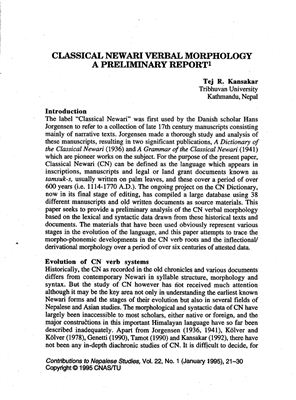
Classical Newari verbal morphology: A preliminary report
Неварский язык

Parlons néwari
2009 · PDF