Learning and Intelligent Optimization: 15th International Conference, LION 15, Athens, Greece, June 20–25, 2021, Revised Selected Papers (Lecture Notes in Computer Science)
Book information
Description
This book constitutes the refereed post-conference proceedings on Learning and Intelligent Optimization, LION 15, held in Athens, Greece, in June 2021. The 30 full papers presented have been carefully reviewed and selected from 35 submissions. LION deals with designing and engineering ways of "learning" about the performance of different techniques, and ways of using past experience about the algorithm behavior to improve performance in the future. Intelligent learning schemes for mining the knowledge obtained online or offline can improve the algorithm design process and simplify the applications of high-performance optimization methods. Combinations of different algorithms can further improve the robustness and performance of the individual components. Guest Editorial Organization Contents An Optimization for Convolutional Network Layers Using the Viola-Jones Framework and Ternary Weight Networks 1 Introduction 2 Background 3 Methodology 4 Experiments 5 Results 6 Discussion and Future Work 7 Conclusion References Learning to Optimize Black-Box Functions with Extreme Limits on the Number of Function Evaluations 1 Introduction 2 Related Work 2.1 Candidate Generators 2.2 Candidate Selectors 3 Hyperparameterized Parallel Few-Shot Optimization (HPFSO) 3.1 Candidate Generators 3.2 Sub-selection of Candidates 3.3 Hyperparameterized Scoring Function 4 Numerical Results 4.1 Experimental Setup 4.2 Effectiveness of Hyperparameter Tuning 4.3 Importance of the Selection Procedure 4.4 Comparison with the State of the Art 5 Conclusion References Graph Diffusion & PCA Framework for Semi-supervised Learning 1 Introduction 2 Graph-Based Semi-supervised Learning 3 Graph Diffusion with Reorganized PCA Loss 3.1 PCA for Binary Clustering (PCA-BC) 3.2 Generalization of PCA-BC for GB-SSL 4 Experiments 4.1 Datasets Description 4.2 State-of-the-Art (SOTA) Algorithms 4.3 Results 5 Conclusion A Proof of Proposition 1 B Proof of Proposition 2 C Generation of Synthetic Adjacency Matrix References Exact Counting and Sampling of Optima for the Knapsack Problem 1 Introduction 2 Problem Formulation 3 Exact Counting and Sampling of Optima 3.1 Recap: Dynamic Programming for the KP 3.2 Dynamic Programming for #KNAPSACK* 3.3 Uniform Sampling of Optimal Solutions 4 Experiments 4.1 Experimental Setup 4.2 Insights into the Number of Optima 4.3 Closing Remarks 5 Conclusion References Modeling of Crisis Periods in Stock Markets 1 Introduction 2 Detecting Shock Events with Copulae 2.1 Shock Detection Using Real Data 3 Exploring the Dynamics of Copulae 3.1 Clustering of Copulae 3.2 Modeling Copulae A Data B Crises Indicator C Clustering of Copulae References Feature Selection in Single-Cell RNA-seq Data via a Genetic Algorithm 1 Introduction 2 Approach 2.1 Problem Formulation 2.2 Feature Selection via Genetic Algorithms 3 Experimental Analysis on scRNA-seq Datasets 3.1 Evaluation of Feature Selection Process 3.2 Evaluation of Selected Features 3.3 Biological Analysis 4 Discussion and Conclusion References Towards Complex Scenario Instances for the Urban Transit Routing Problem 1 Introduction 2 UTRP Instance Benchmark Analysis 3 Relaxing UTRP Instances 3.1 Basic Definitions 3.2 Relaxed Road Network 3.3 Relaxed Demand Matrix 4 Experimental Configuration 4.1 Clustering Algorithms 4.2 Relaxed Road Network 4.3 Relaxed Demand Matrix 5 Experimental Highlights 5.1 Clustering Algorithm Recomendation 5.2 UTRP Relaxing Scenarios 5.3 Similarity Between Clustering Algorithms 5.4 Demand Distribution 6 Conclusions and Perspectives References Spirometry-Based Airways Disease Simulation and Recognition Using Machine Learning Approaches 1 Introduction 1.1 Lung Ventilation 1.2 Mathematical Modeling 2 Methods 2.1 Creation of the Dataset 2.2 Training Machine Learning Algorithms 2.3 Training 3 Results 3.1 Lung Model 3.2 Machine Learning Results 4 Conclusions and Outlook References Long-Term Hypertension Risk Prediction with ML Techniques in ELSA Database 1 Introduction 2 Methods for the Long-Term Risk Prediction 2.1 Training and Test Dataset 2.2 Feature Selection 2.3 Performance Evaluation of ML Models 3 Conclusions References An Efficient Heuristic for Passenger Bus VRP with Preferences and Tradeoffs 1 Introduction 2 Related Work 3 Preliminaries 4 An Incremental Algorithm 5 Evaluation 6 Conclusion References Algorithm for Predicting the Quality of the Product Based on Technological Pyramids in Graphs 1 Introduction 2 Basic Definitions 3 Formulation of the Problem 3.1 The Concept of Decision Tree Construction 3.2 Algorithm for Constructing the Decision Function for the Node of Decision Tree 3.3 Algorithm for Constructing an Optimal Partition of a Set of Classes References Set Team Orienteering Problem with Time Windows 1 Introduction 2 Problem Description 3 Proposed Algorithm 4 Computational Results 5 Conclusion References Reparameterization of Computational Chemistry Force Fields Using GloMPO (Globally Managed Parallel Optimization) 1 Introduction 2 GloMPO Package 3 Results 4 Conclusion References Towards Structural Hyperparameter Search in Kernel Minimum Enclosing Balls 1 Introduction 2 Overview of the Problem 3 Proposed Approach 4 Results 5 Future Work References Using Past Experience for Configuration of Gaussian Processes in Black-Box Optimization 1 Introduction 2 Gaussian Processes and Their Neural Extension 2.1 Gaussian Processes 2.2 GP as the Output Layer of a Neural Network 3 Gaussian Processes as Black-Box Surrogate Models 3.1 Combining GPs with the Black-Box Optimizer CMA-ES 3.2 Using Data from Past CMA-ES Runs 4 Empirical Investigation of GP Configurations 4.1 Experimental Setup 4.2 Results 5 Conclusion and Future Work References Travel Demand Estimation in a Multi-subnet Urban Road Network 1 Introduction 2 Multi-subnet Urban Road Network 3 Demand Estimation in a Multi-subnet Road Network 4 Multi-subnet Road Network with Disjoint Routes 5 Toll Road Counters for Travel Demand Estimation 6 Conclusion References The Shortest Simple Path Problem with a Fixed Number of Must-Pass Nodes: A Problem-Specific Branch-and-Bound Algorithm 1 Introduction 2 Problem Statement 3 Computational Complexity 4 Branch-and-Bound Algorithm 5 Numerical Evaluation 6 Conclusion References Medical Staff Scheduling Problem in Chinese Mobile Cabin Hospitals During Covid-19 Outbreak 1 Introduction 2 Problem Description 3 The Proposed VNS 4 Experiments 5 Conclusions References Performance Evaluation of Adversarial Attacks on Whole-Graph Embedding Models 1 Introduction 2 Related Work 3 Background 3.1 Whole-Graph Embedding 3.2 Graph Adversarial Attacks 4 Experiments 4.1 Datasets 4.2 Compared Methods 4.3 Implementation Details 4.4 Performance Evaluation 5 Conclusions and Future Work References Algorithm Selection on Adaptive Operator Selection: A Case Study on Genetic Algorithms 1 Introduction 2 Background 2.1 Adaptive Operator Selection 2.2 Algorithm Selection 3 Algorithm Selection for AOS 3.1 Instance Features 4 Computational Analysis 5 Conclusion References Inverse Free Universum Twin Support Vector Machine 1 Introduction 2 Related Works 2.1 Universum Support Vector Machine 2.2 Universum Twin Support Vector Machine 3 Improvements on Twin Bounded Support Vector machine with Universum Data 3.1 Linear IUTBSVM 3.2 Nonlinear IUTBSVM 4 Numerical Experiments 4.1 Parameter Selection 4.2 Results Comparisons and discussion for UCI Data Sets 5 Conclusions References Hybridising Self-Organising Maps with Genetic Algorithms 1 Introduction 2 Related Works 3 Solution Methodologies 3.1 Self-Organising Map 3.2 Genetic Algorithm 3.3 Our Approach 4 Computation Results 5 Conclusions References How to Trust Generative Probabilistic Models for Time-Series Data? 1 Introduction 2 Generative Probabilistic Models 3 Discrepancy 3.1 Distance Measures on Time-Series Data 4 Empirical Evaluation 4.1 Hyper-parameter Search 4.2 Data 4.3 Results 5 Conclusion References Multi-channel Conflict-Free Square Grid Aggregation 1 Introduction 1.1 Our Contribution 2 Problem Formulation 3 Heuristic Algorithm 3.1 Vertical Aggregation 3.2 Horizontal Aggregation 4 ILP Formulation 5 Simulation 6 Conclusion References Optimal Sensor Placement by Distribution Based Multiobjective Evolutionary Optimization 1 Introduction 1.1 Organization of the Paper 2 Background Knowledge on Multiobjective Optimization: Pareto Analysis and Performance Metric 2.1 Pareto Analysis 2.2 Hypervolume 2.3 Coverage 3 The Wasserstein Distance – Basic Notions and Numerical Approximation 4 The Formulation of Optimal Sensor Placement 4.1 Problem Formulation 4.2 Network Hydraulic Simulation 5 Distributional Representation and the Information Space 5.1 Probabilistic Representation of a Solution 5.2 Search Space and Information Space 6 The Algorithm MOEA/WST 6.1 General Framework 6.2 Chromosome Encoding 6.3 Initialization 6.4 Selection 6.5 Crossover 6.6 Mutation 7 Computational Results 7.1 Hanoi 7.2 Neptun 8 Conclusions References Multi-objective Parameter Tuning with Dynamic Compositional Surrogate Models 1 Introduction 2 State of the Art 2.1 Single-Objective Surrogate-Model-Based Optimization 2.2 Multi-objective Surrogate-Model-Based Optimization 3 Problem Definition 4 Dynamic Compositional Surrogate Models with TutorM 5 Evaluation 5.1 Results 5.2 Runtime Behavior 5.3 Threats to Validity 6 Conclusion and Future Work References Corrected Formulations for the Traveling Car Renter Problem 1 Introduction 2 Explanation of Errors in the Original Formulation 3 Proposed Formulations 3.1 First Correction Proposal - Model01 3.2 Second Correction Proposal - Model02 4 Experiments 5 Conclusion References Hybrid Meta-heuristics for the Traveling Car Renter Salesman Problem 1 Introduction 2 CaRS 2.1 Mathematical Formulation 3 Solution Methods 3.1 The Scientific Algorithms 3.2 The ALSP and IALSP Algorithms 3.3 VND Algorithm 4 Proposed Hybrid Algorithms 5 Computational Experiments 6 Conclusion References HybridTuner: Tuning with Hybrid Derivative-Free Optimization Initialization Strategies 1 Introduction 2 Literature Review 2.1 Autotuners 2.2 Derivative-Free Optimization Algorithms 2.3 Existing Hybrid Tuning Algorithms 3 Proposed Hybrid Tuning Algorithms 3.1 Multi-armed Bandit Technique 3.2 Initialization Strategy 4 Computational Results 4.1 Matrix Multiplication on the Tesla K40 4.2 Matrix Multiplication on the Tesla P100 5 Conclusions References Sensitivity Analysis on Constraints of Combinatorial Optimization Problems 1 Introduction 2 Bilevel Innovization 3 Data Generation 3.1 Lower-Level Model 3.2 Decision Variables (Input Data) 3.3 Upper-Level Model 3.4 N Optimization Runs 4 Data Analysis 4.1 Visualization of Output Data 4.2 Data Mining and Visualization of Input Data 5 Conclusions References Author Index
Similar books

Learning and Intelligent Optimization: 15th International Conference, LION 15, Athens, Greece, June 20–25, 2021, Revised Selected Papers (Theoretical Computer Science and General Issues)
2021 · PDF

Learning and Intelligent Optimization: 14th International Conference, LION 14, Athens, Greece, May 24–28, 2020, Revised Selected Papers (Lecture Notes in Computer Science (12096))
2020 · PDF

Optimization, Simulation and Control: ICOSC 2022, Ulaanbaatar, Mongolia, June 20–22 (Springer Proceedings in Mathematics & Statistics, 434)
2023 · PDF

Disruptive Technologies and Optimization Towards Industry 4.0 Logistics (Springer Optimization and Its Applications, 214)
2024 · RAR
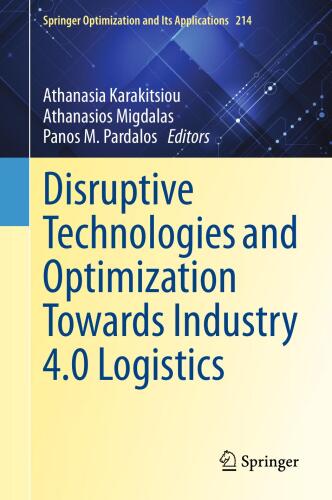
Disruptive Technologies and Optimization Towards Industry 4.0 Logistics (Springer Optimization and Its Applications, 214)
2024 · EPUB

Disruptive Technologies and Optimization Towards Industry 4.0 Logistics (Springer Optimization and Its Applications, 214)
2024 · PDF

Handbook of Optimization in Telecommunications
2006 · PDF

Recent Trends in Analysis of Images, Social Networks and Texts: 10th International Conference, AIST 2021, Tbilisi, Georgia, December 16–18, 2021, ... in Computer and Information Science, 1573)
2022 · PDF