Fusion-Fission Hybrid Nuclear Reactors: For enhanced nuclear fuel utilization and radioactive waste reduction
Book information
Description
Nuclear energy is contributing to the long-term solution to stave off climate change. However, current nuclear fission technology accesses only about 1-3% of the nuclear energy content of natural uranium, which is inefficient, and also creates a radioactive waste disposal problem. Combining nuclear fission technology with emerging nuclear fusion technology to create a fusion-fission hybrid would yield extra fusion neutrons to 1) convert much more of the uranium into fissionable material, which would increase efficient utilization of the nuclear fuel resource, and 2) significantly reduce (by fission) the most long-lived radioactive nuclear waste. This book describes fusion-fission hybrid physics and technology. The first parts briefly review nuclear fission principles and describe design and safety of nuclear fission reactors; then the fundamentals of nuclear fusion and fusion reactor concepts are described, together with ongoing and future challenges and anticipated developments in this not-yet matured technology. Chapters cover the scientific basis of nuclear fission and the fission fuel cycle, advanced fission reactors, safety aspects, the scientific and technological basis of nuclear fusion power, future improvements expected, and then the fusion-fission hybrid (FFH) breeder and burner reactor concept principles, with illustrative FFH design concepts, safety analyses, and examples of the use of fusion neutrons for helping to achieve burning and breeding fission fuel cycles. This concise work is essential reading for researchers and policy makers in nuclear energy research and engineering, including advanced students. Cover Contents List of figures List of tables About the author Acknowledgments Preface 1 Introduction 2 Nuclear electric power production 3 Scientific basis of nuclear fission energy 4 Uranium nuclear fission power fuel cycle 5 Fission energy fuel resources 5.1 Uranium resources 5.2 Thorium resources 6 Technological basis of nuclear fission power 7 Conversion of nuclear fission energy to electrical energy 8 Advanced fission reactors 9 The Nuclear Reactor Physics, Nuclear Reactor Engineering, Plasma Physics, and Fusion Technology disciplines 10 Safety of nuclear fission power reactors 11 The nuclear fission power fuel cycle 12 Scientific and technological basis of nuclear fusion power 13 Nuclear fusion power reactor studies 14 Future improvements in fusion physics and technology 15 Fusion–fission hybrid reactors 16 Principles and technical rationale of the fusion–fission hybrid breeder and burner reactors 17 Illustrative future fusion–fission hybrid reactor designs 17.1 SABR#1 Na loop-cooled tokamak FFH design with ANL fuel 17.2 SABR#1 Na loop-cooled tokamak with European fuel type 17.2.1 SABR#1 fuel shuffling 17.3 SABR#2 design 17.4 SABR#3 design 17.4.1 Thermal property data and empirical correlations 17.4.2 Design basis accidents 17.5 Tandem mirror FFH designs 17.6 Mirror designs discussion 17.7 Summary of the mirror FFH 18 SABR tokamak burner fuel cycles (using fusion neutrons to fission nuclear waste and close the back end of the fission fuel cycle 19 Computational models for tritium breeding ratio and fissile breeding ratios 19.1 Design constraints 19.2 Results and discussion 19.2.1 TBR case 19.2.2 FBR case 19.2.3 Neutronic effect of insulating sheath 19.2.4 Neutron spectra comparison 19.2.5 Power distributions 19.2.6 Comparison of SABrR to critical fast reactor system 19.3 Conclusion 20 Physics and engineering design constraints on fusion–fission hybrids 20.1 Input electrical power requirement 20.2 Comparison of waste thermal energy 20.2.1 Comparison of plant electrical energy gain 20.2.2 Limitations on fusion neutron source capabilities for transmutation reactors 20.2.3 Radiation damage limits to the first wall 20.2.4 Thermal limits to the first wall 20.2.5 Tokamak physics limits 20.2.6 Engineering limits on a tokamak fusion neutron source 21 Status of fusion development vis-à-vis a neutron source for FFH 22 Fusion neutron enhancement of a breeding nuclear fission fuel cycle 22.1 Closing the fission fuel cycle with a burner FFH 23 Using fusion neutrons to achieve a burning fission fuel cycle 23.1 Introduction 23.2 The SABR tokamak FFH design concept 23.2.1 Overview 23.2.2 Fuel element and fuel assembly design 23.2.3 SABR fuel assemblies for European MA-rich fuel 23.2.4 Fusion neutron source 23.2.5 SABR fuel cycle 23.2.6 SABR fuel cycle simulations 23.2.7 Accumulated radiation damage versus burnup for metal-TRU fuel 23.2.8 Minor actinide burner 23.3 Conclusions 24 Fuel cycle methodology, summary and conclusions 24.1 Calculation methodology 24.1.1 Design constraints 24.2 Results and discussion 24.2.1 TBR case 24.2.2 FBR case 24.2.3 Neutronic effect of insulating sheath 24.2.4 Neutron spectra comparison 24.2.5 Power distributions 24.2.6 Comparison to critical fast reactor system 24.3 Conclusion 25 Using fusion neutrons to achieve a breeding fission fuel cycle 25.1 Introduction 25.2 SABrR design concept 25.2.1 Fusion neutron source 25.2.2 Annular fast reactor 25.3 Computational model 25.3.1 Design constraints 25.4 Results and discussion 25.4.1 FBR case 25.5 Neutronic effect of insulating sheath 25.5.1 Neutron spectra comparison 25.5.2 Power distributions 25.5.3 Comparison with critical fast reactor system 26 Dynamic safety analyses of FFH reactors 26.1 Sodium loop-cooled fast reactor (SABR#1) 26.2 Introduction (SABR#1) 26.3 SABR#1 design overview 26.4 Dynamics calculation model 26.5 Accident simulations 26.5.1 Loss-of-flow accident 26.5.2 Loss-of-heat-sink accident 26.5.3 Loss-of-power accident 26.5.4 Worst possible control rod accident 26.5.5 Control rod ejection 26.5.6 Accidental increase in fusion neutron source strength 26.6 Summary and conclusions for “point kinetics” analyses 26.7 Nodal dynamics model 26.7.1 Neutron kinetics model 26.7.2 Calculation of nodal kinetics terms 26.7.3 Calculation of feedback effects 26.7.4 Thermal-hydraulic model 26.7.5 Modeling the coupled cores 26.7.6 Modeling the heat exchanger 26.7.7 Modeling the sodium pools 26.7.8 Thermal property data and empirical correlations 26.7.9 Calculation of nodal heat transfer terms 26.8 Verification tests 26.8.1 Neutron kinetics model 26.8.2 Thermal-hydraulic model 26.8.3 Fuel bowing model 26.9 Dynamic safety analysis of SABR#2 26.9.1 Accident scenarios and corrective actions 26.9.2 Accident results 26.9.3 Neutronic coupling 26.10 Discussion 27 Space-dependent dynamics calculation model for a sodium pool-cooled fast transmutation reactor (SABR#2) 27.1 Neutron kinetics model 27.1.1 Calculation of nodal kinetics terms 27.1.2 Calculation of feedback effects 27.1.3 Modeling the core 27.1.4 Thermal-hydraulic model 27.1.5 Modeling the heat exchanger 27.1.6 Modeling the sodium pool 27.1.7 Thermal property data and empirical correlations 27.1.8 Calculation of nodal heat transfer terms 27.2 Verification tests 27.2.1 Neutron kinetics model 27.2.2 Thermal-hydraulic model 27.2.3 Fuel bowing model 27.3 Dynamic safety analysis 27.3.1 Accident scenarios and corrective actions 27.3.2 Accident analyses 27.3.3 Neutronic coupling 27.4 Discussion 28 The panacea of just harvesting “free” green energy? 29 Summary, discussion, and recommendations Further reading: Georgia Tech Fusion–Fission Hybrid Papers Glossary for “Fusion–Fission Hybrid Reactors” References for “Fusion–Fission Hybrids” Topical Summary Other volumes in this series Back Cover
Similar books

Nuclear Reactor Physics
2018 · PDF

Fusion Plasma Physics
2005 · PDF

Fusion Plasma Physics
2012 · PDF

The Quest for a Fusion Energy Reactor: An Insider's Account of the INTOR Workshop
2010 · PDF

Nuclear reactor physics
2001 · PDF

Fusion Plasma Physics (Physics Textbook)
2005 · PDF
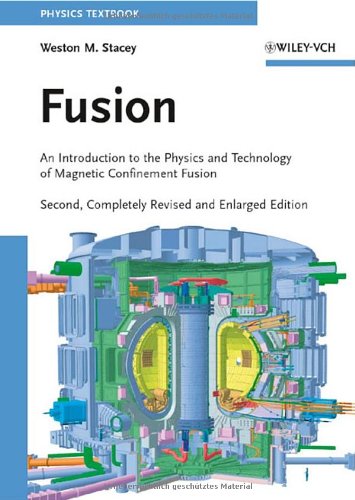
Fusion: An Introduction to the Physics and Technology of Magnetic Confinement Fusion - Second, Completely Revised and Enlarged edition
2010 · PDF

Nuclear Reactor Physics, Second Edition
2007 · PDF