Jesus, Q, and the Dead Sea Scrolls: A Judaic Approach to Q
Book information
Description
In his work, Simon J. Joseph proposes a new working model for understanding the Jewish ethnicity, community, provenance, and compositional traits in Q ― the earliest and most reliable source for the Palestinian Jewish Jesus movement. He critically compares the major literary features of Q 3-7, a section which introduces John the Baptist and includes the Beatitudes and Jesus' reply to John in light of the Dead Sea Scrolls, the Essenes, and first-century Jewish wisdom traditions and messianism. By conducting a critical comparative analysis of Q 6:20-23, Q 7:22, 4Q525, and 4Q521, this approach effectively challenges the prevailing assumption that Q is a Galilean text representing a non-messianic and non-apocalyptic Galilean branch of the early Jesus movement that was dissociated from the early Jerusalem community and provides a new way of understanding the intimate relationship between Early Judaism and Christianity. Cover Preface Table of Contents Chapter 1: Introduction and Methodology 1.1 Introduction 1.2 On the Comparative Method 1.3 Q, the Essenes, and the Dead Sea Scrolls 1.4 Conclusion Chapter 2: Reconstructing Q 2.1 Introduction 2.2 The Existence of Q 2.3 A History of Research on Q 2.4 The Ethnicity of Q 2.5 The Aramaic Substratum of Q 2.6 The Composition of Q 2.7 The Community of Q 2.8 The Provenance of Q 2.9 The Social Structure(s) of Q 2.10 Conclusion Chapter 3: Qumran, the Essenes, and the Dead Sea Scrolls 3.1 Introduction 3.2 The Identity of the Qumran Community 3.3 The Qumran Essene Hypothesis 3.4 Qumran, the Essenes, and the Enoch Tradition 3.5 Qumran Messianism 3.6 Conclusion Chapter 4: Q, John the Baptist, and Jesus 4.1 Introduction 4.2 The Role of John the Baptist in Q 4.3 John and the Essenes 4.4 “More Than A Prophet?” 4.5 Conclusion Chapter 5: The Eschatological Wisdom of the Beatitudes 5.1 Introduction 5.2 The Eschatological Wisdom of 4QInstruction 5.3 The Beatitudes (Q 6:20–23) 5.4 The Wisdom of 4QBeatitudes 5.5 Conclusion Chapter 6: “The One Who Is To Come” 6.1 Introduction 6.2 The Reconstruction of Q 7:22 6.3 4Q521: Date, Genre, and Provenance 6.4 The Messiah of 4Q521 6.5 Q 7:22 and 4Q521: The Case for Literary Dependence 6.6 Conclusion Chapter 7: Conclusion Bibliography Index of Ancient Sources Hebrew Bible New Testament Apocrypha and Pseudepigrapha Philo Josephus Dead Sea Scrolls Greek and Latin Literary Sources Early Christian Literature Rabbinic Literature Index of Authors Index of Subjects
Similar books

A Social History of Christian Origins: The Rejected Jesus
2022 · PDF

The Nonviolent Messiah: Jesus, Q, and the Enochic Tradition
2014 · EPUB

A Social History of Christian Origins: The Rejected Jesus
2022 · PDF

Jesus, the Essenes, and Christian Origins: New Light on Ancient Texts and Communities
2018 · PDF

Jesus and the Temple: The Crucifixion in its Jewish Context
2016 · PDF

Die Kunst, alle animalischen und vegetabilischen Substanzen, nähmlich alle Gattungen Fleisch, Geflügel, Wildpret, Fische, Zugemüse, Küchen- und Arzneygewächse, Früchte, Sulzen, Säfte; ferner Bier, schon zum Genusse völlig bereiteten Kaffeh, Thee u.s.w., in voller Frische, Schmackhaftigkeit und eigenthümlicher Würze mehrere Jahre zu erhalten : eine der nützlichsten Erfindungen von H. Appert in Paris, die nicht allein für die kleinste Haushaltung ohne allen Kostenaufwand anwendbar, und deßwegen ein unentbehrlicher, noch nie gegebener Anhang zu allen Koch- und Wirthschaftsbüchern ist, sondern auch die größten nur denkbaren Vortheile für Hospitäler, Armeen, Flotten etc. etc. gewährt, und wegen ihrer Gemeinnützigkeit von der französischen Regierung mit 12.000 Franken belohnt wurde
1832 · PDF

Geschichte des Rechtsstreits zwischen der ältern und jüngern Linie des Fürstenhauses Anhalt-Bernburg. Band 3, Abteilung 1 Commentar zu den Gründen des, den Beytritt der vertretenen Streitgenossen, zu der von den unvertretenen erhobenen Nichtigskeitsquerel, abweisenden ersten Instanzurtheils vom 25sten November 1820: Fortgesetze Betrachtungen über die Natur einer prozessualischen Streitgenossenschaft, und über die Untheilbarkeit eines Verfahrens und Urtheils, den der Untheilbarkeit der Thatsachen und des Streitgegenstandes
1822 · PDF
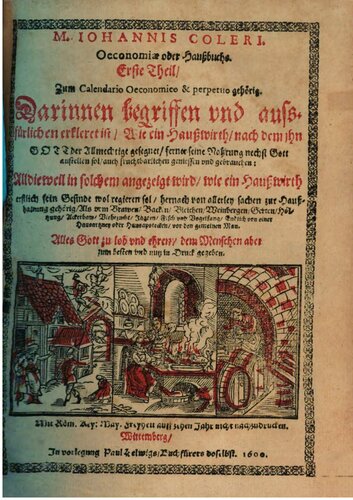
Oeconomia. Oder Haußbuch : Zum Calendario Oeconomico & perpetuo gehörig. 1 Darinnen begriffen vnnd außführlichen erkleret ist, Wie ein Hauswirth, nach dem ihn Gott der Allmechtige gesegnet, ferner seine Nahrung nechst Gott anstellen sol, auch fruchtbarlichen geniessen vnd gebrauchen : Alldieweil in solchem angezeigt wird, wie ein Haußwirth erstlich sein Gesinde wol regieren sol, hernach, von allerley sachen zur Haußhaltung gehörig, Als von Brawen, Backen, Bleichen, Weinbergern, Gärten, Höltzung, Ackerbaw, Viehzucht, Jagten, Fisch vnd Vogelfang, Endlich von einer Haußartzney oder Haußapotecken vor den gemeinen Man.
1600 · PDF