Neo-Traditionalism in Islam in the West: Orthodoxy, Spirituality and Politics
Book information
Description
Studies the impact neo-traditionalism has on the religious and political subjectivities of Muslims in the West Shows the importance of neo-traditionalism in the changing conceptions of religious orthodoxy, religious authority and spirituality for young Muslims in the West Studies primarily although not exclusively three neo-traditionalist shaykhs: Hamza Yusuf, Abdal Hakim Murad and Umar Faruq Abd-Allah Analyses how neo-traditionalist shaykhs construct the notion of 'tradition' concerning what they perceive to have been lost in modernity Examines the political implications to their critiques of modernity as it pertains to political quietism, race and gender This book examines the salience of neo-traditionalism in Anglo-American Muslim communities. By tracing the scholarship and impact of the key public pedagogues (shaykhs) associated with this phenomenon Hamza Yusuf, Abdal Hakim Murad, and Umar Faruq Abd-Allah, Quisay shows how their critiques of modernity is solidified as political ideals and strategies. The shaykhs guide their community of followers and students known as 'seekers of sacred knowledge' to paradigmatic critique of modernity that emphasises the importance of reconnecting with the tradition, self-purification, religious orthodoxy, and advocating for the notion of traditional metaphysical worldview and recognition and deference to spiritual (and political) authorities. In secluded, spiritual retreats held by the shaykhs the seekers hope to opt out of the disenchanted modern in search for a form of re-enchantment where neither the modern world nor the particularities of their modern subjectivities can intrude. The enticement of re-enchantment, however, proves problematic in the face of modern political power. Cover Half Title Dedication Title Page Copyright Contents Acknowledgments Foreword Introduction Stories of Disenchantment 1 Locating the (Neo)Traditional 2 Modern Times Places of Re-Enchantment 3 Travelers to Tradition 4 Formation of Authority and Conditions of Plausibility 5 The Metaphysical Lens 6 Race, Gender, and Belonging Locating Neo-Traditionalism in Modernity 7 The Sufi, the Palace, and the People 8 The Seekers, Politics, and Power Conclusion Notes Bibliography Index
Similar books

When Only God Can See: The Faith of Muslim Political Prisoners
2024 · EPUB
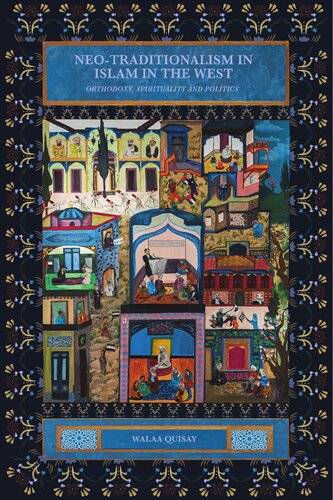
Neo-Traditionalism in Islam in the West: Orthodoxy, Spirituality and Politics
2023 · EPUB

Neo-traditionalism in Islam in the West: Orthodoxy, Spirituality and Politics
2023 · PDF

MySQL® Notes for Professionals book
2018 · PDF

MrExcel 2022: Boosting Excel
2022 · PDF

MrExcel 2022: Boosting Excel
2022 · PDF

Session C11: Ancient Cultural Landscapes in South Europe – their Ecological Setting and Evolution, Session C22: Gardeners from South America, Session S04: Agro-Pastoralism and Early Metallurgy Sessions, Session WS29: The Idea of Enclosure in Recent Iberian Prehistory, Session C88: Rhytmes et causalites des dynamiques de l'anthropisation en Europe entre 6500 ET 500 BC: Hypotheses socio-culturelles et/ou climatiques: Proceedings of the XV UISPP World Congress (Lisbon 4-9 September 2006) / Actes du XV Congrès Mondial (Lisbonne 4-9 Septembre 2006) Vol.36
2010 · PDF

THE BRITISH ARMY IN INDIA: ITS PRESERVATION BY AN APPROPRIATE CLOTHING, HOUSING, LOCATING, RECREATIVE EMPLOYMENT, AND HOPEFUL ENCOURAGEMENT OF THE TROOPS. with AN APPENDIX ON INDIA : THE CLIMATE OP ITS HILLS ; THE DEVELOPMENT OF ITS RESODRCBS, INDUSTRY, AND ARTS ; THE ADMINISTRATION OF JUSTICE ; THE BLACK ACT ; THE PROGRESS OF CHRISTIANITY ; THE TRAFFIC IN OPIUM ; THE VALUE OF INDIA ; PERMANENT CAUSES OF DISAFFECTION, AND OF THE RECENT REBELLION ; THE TRADITIONARY POLICY; MISGOVERNMENT BY NATIVE RULERS ; ANNEXATIONS OF THEIR TERRITORY, ETC.
1858 · PDF