Analysis and Control of Polynomial Dynamic Models with Biological Applications
Book information
Description
Analysis and Control of Polynomial Dynamic Models with Biological Applications synthesizes three mathematical background areas (graphs, matrices and optimization) to solve problems in the biological sciences (in particular, dynamic analysis and controller design of QP and polynomial systems arising from predator-prey and biochemical models). The book puts a significant emphasis on applications, focusing on quasi-polynomial (QP, or generalized Lotka-Volterra) and kinetic systems (also called biochemical reaction networks or simply CRNs) since they are universal descriptors for smooth nonlinear systems and can represent all important dynamical phenomena that are present in biological (and also in general) dynamical systems. Cover......Page 1 Analysis and Control of Polynomial Dynamic Models with Biological Applications ......Page 3 Copyright......Page 4 Dedication......Page 5 About the Authors......Page 6 Preface......Page 7 Acknowledgments......Page 9 Introduction......Page 10 Dynamic Models for Describing Biological Phenomena......Page 11 Kinetic Systems......Page 12 Chemical Reaction Networks With Mass Action Law......Page 13 Chemical Reaction Networks With Rational Functions as Reaction Rates......Page 14 Original Lotka-Volterra Equations......Page 15 Generalized Lotka-Volterra Equations......Page 16 Model Transformations and Equivalence Classes......Page 46 Affine Transformations and Their Special Cases for Positive Polynomial Systems......Page 47 Positive Diagonal Transformation of CRNs: Linear Conjugacy......Page 48 Linear Conjugacy of Networks With Mass Action Kinetics......Page 49 Linear Conjugacy of CRNs With Rational Reaction Rates......Page 50 X-Factorable Transformation......Page 53 Time-Rescaling Transformation of QP Models......Page 54 Quasimonomial Transformation and the Corresponding Equivalence Classes of QP Systems......Page 56 The Lotka-Volterra (LV) Form and the Invariants......Page 57 Embedding Smooth Nonlinear Models Into QP Form (QP Embedding)......Page 59 Embedding Rational Functions Into Polynomial Form (CRN embedding)......Page 61 Generality and Relationship Between Classes of Positive Polynomial Systems......Page 62 Model Analysis......Page 64 Local Stability Analysis of QP and LVModels......Page 65 Global Stability Analysis Through the Solution of Linear Matrix Inequalities......Page 66 The Time-Reparametrization Problem as a BMI......Page 67 Example......Page 70 Deficiency Zero and Deficiency OneTheorems......Page 71 Linear First Integrals of Kinetic Systems and Their Relations to Conservation......Page 74 Mass Conserving Chemical Reactions......Page 75 Invariants of QP Systems and Their Computation......Page 76 The Physical-Chemical Origin of the Natural Lyapunov Function of Kinetic Models......Page 77 Relationship With the Logarithmic Lyapunov Function of QP Models......Page 78 Computational Analysis of the Structure of Kinetic Systems......Page 79 Computational Model for Determining Linearly Conjugate Realizations of Kinetic Systems......Page 80 Dense Reaction Graphs......Page 81 Sparse Realizations......Page 83 Computing Linearly Conjugate Realizations With Preferred Properties......Page 84 Weakly Reversible Structures......Page 85 Deficiency Zero Realizations......Page 86 Further Structures Computable in an Optimization Framework......Page 88 Computing All Possible Graph Structures of a Kinetic System......Page 89 Computation of Linearly Conjugate Bio-CRNs......Page 94 Computation-Oriented Representation of Uncertain Kinetic Models and Their Realizations......Page 95 Realizations of an Uncertain Kinetic Model......Page 96 Dense and Sparse Realizations......Page 98 Stabilizing Feedback Control Design......Page 100 LQ Control of QP Systems Based on Their Locally Linearized Dynamics......Page 101 LQ Feedback Structure......Page 102 Suboptimal LQ With Diagonal Stability......Page 103 Stabilizing Control of QP Systems by Solving Bilinear Matrix Inequalities......Page 104 Numerical Solution of the Controller Design Problem......Page 105 Stabilizing State Feedback Control of Nonnegative Polynomial Systems Using Special CRN Realizations of the Closed-Loop S......Page 108 Underlying Realization Computation Problem......Page 109 Feedback Computation in the Complex BalancedClosed-Loop Case......Page 110 Feedback Computation in the Weakly Reversible Closed Loop With Zero Deficiency Case......Page 111 Handling the Parametric Uncertainty of Stabilizing Control of Polynomial Systems in the Complex Balanced Closed-Loop C......Page 113 Optimization-Based Structural Analysis and Design of Reaction Networks......Page 116 Computing All Mathematically Possible Structures of a G1/S Transition Model in Budding Yeast......Page 117 Analysis of a Five-Node-Repressilator WithAuto Activation......Page 120 Different Realizations of an Oscillating Rational System......Page 122 Dynamically Equivalent Representation......Page 123 Linearly Conjugate Structures of the Model......Page 125 Kinetic Representation......Page 128 10% Uncertainty for All Parameters......Page 130 20% Uncertainty for All Parameters......Page 131 Constrained Uncertain Model......Page 132 Analysis of the Number of Realizations for Different Degrees of Uncertainty......Page 133 Zero Dynamics of the Simple Fermentation Process......Page 135 Partially Actuated Fermentation Example in QP Form......Page 137 Fully Actuated Fermentation Example in QP Form......Page 139 Feedback Design for a Simple Fermentation Process......Page 141 Notations......Page 144 Directed Graphs......Page 148 Matrices of Key Importance......Page 150 Linear Programming......Page 153 Mixed Integer LP and Propositional Logic......Page 154 Basic Notions From Systems and Control Theory......Page 156 Transformation of States......Page 157 Lyapunov Function, Lyapunov Theorem......Page 158 Stabilizing Feedback Controllers......Page 159 Input-Output Linearization via State Feedback......Page 160 Polytopic Sets......Page 161 Bibliography......Page 163 E......Page 168 L......Page 169 O......Page 170 R......Page 171 Z......Page 172 Back Cover......Page 173
Similar books

Analysis and Control of Nonlinear Process Systems
2010 · PDF

et al Analysis and control of nonlinear process systems
2004 · PDF
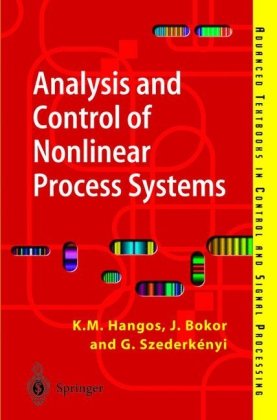
Analysis and Control of Nonlinear Process Systems
2004 · PDF

Analysis and Control of Nonlinear Process Systems
2004 · PDF

Analysis and Control of Nonlinear Process Systems
2004 · PDF

Analysis and Control of Nonlinear Process Systems
2004 · PDF

Analysis and Control of Nonlinear Process Systems
2004 · PDF
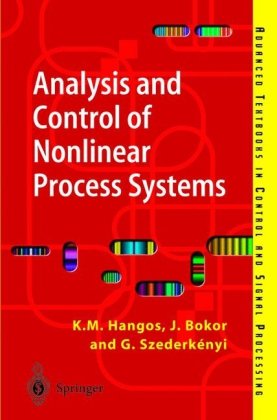
Analysis and Control of Nonlinear Process Systems
2004 · PDF