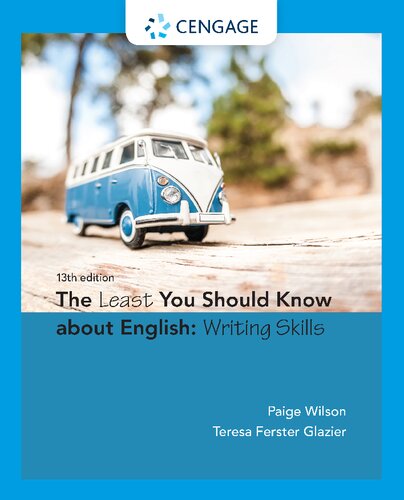
The Least You Should Know about English: Writing Skills
Book information
Description
Most English textbooks cover more than you need to know. This book will present the least you should know in order to write with clarity and confidence. Improving your writing skills doesn’t require memorizing complex grammatical terms like gerund, auxiliary verb, or demonstrative pronoun. You can write well without knowing such technical labels if you understand certain key concepts—what we call “the least you should know about English.” The concepts covered in the four parts of this book progress from smaller structures to larger ones but can be approached in any order. Part One on “Word Use” demonstrates how words work alone and together in predictable ways to express meaning. Part Two on “Sentence Structure” explains how subjects and verbs create clauses and join other structures to form sentences. Part Two also illustrates how knowing the patterns of English can help writers avoid and correct common errors. Part Three on “Punctuation” shows how punctuation marks act as a written code to aid understanding. Part Four on “Writing” explains how paragraphs and essays present ideas and evidence on a larger scale and in a variety of ways through the process of composition. To reinforce these concepts, all four parts focus less on “rules” and more on the skills and structures that successful writers use to communicate. Contents Preface Acknowledgments Getting the Most from The Least You Should Know about English 1. Word Use What Is the Least You Should Know about Word Use? Word Use Preview Test 1. Words Often Confused (Set 1) 2. Words Often Confused (Set 2) 3. The Eight Parts of Speech 4. Adjectives and Adverbs 5. Contractions 6. Possessives 7. Consulting a Dictionary Word Use Progress Test Word Use Practice 2. Sentence Structure What Is the Least You Should Know about Sentence Structure? Sentence Structure Preview Test 8. Locating Prepositional Phrases 9. Finding Subjects and Verbs 10. Understanding Dependent Clauses 11. Correcting Fragments 12. Correcting Run-on Sentences 13. Identifying Verb Phrases 14. Using Standard English Verbs 15. Using Regular and Irregular Verbs 16. Maintaining Subject-Verb Agreement 17. voiding Shifts in Time 18. Recognizing Verbal Phrases 19. Correcting Misplaced or Dangling Modifie 20. Following Sentence Patterns 21. voiding Clichés, Awkward Phrasing, and Wordiness 22. Correcting for Parallel Structure 23. Using Pronouns 24. Avoiding Shifts in Person Sentence Structure Progress Test Sentence Structure Practice 3. Punctuation What Is the Least You Should Know about Punctuation? Punctuation Preview Test 25. Periods, Question Marks, Exclamation Points, Semicolons, Colons, Dashes 26. Commas Used to Separate Elements 27. Commas Used to Enclose Elements 28. Quotation Marks and Italics/Underlines 29. Capital Letters Punctuation Progress Test Punctuation Practice 4. Writing What Is the Least You Should Know about Writing? Basic Structures 30. The Paragraph 31. The Essay Writing Skills 32. Writing in Your Own Voice 33. Finding a Topic 34. Organizing Ideas 35. Supporting with Details 36. Choosing and Using Quotations 37. Writing in Response to a Reading 38. Writing an Argument 39. Writing Summaries 40. Revising, Proofreading, and Presenting Your Work Answers Index
Similar books

Building Writing Skills the Hands-on Way - Online Resource Pages: Common Sentence Joining Patterns
2017 · PDF

Building Writing Skills the Hands-on Way
2017 · PDF

Building Writing Skills the Hands-on Way - Online Resource Pages: Grammar and Editing Codes
2017 · PDF
The Least You Should Know about English
2018 · PDF

The Least You Should Know about Vocabulary Building: Word Roots
2014 · PDF

The Least You Should Know About English: Writing Skills, Form C, Tenth Edition
2010 · PDF

The Least You Should Know about English: Writing Skills, Form A (10th edition)
2008 · PDF

MySQL® Notes for Professionals book
2018 · PDF