Kant's Philosophy: A Study for Educators
Book information
Description
James Scott Johnston's incisive study draws on a holistic reading of Kant: one that views him as developing and testing a complete system (theoretical, practical, historical and anthropological) with education as a vital component. As such, the book begins with an extensive overview of Kant's chief theoretical work (the Critique of Pure Reason), and from that overview distils crucial discussions (the role of practical reason; the claims of the third antinomy) for his moral theory. An extended discussion of Kant's moral and political theories and the place of pedagogy in it follow, with attention to all of Kant's important moral works as well as his chief religious work, Religion within the Bounds of Mere Reason. A discussion of culture and character follows, chiefly through a discussion of Kant's Critique of the Power of Judgment and Anthropology from a Pragmatic Standpoint, together with certain lectures and published essays on history and politics. Finally, an extensive discussion of Kant's published works on education, together with only recently published letters and announcements (in English), is provided. This culminates in Johnston's estimation of what a Kantian education, systematically conceived, might look like: an education that is attentive to theoretical, moral, cultural-historical, and pedagogic domains of Kant's thinking.
Similar books

Kant’s Philosophy
2013 · PDF

Problems in Philosophy of Education: A Systematic Approach
2019 · PDF
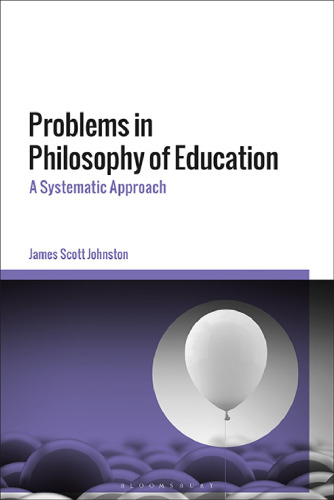
Problems in Philosophy of Education: A Systematic Approach
2019 · PDF

John Dewey's Later Logical Theory
2020 · PDF

Democracy and the Intersection of Religion: The Reading of John Dewey’s Understanding of Democracy and Education
2010 · PDF

Kant’s Philosophy: A Study for Educators
2013 · PDF

Deweyan Inquiry: From Education Theory to Practice
2009 · PDF

MySQL® Notes for Professionals book
2018 · PDF