The Post-war Novel And The Death Of The Author
Book information
Description
This book not only discloses and examines different functions and concepts of authorship in fiction and theory from the 1950s and 1960s to the present but it also reveals, at least implicitly, a trajectory of some of the modes and functions of the novel as a genre in the last few decades. It argues that the explicit terms of much of the theoretical and philosophical debate surrounding the concept of authorship in the moment of High Theory in the 1980s had already been engaged, albeit often more implicitly, in literary fictions by writers themselves. This book examines the fortunes of the authorship debate and the conceptualisations and functions of authorship before, during, and after the Death of the Author came to prominence as one of the key foci for the moment of High Theory in the 1980s. Foreword......Page 5 Contents......Page 7 Introduction......Page 9 The Rise of Theory......Page 14 Roland Barthes and the Death of the Author......Page 21 Jacques Derrida and the Critique of Authorship......Page 29 Michel Foucault: Author as a Function......Page 35 The Paradox of Self-Referentiality: Jorge Luis Borges......Page 44 References......Page 51 Introduction: The Woman Writer and Authorship......Page 54 Hysterical Woman and Authorship in Muriel Spark’s The Driver’s Seat......Page 69 Dying into Art: The Myth of the Author and the Woman Writer in the 1960s......Page 81 Finding an Authorial Voice in the 1960s: Lessing’s The Golden Notebook and Laing’s The Divided Self......Page 99 References......Page 120 Introduction......Page 124 Hearing Voices in Samuel Beckett’s The Unnamable (1953)......Page 126 The Novel in the Age of Roland Barthes......Page 138 Paranoia, Critical Anxiety and Authorial Voice in Vladimir Nabokov’s Pale Fire......Page 155 The Cold War, the Policy of Containment Culture and Paranoia......Page 157 Solipsism or Schizophrenia or a Re-fashioning of Authorship......Page 161 The Cold War and Its Generated Paranoid-Schizophrenic Author in Pale Fire......Page 169 References......Page 178 Globalisation and Risk Society......Page 182 Beyond Postmodernism: The New Sincerity and Metamodernism......Page 186 The Return of the Author as an Ethically and Politically Committed Social Reformist: The Secretary of the Invisible......Page 193 Pushing the Limits of the Novel and the Self Towards the Infinite......Page 202 The Author as a Traumatised Wounded Figure and the Healer in the Age of Globalised Trauma......Page 213 References......Page 233 5 Conclusion......Page 236 References......Page 239 Index......Page 240
Similar books

Insurgent Cultures: World Literatures and Violence from the Global South
2024 · PDF

Библиотека выживания. 50 лучших книг
2023 · FB2
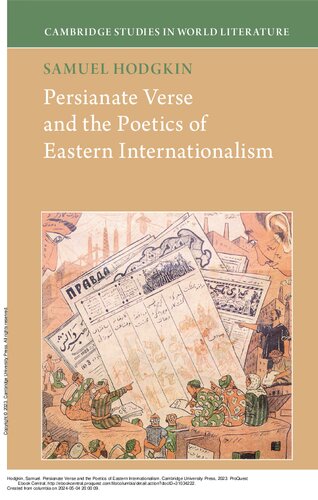
Persianate Verse and the Poetics of Eastern Internationalism
2023 · PDF
Literature and Medicine
2024 · PDF

Viktor Shklovsky: An International Bibliography of Works by and About Him
1977 · PDF

Legacies of Paul de Man
2007 · PDF

Tolkien, Race and Cultural History. From Fairies to Hobbits
2008 · PDF

The Bisexual Imaginary: Representation, Identity and Desire
1997 · PDF