The knowledge of good: critique of axiological reason
Book information
Description
This book presents Robert S. Hartman’s formal theory of value and critically examines many other twentieth century value theorists in its light, including A.J. Ayer, Kurt Baier, Brand Blanshard, Paul Edwards, Albert Einstein, William K. Frankena, R.M. Hare, Nicolai Hartmann, Martin Heidegger, G.E. Moore, P.H. Nowell-Smith, Jose Ortega y Gasset, Charles Stevenson, Paul W. Taylor, Stephen E. Toulmin, and J.O. Urmson. THE KNOWLEDGE OF GOOD: Critique of Axiological Reason Copyright CONTENTS Editorial Foreword Acknowledgments Part I: The Order of Value Reason ONE The Knowledge of Value 1. The Nature of Critique 2. The Axiological Fallacies 3. The Cognition of Value TWO The Levels of Value Language 1. First Level: Empirical Value Language A. Indefiniteness of the Moral Realm B. Vagueness and Arbitrariness of Empirical Value Concepts. 2. Second Level: Analysis of Empirical Value Language By A. Pragmatic Analysis B. Semantic Analysis C. Logical Analysis D. Epistemological Analysis E. Mathematical Analysis 3. Third Level: Systematic Value Language THREE: Value Science and Natural Science 1. The Present State of Ethical Theory 2. The Formal Analogy Between Natural Science and Moral Science A. Third-Level Construction in Science and in Ethics 3. Primary Qualities in Science and in Ethics A. The Value Freedom of Value Science B. The "Galilean Revolution" in Value Science FOUR: Moore's Metaethics: The Science of Good 1. Moore's Axiomatic of the Science of Ethics A. "Good" is Unknown but Not Unknowable. B. Propositions with "Good" are Self-evident. C. All Ethical Propositions Must Rest for Their Evidence "Upon Some Proposition Which Must be Simply Accepted or Rejected" D. All Ethical Propositions are Synthetic E. "Good" May be Subject to Formal Structurization F. The Formula for the Structurization of "Good" is Provided by Moore 2. The Axiomatic of the Science of Value Part II: Reason and Reasons of Value FIVE: Non-Cognitivists and Semi-Cognitivists 1. Non-Cognitivists A. Non-Cognitivist Empiricists. B. Non-Cognitivist Formalists. 2. Semi-(Non)-Cognitivists A. Semi-Cognitivist Empiricists B. Semi-Cognitivist Fonnalists i. The Oxford School ii. The Midwest School SIX: Naturalistic Cognitivists 1. Naturalistic Empiricists 2. Naturalistic Formalists SEVEN: Non-Naturalistic Cognitivists 1. Non-Naturalist Empiricists A. Ontologists B. Phenomenological Empiricists 2. Non-Naturalistic Formalists 3. The Formal Nature of Value: Axiological Science Part III: The Value of Reason EIGHT: The Axiological Value of Reason 1. The Logical Necessity of Reason in Moral Conduct A. Logical Relativism: The Problem B. Logical Relativism: The Formal Solution C. Methodological Relativism: The Problem (D) Methodological Relativism: The Formal Solution 2. The Logical Relation between "Is" and "Ought" NINE: The Symbolization of Value 1. The Transposition of Synthetic System and Analytic Reality 2. Analytic and Synthetic Formulae: "Exemplification" and Intensional Fulfillment 3. The Symbolization of"Ought" 4. Analytic Shorthand and Synthetic Symbolism TEN: The Measurement of Value 1. Analytic Reality and Synthetic Reality 2. Analytic and Synthetic Measurement of Value 3. Analytic "Value Measurement" 4. Synthetic Value Measurement and Prediction ELEVEN: The Formalization of Value 1. The Non-Reality of Value 2. The Situational Reality of Value 3. The Formal Reality of Value Notes Bibliography About the Author and the Editors Index VALUE INQUIRY BOOK SERIES
Similar books

The knowledge of good: critique of axiological reason
2002 · PDF

El conocimiento del bien: Crítica de la razón axiológica
1965 · PDF

La estructura del valor: Fundamentos de la axiología científica
1959 · PDF

The Knowledge of Good: Critique of Axiological Reason
2002 · PDF

The Structure of Value: Foundations of Scientific Axiology
1967 · PDF

Freedom to Live: The Robert Hartman Story
1994 · PDF

Los Alucinógenos: De la Concepción Indígena a una Nueva Psicoterapia
1981 · PDF
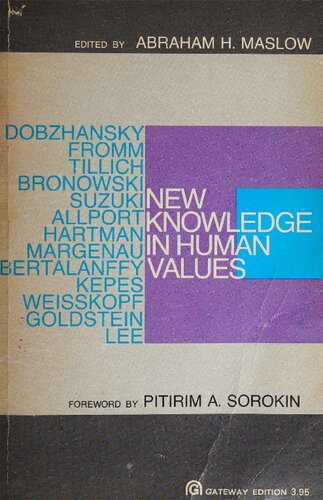
New knowledge in human values
1970 · PDF