Partial Differential Control Theory: Volume I: Mathematical Tools, Volume II: Control System (Mathematics and Its Applications)
Book information
Description
The mathematical theory of "open" dynamical systems is a creation of the twentieth century. Its humble beginnings focused on ideas of Laplace transforms applied to linear problems of automatic control and to the analysis and synthesis of electrical circuits. However during the second half of the century, it flowered into a field based on an array of sophisticated mathematical concepts and techniques from algebra, nonlinear analysis and differential geometry. The central notion is that of a dynamical system that exchanges matter, energy, or information with its surroundings, i.e. an "open" dynamical system. The mathema tization of this notion evolved considerably over the years. The early development centered around the input/output point of view and led to important results, particularly in controller design. Thinking about open systems as a "black box" that accepts stimuli and produces responses has had a wide influence also in areas outside engineering, for example in biology, psychology, and economics. In the early 1960's, especially through the work of Kalman, input/state/output models came in vogue. This model class accommodates very nicely the internal initial conditions that are essentially always present in a dynamical system. The introduction of input/state/output models led to a tempestuous development that made systems and control into a mature discipline with a wide range of concepts, results, algorithms, and applications.
Similar books

A First Course in Differential Equations with Modeling Applications
2017 · PDF

Eigenfunctions of the Laplacian of Riemannian manifolds
2017 · PDF

Dynamic Impulse Systems: Theory and Applications (Mathematics and Its Applications)
2010 · DJVU
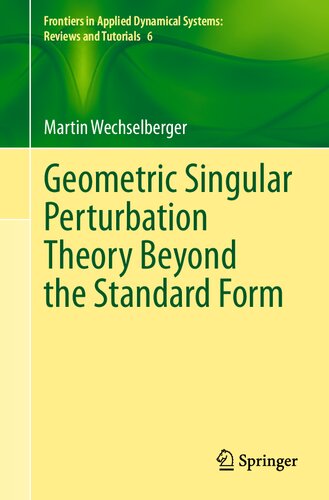
Geometric Singular Perturbation Theory Beyond the Standard Form (Frontiers in Applied Dynamical Systems: Reviews and Tutorials)
2020 · PDF

Theory of Translation Closedness for Time Scales: With Applications in Translation Functions and Dynamic Equations (Developments in Mathematics (62))
2020 · PDF

Applications of Lie Algebras to Hyperbolic and Stochastic Differential Equations (Mathematics and Its Applications)
2012 · DJVU

Orthogonal Polynomials and Painlevé Equations (Australian Mathematical Society Lecture Series)
2017 · PDF

Differential Inclusions in a Banach Space (Mathematics and Its Applications;)
2010 · DJVU