Big Data in the Arts and Humanities: Theory and Practice (Data Analytics Applications)
Book information
Description
As digital technologies occupy a more central role in working and everyday human life, individual and social realities are increasingly constructed and communicated through digital objects, which are progressively replacing and representing physical objects. They are even shaping new forms of virtual reality. This growing digital transformation coupled with technological evolution and the development of computer computation is shaping a cyber society whose working mechanisms are grounded upon the production, deployment, and exploitation of big data. In the arts and humanities, however, the notion of big data is still in its embryonic stage, and only in the last few years, have arts and cultural organizations and institutions, artists, and humanists started to investigate, explore, and experiment with the deployment and exploitation of big data as well as understand the possible forms of collaborations based on it. Big Data in the Arts and Humanities: Theory and Practice explores the meaning, properties, and applications of big data. This book examines therelevance of big data to the arts and humanities, digital humanities, and management of big data with and for the arts and humanities. It explores the reasons and opportunities for the arts and humanities to embrace the big data revolution. The book also delineates managerial implications to successfully shape a mutually beneficial partnership between the arts and humanities and the big data- and computational digital-based sciences. Big data and arts and humanities can be likened to the rational and emotional aspects of the human mind. This book attempts to integrate these two aspects of human thought to advance decision-making and to enhance the expression of the best of human life. Cover Half Title Series Page Title Page Copyright Page Dedication Table of Contents Foreword Foreword Preface Editor Contributors Section I: Big Data and Management: Theoretical Foundations 1 Big Data Analytics: Innovation Management and Value Creation 1.1 Introduction 1.2 Research Method 1.3 Big Data Analytics: The Innovation Driver 1.4 Value Creation through Innovation 1.4.1 Creating Value for an Organization Using Information Resources and ICT 1.4.2 Creating Value for the Consumer through Innovation 1.4.3 Value Creation through Innovation: Conceptual Model 1.5 Conclusions References 2 Human Resource Management in the Era of Big Data 2.1 Introduction 2.2 Influence of Big Data on HRM 2.3 HRM and Big Data As a Subject of Interests 2.4 Results of the Analysis 2.5 Conclusions and Future Research References 3 Knowledge Management and Big Data in Business 3.1 Introduction 3.2 Situation and Challenges in Theory and Practice of Knowledge Management in the Era of the Big Data 3.3 Evidence-Based Management versus Knowledge Management in the Big Data Era 3.4 Improvement of Business Processes Using the Management Concept Based on Big Data 3.5 Improving Student Onboarding Using the Knowledge Management Conception Based on Big Data Analysis and Gamification 3.5.1 Situation Analysis 3.5.2 Shortcomings of the Current Onboarding System 3.5.3 The Conception of Student Onboarding Improvement Using Big Data Acquired in the Serious Game 3.6 Conclusion References 4 Information Management and the Role of Information Technology in a Big Data Era 4.1 Introduction 4.2 The Big Data Perspective 4.3 Literature Review and Synthesis 4.4 Information Management in the Big Data Perspective 4.4.1 Information System and Managerial Information System 4.4.2 Decision-Making Processes and Decision-Makers 4.4.3 Organization Culture 4.5 Role of Information Technologies in the Era of Big Data 4.5.1 Date Warehouses 4.5.2 Distributed and Parallel Processing of Big Data Sets 4.5.3 Machine Learning 4.6 Conclusions References 5 Financial Management in the Big Data Era 5.1 Introduction 5.2 Big Data Characteristics in Financial Management 5.3 Implementation of Big Data Technologies for Supporting Financial Management Decision 5.3.1 Financial and Non-Financial Organizations 5.3.1.1 Financial Institutions 5.3.1.2 Non-Financial Companies 5.3.2 Capital Market Investments 5.3.3 Risk Management 5.3.4 Financial Markets 5.3.5 Accounting Data Processing 5.3.6 Budget Management 5.3.7 Controlling and Audits 5.4 Conclusions References 6 Ethics and Trust to Big Data in Management: Balancing Risk and Innovation 6.1 Introduction 6.2 The Digital Risk Associated with Big Data 6.3 Trust in Big Data 6.4 Building a Sensible Trust in Big Data in Organization Management 6.5 The Impact of Data Ethics Solutions on Organizational Innovation and Organization Management in the Digital Age 6.6 Balancing Digital Security with the Innovation Risk in Evidence-Based Management Using Big Data 6.7 Conclusion References Section II: Big Data in Management: Applications,Prospects, and Challenges 7 Big Data in Modern Farm Management 7.1 Introduction 7.2 Farm Management before the Era of Big Data 7.3 Big Data in Animal Production Management 7.4 Advantages of Big Data in Farm Management 7.5 Disadvantages of Big Data in Farm Management 7.6 Farmers’ Perception of Big Data 7.7 Conclusions and Proposition for Future Research References 8 Big Data Analytics and Corporate Social Responsibility: An Example of the Agribusiness Sector 8.1 Introduction 8.2 Premises for Changes in the Agribusiness Sector 8.3 Methodology 8.4 Research Results 8.5 Conclusion References 9 Big Data Analytics in Tourism: Overview and Trends 9.1 Introduction 9.2 Conditions for Using Big Data Analysis in the Tourism Industry 9.3 The Use of Big Data in Tourism 9.4 Trends in the Use of Big Data in Tourism 9.5 Conclusion References 10 Use of Big Data for Assessment of Environmental Pressures from Agricultural Production 10.1 Introduction 10.1.1 Farm Accountancy Data Network (FADN) 10.1.2 GHG Emissions: Challenge for the Farming Sector 10.2 Methodology 10.3 Results 10.4 Discussion and Conclusions References 11 Big Data as a Key Aspect of Customer Relationship Management: An Example of the Restaurant Industry 11.1 Introduction 11.2 Customer Relationship Management 11.3 Analysis of the Gastronomy Market in Poland 11.4 Structure of Consumer Spending 11.5 Characteristics of the Pizzeria “L’Olivo” 11.6 Digitization and Use of Data on Consumer Behavior in Creating a Personalized Offer 11.7 Research on Consumer Behavior in Creating Strategies for Influencing Purchasing Decisions 11.8 Conclusion References 12 Blockchain and Big Data: Example of Management of Beef Production 12.1 Introduction 12.2 Statement of the Problem 12.3 The Genesis of Blockchain Technology and Its Development Stages 12.4 The Concept of Using Blockchain Technology and Factors Limiting It in Beef Production in Poland 12.5 Conclusions, Limitations, and Further Research References 13 Big Data Analysis for Management from Solow’s Paradox Perspective in Polish Industry 13.1 Introduction 13.2 Big Data 13.3 Scope, Data Sources, and Methods 13.4 Results 13.5 Conclusion References 14 Big Data on Commuting: Application for Business 14.1 Introduction 14.2 Review of the Literature 14.3 Methodology 14.4 Results 14.5 Discussion 14.6 Conclusion References 15 How to Support Real-Time Quantitative Big Data by More Future-Orientated Qualitative Data for Understanding Everyday Innovative Businesses? 15.1 Introduction 15.2 The Oretical Background 15.2.1 Innovation 15.3 Research Gap 15.4 Method 15.4.1 Analytical Hierarchy Process 15.4.2 Innovation Strategy Index 15.4.3 Weak Market Test 15.5 Empirical Research 15.6 Sample and Analysis 15.6.1 Case Company 1 15.6.2 Case Company 2 15.7 Discussion 15.8 Conclusion References Index
Similar books

Knowledge Management, Arts, and Humanities: Interdisciplinary Approaches and the Benefits of Collaboration
2019 · PDF

Big Data in the Arts and Humanities: Theory and Practice
2018 · PDF
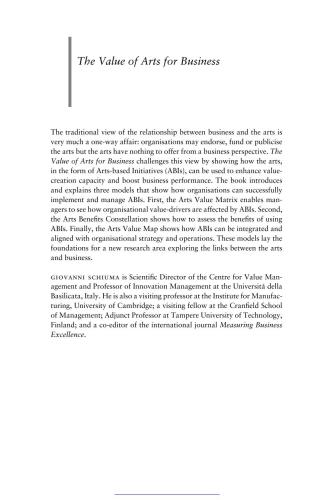
The Value of Arts for Business
2011 · PDF

The value of arts for business
2011 · PDF

Managing Knowledge Assets and Business Value Creation in Organizations: Measures and Dynamics (Premier Reference Source)
2010 · PDF

MySQL® Notes for Professionals book
2018 · PDF

MrExcel 2022: Boosting Excel
2022 · PDF

MrExcel 2022: Boosting Excel
2022 · PDF