Hegel-Studien Band 48: 2015
Book information
Description
AbstractsPirmin Stekeler-Weithofer: Autonome Vernunft und Normbefolgung des VerstandesWie Hegel eine Unterscheidung Kants präzisiertH.s central criticism of Kant’s philosophy urges us to separate the level of understanding or rationality (“Verstand”) from the level of (speculative) reason (“Vernunft”). The first is a faculty to follow explicit rules properly and to comply with implicitly given norms, the second is active autonomy in developing the rules and norms. This claim might be astounding since Kant himself seems to have stressed the distinction. But it was H. who has drawn the necessary consequences, for example that it is logically impossible to determine laws autonomously for oneself because we need a frame of a we-group or community and a communal practice or institution for the very possibility of having well-determined rules at all. The conceptual relation between norms of proper conduct and forms of cooperation shows up paradigmatically in the fact that I can sing in a choir correctly only together with others. Moreover, only after I can show that I can participate and judge the fulfilment of the norms, my proposals to change such forms of action and practices will count in a community. This holds as well for any attempt to make rules explicit by articulating implicit norms that already govern our (cooperative) actions implicitly – which is a prerequisite for conscious changes of general laws that presuppose at least some forms of comments on pregiven norms. All this holds for the dimensions of the (epistemic) True in diverse areas of judgements and inference as well as for dimensions of the (legal or moral) Good, in evaluating actions or for (aesthetic) Beauty and the corresponding attitudes and reactions.Georg Sans Sj: Weisen der WelterschliessungZur Rolle des Chemismus in Hegels subjektiver LogikThe second section of H.s Subjective Logic deals with the “objectivity” of the concept. It is explained through the categories of mechanism, chemism, and teleology. For H., in contrast to Kant, the alternative between mechanism and teleology is incomplete. As the case of chemism shows, it is not necessary to suppose internal finality in order to conceive of objects which determine themselves according to their concepts. After highlighting the distinction between physical bodies and chemical substances, I discuss H.s claim that chemical processes can be represented in inferential form, namely as a circle of three syllogisms. The syllogistic presentation provides evidence of the conceptual structure behind the chemical phenomena, as exemplified in particular by elective affinities. H.s treatment of chemism, however, is not limited to the realm of chemistry but concerns also spiritual relations like friendship and love. These fields of application prove chemism to be a third way, besides mechanism and teleology, of understanding objective wholes.Nadine Mooren/Tim Roje K: Hegels Begriff der „Wissenschaft“H.s view of the relation between philosophical and non-philosophical sciences has been neglected in debates that concentrate on the relation of common sense and philosophy. Based on this diagnosis the article aims to explicate H.s understanding of non-philosophical sciences as well as their relation to his speculative philosophy. In addition, the article demonstrates that in H.s view philosophy and non-philosophical sciences are not competing or in conflict with each other. Rather, he conceives of them as compatible. After specifying the scope of our research (1.) and presenting a systematic overview of relevant forms of Weltbezug in H. (2.), we analyze four central relations between speculative philosophy and non-philosophical sciences through a close-reading (3.). The final section sketches the systematic implications of our reading (4.).Philipp Erbentraut: Ein kritischer Freund der ParteienHegels Auffassung der politischen Partei war differenzierter als bislang angenommenIn this paper I discuss H. as a “critical friend” of political parties. This characterisation clearly contradicts the prevailing opinion as expressed in the relevant academic literature, which identifies him as the main opponent of political parties and opposition in general among contemporary political theorists in 19th century Germany. Against this longstanding prejudice I argue that, in fact, H. advocates the existence of intermediate organisations as competing brokers between civil society and the state. Furthermore, he highlights the necessity of opposition and party competition within any legislative assembly and acknowledges that the ministry depends on the majority party’s support. Hence, special attention should be paid to H.s praise of the highly developed political parties in England. Representing the national interest instead of any particular faction, Whigs and Tories are described as legitimate keepers of governmental power and as guarantors of the stability of the English constitution. In conclusion, I argue for a revision of our verdict on H.s concept of political parties in favour of a more benign view. This finding could help to break another obsolete cliché: There was nothing like a general antiparty sentiment in 19th century German political thinking at all.Jon Stewart: Hegel and the Egyptian ReligionH.s Behandlung der Religion des alten Ägypten gehört zu den faszinierendsten Analysen in seinen Vorlesungen über die Philosophie der Religion. Dieses Thema wird aber nicht nur in diesem Werk, sondern auch in den Vorlesungen über die Philosophie der Geschichte, in den Vorlesungen über die Philosophie der Kunst und sehr verkürzt auch in der Phänomenologie des Geistes behandelt. Trotz des häufigen Vorkommens dieses Problems ist H.s Analyse der ägyptischen Religion im allgemeinen ein vernachlässigtes Thema in der H.-Forschung. Der Grund dafür ist vermutlich, daß die Bedeutung dieses Themas für die zentralen Fragestellungen der H.schen Philosophie als marginal angesehen wird. Schaut man aber genauer hin, zeigt sich, daß H.s Darstellung des ägyptischen Todeskultus für eine der zentralen Diskussionen in der Bildung der H.schen Schulen in den 1830er und 40er Jahren aufschlußreich ist. Es geht dabei um die Frage, ob H. eine Theorie der Unsterblichkeit hatte oder nicht. H.s positive Auffassung des Glaubens der alten Ägypter an Unsterblichkeit gibt eine Einsicht in seine Einstellung zu diesem Thema. Die Idee der Unsterblichkeit, die H. häufig in seinen verschiedenen Vorlesungen analysiert, ist mit der Idee der subjektiven Freiheit eng verbunden. Die Idee der Unsterblichkeit setzt voraus, daß der einzelne Mensch als an sich wertvoll und bedeutsam aufgefaßt wird. Dies ist aber etwas, das sich im Laufe der Geschichte entwickeln muß, und lt. H. findet man die erste wahrhafte Auffassung des Selbst bei den alten Ägyptern. In meinem Beitrag argumentiere ich, daß H.s Analyse der Unsterblichkeitsidee im alten Ägypten davon zeugt, daß er in der Tat eine Theorie der Unsterblichkeit hatte. Wenn es sich dabei auch um eine unkonventionelle Theorie handelt, stellt sie einen wichtigen Teil von H.s übergeordneter Theorie der Entwicklungen der subjektiven Freiheit dar.Emanuele Cafagna: Positivität und Polemik. Hegel als Leser der „Reden über die Religion“ von SchleiermacherH.s dispute with Schleiermacher in Berlin had as its premise his reception of Schleiermacher’s Reden über die Religion. My intention is to clarify the history of this reception by arguing that H.’s Frankfurt writings already contain signs that he read Schleiermacher’s work. Differently from previous interpretations, however, I will not support the hypothesis that, during his Frankfurt period, H. was influenced by Schleiermacher’s concept of religion. My contention is that, from the very beginning, H. opposed Schleiermacher’s concepts of positivity and polemics as specific features of the Christian religion. This interpretation is confirmed by an analysis of the works that H. wrote in the Jena period, such as Differenz des Fichte’schen und Schelling’schen Systems der Philosophie, Glauben und Wissen and Phänomenologie des Geistes. By carefully reading these works, it is possible to establish, in contrast to previous scholarship, that H.s approach to Schleiermacher’s idea of the Christian religion remained consistent over time. A final aspect that I will consider is the persistence of H.s views on the broader significance of Schleiermacher’s Reden über die Religion – an aspect that emerges from a closer analysis of some crucial sentences in the Grundlinien der Philosophie des Rechts.Hans Friedrich Fulda: Ein Neues Konzept für die Darstellung einer Philosophie-EpocheWalter Jaeschke und Andreas Arndt über die klassische deutsche Philosophie nach KantHow to present an epoch of philosophy, for example the whole period of post-Kantian German Idealism, in one single book? Andreas Arndt and Walter Jaeschke recently gave us a very stimulating idea to answer this question. In two parallel books they gave shape to the idea which will be discussed in the following. Section I of my paper focuses on the main features of the new concept and makes clear why one should adopt it rather than following the ordinary path of historical handbooks or problem histories. Passing through all seven parts of the larger book section II tries to identify the specific advantages of Jaeschke’s and Arndt’s way of presenting post-Kantian German Idealism, and combines it with pointing to some (probably accidental) shortcomings. Section III however indicates one essential disadvantage of the new concept which should stimulate further reflections.
Similar books

Hegel-Studien Band 52

Hegel-Studien Band 47: 2014

Hegel-Studien Band 50: 2017

Hegel-Studien Band 51

Hegel-Studien Band 49: 2016

Die Kunst, alle animalischen und vegetabilischen Substanzen, nähmlich alle Gattungen Fleisch, Geflügel, Wildpret, Fische, Zugemüse, Küchen- und Arzneygewächse, Früchte, Sulzen, Säfte; ferner Bier, schon zum Genusse völlig bereiteten Kaffeh, Thee u.s.w., in voller Frische, Schmackhaftigkeit und eigenthümlicher Würze mehrere Jahre zu erhalten : eine der nützlichsten Erfindungen von H. Appert in Paris, die nicht allein für die kleinste Haushaltung ohne allen Kostenaufwand anwendbar, und deßwegen ein unentbehrlicher, noch nie gegebener Anhang zu allen Koch- und Wirthschaftsbüchern ist, sondern auch die größten nur denkbaren Vortheile für Hospitäler, Armeen, Flotten etc. etc. gewährt, und wegen ihrer Gemeinnützigkeit von der französischen Regierung mit 12.000 Franken belohnt wurde
1832 · PDF

Geschichte des Rechtsstreits zwischen der ältern und jüngern Linie des Fürstenhauses Anhalt-Bernburg. Band 3, Abteilung 1 Commentar zu den Gründen des, den Beytritt der vertretenen Streitgenossen, zu der von den unvertretenen erhobenen Nichtigskeitsquerel, abweisenden ersten Instanzurtheils vom 25sten November 1820: Fortgesetze Betrachtungen über die Natur einer prozessualischen Streitgenossenschaft, und über die Untheilbarkeit eines Verfahrens und Urtheils, den der Untheilbarkeit der Thatsachen und des Streitgegenstandes
1822 · PDF
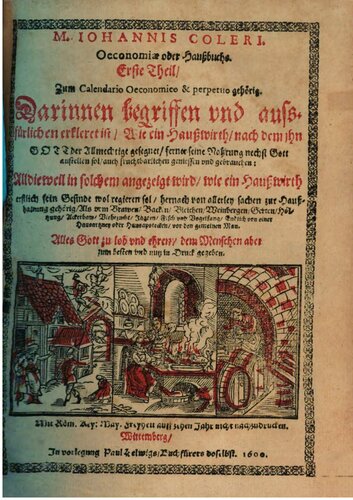
Oeconomia. Oder Haußbuch : Zum Calendario Oeconomico & perpetuo gehörig. 1 Darinnen begriffen vnnd außführlichen erkleret ist, Wie ein Hauswirth, nach dem ihn Gott der Allmechtige gesegnet, ferner seine Nahrung nechst Gott anstellen sol, auch fruchtbarlichen geniessen vnd gebrauchen : Alldieweil in solchem angezeigt wird, wie ein Haußwirth erstlich sein Gesinde wol regieren sol, hernach, von allerley sachen zur Haußhaltung gehörig, Als von Brawen, Backen, Bleichen, Weinbergern, Gärten, Höltzung, Ackerbaw, Viehzucht, Jagten, Fisch vnd Vogelfang, Endlich von einer Haußartzney oder Haußapotecken vor den gemeinen Man.
1600 · PDF