Concepts of Programming Languages
Book information
Description
Concepts of Computer Programming Languages, 12th Edition introduces readers to the fundamental concepts of computer programming languages and provides them with the tools necessary to evaluate contemporary and future languages. Through a critical analysis of design issues of various program languages, the text teaches readers the essential differences between computing with specific languages, while the in-depth discussion of programming language structures also prepares them to study compiler design. The 12th Edition includes new material on contemporary languages like Swift and Python, replacing discussions of outdated languages. Copyright Changes for the Twelfth Edition Preface Contents Chapter 1: Preliminaries 1.1 Reasons for Studying Concepts of Programming Languages 1.2 Programming Domains 1.3 Language Evaluation Criteria 1.4 Influences on Language Design 1.5 Language Categories 1.6 Language Design Trade-Offs 1.7 Implementation Methods 1.8 Programming Environments Summary • Review Questions • Problem Set Chapter 2: Evolution of the Major Programming Languages 2.1 Zuse’s Plankalkül 2.2 Pseudocodes 2.3 The IBM 704 and Fortran 2.4 Functional Programming: Lisp 2.5 The First Step Toward Sophistication: ALGOL 60 2.6 Computerizing Business Records: COBOL 2.7 The Beginnings of Timesharing: Basic 2.8 Everything for Everybody: PL/I 2.9 Two Early Dynamic Languages: APL and SNOBOL 2.10 The Beginnings of Data Abstraction: SIMULA 67 2.11 Orthogonal Design: ALGOL 68 2.12 Some Early Descendants of the ALGOLs 2.13 Programming Based on Logic: Prolog 2.14 History’s Largest Design Effort: Ada 2.15 Object-Oriented Programming: Smalltalk 2.16 Combining Imperative and Object-Oriented Features: C++ 2.17 An Imperative-Based Object-Oriented Language: Java 2.18 Scripting Languages 2.19 The Flagship .NET Language: C# 2.20 Markup-Programming Hybrid Languages Summary • Bibliographic Notes • Review Questions • Problem Set •Programming Exercises Chapter 3: Describing Syntax and Semantics 3.1 Introduction 3.2 The General Problem of Describing Syntax 3.3 Formal Methods of Describing Syntax 3.4 Attribute Grammars 3.5 Describing the Meanings of Programs: Dynamic Semantics Summary • Bibliographic Notes • Review Questions • Problem Set Chapter 4: Lexical and Syntax Analysis 4.1 Introduction 4.2 Lexical Analysis 4.3 The Parsing Problem 4.4 Recursive-Descent Parsing 4.5 Bottom-Up Parsing Summary • Review Questions • Problem Set • Programming Exercises Chapter 5: Names, Bindings, and Scopes 5.1 Introduction 5.2 Names 5.3 Variables 5.4 The Concept of Binding 5.5 Scope 5.6 Scope and Lifetime 5.7 Referencing Environments 5.8 Named Constants Summary • Review Questions • Problem Set • Programming Exercises Chapter 6: Data Types 6.1 Introduction 6.2 Primitive Data Types 6.3 Character String Types 6.4 Enumeration Types 6.5 Array Types 6.6 Associative Arrays 6.7 Record Types 6.8 Tuple Types 6.9 List Types 6.10 Union Types 6.11 Pointer and Reference Types 6.12 Optional Types 6.13 Type Checking 6.14 Strong Typing 6.15 Type Equivalence 6.16 Theory and Data Types Summary • Bibliographic Notes • Review Questions • Problem Set • Programming Exercises Chapter 7: Expressions and Assignment Statements 7.1 Introduction 7.2 Arithmetic Expressions 7.3 Overloaded Operators 7.4 Type Conversions 7.5 Relational and Boolean Expressions 7.6 Short-Circuit Evaluation 7.7 Assignment Statements 7.8 Mixed-Mode Assignment Summary • Review Questions • Problem Set • Programming Exercises Chapter 8: Statement-Level Control Structures 8.1 Introduction 8.2 Selection Statements 8.3 Iterative Statements 8.4 Unconditional Branching 8.5 Guarded Commands 8.6 Conclusions Summary • Review Questions • Problem Set • Programming Exercises Chapter 9: Subprograms 9.1 Introduction 9.2 Fundamentals of Subprograms 9.3 Design Issues for Subprograms 9.4 Local Referencing Environments 9.5 Parameter-Passing Methods 9.6 Parameters That Are Subprograms 9.7 Calling Subprograms Indirectly 9.8 Design Issues for Functions 9.9 Overloaded Subprograms 9.10 Generic Subprograms 9.11 User-Defined Overloaded Operators 9.12 Closures 9.13 Coroutines Summary • Review Questions • Problem Set • Programming Exercises Chapter 10: Implementing Subprograms 10.1 The General Semantics of Calls and Returns 10.2 Implementing “Simple” Subprograms 10.3 Implementing Subprograms with Stack-DynamicLocal Variables 10.4 Nested Subprograms 10.5 Blocks 10.6 Implementing Dynamic Scoping Summary • Review Questions • Problem Set • Programming Exercises Chapter 11: Abstract Data Types and Encapsulation Constructs 11.1 The Concept of Abstraction 11.2 Introduction to Data Abstraction 11.3 Design Issues for Abstract Data Types 11.4 Language Examples 11.5 Parameterized Abstract Data Types 11.6 Encapsulation Constructs 11.7 Naming Encapsulations Summary • Review Questions • Problem Set • Programming Exercises Chapter 12: Support for Object-Oriented Programming 12.1 Introduction 12.2 Object-Oriented Programming 12.3 Design Issues for Object-Oriented Languages 12.4 Support for Object-Oriented Programmingin Specific Languages 12.5 Implementation of Object-Oriented Constructs 12.6 Reflection Summary • Review Questions • Problem Set • Programming Exercises Chapter 13: Concurrency 13.1 Introduction 13.2 Introduction to Subprogram-Level Concurrency 13.3 Semaphores 13.4 Monitors 13.5 Message Passing 13.6 Ada Support for Concurrency 13.7 Java Threads 13.8 C# Threads 13.9 Concurrency in Functional Languages 13.10 Statement-Level Concurrency Summary • Bibliographic Notes • Review Questions • Problem Set • Programming Exercises Chapter 14: Exception Handling and Event Handling 14.1 Introduction to Exception Handling 14.2 Exception Handling in C++ 14.3 Exception Handling in Java 14.4 Exception Handling in Python and Ruby 14.5 Introduction to Event Handling 14.6 Event Handling with Java 14.7 Event Handling in C# Summary • Bibliographic Notes • Review Questions • Problem Set • Programming Exercises Chapter 15: Functional Programming Languages 15.1 Introduction 15.2 Mathematical Functions 15.3 Fundamentals of Functional Programming Languages 15.4 The First Functional Programming Language: Lisp 15.5 An Introduction to Scheme 15.6 Common Lisp 15.7 ML 15.8 Haskell 15.9 F# 15.10 Support for Functional Programming in PrimarilyImperative Languages 15.11 A Comparison of Functional and Imperative Languages Summary • Bibliographic Notes • Review Questions • Problem Set • Programming Exercises Chapter 16: Logic Programming Languages 16.1 Introduction 16.2 A Brief Introduction to Predicate Calculus 16.3 Predicate Calculus and Proving Theorems 16.4 An Overview of Logic Programming 16.5 The Origins of Prolog 16.6 The Basic Elements of Prolog 16.7 Deficiencies of Prolog 16.8 Applications of Logic Programming Summary • Bibliographic Notes • Review Questions • Problem Set • Programming Exercises Bibliography Index
Similar books
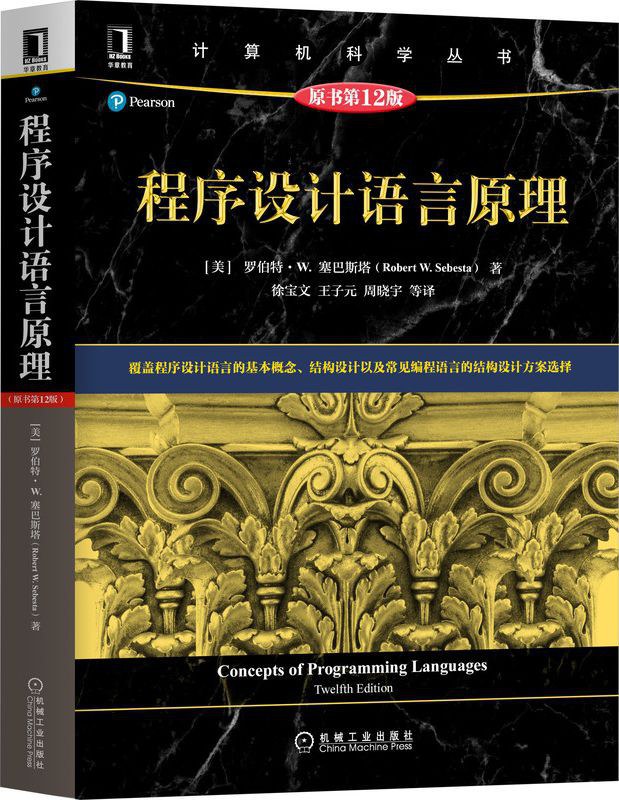
程序设计语言原理(原书第12版)
2022 · PDF

Concepts of Programming Languages (12th)
2019 · PDF

Concepts of Programming Languages
2019 · PDF

Concepts of programming languages
2012 · PDF

Conceitos de Linguagem de Programação
2011 · PDF

Concepts of Programming Languages

Concepts of Programming Languages 11th global ed.
2016 · PDF

Programming the World Wide Web
2007 · PDF