Finite Model Theory
Book information
Description
This is the first edition. The second edition was published in the "Springer Monographs in Mathematics" series in 2005. The branch of model theory described in the present book and called finite model theory has its roots in classical model theory but owes its systematic development to research from complexity theory. Model theory or the theory of models, as it was first named by Tarski in 1954, may be considered as the part of the semantics of f.Qrmalized languages that is concerned with the interplay between the syntactic structure of an axiom system on the one hand and (algebraic, set-theoretic, ... ) properties of its models on the other hand. As it turned out, first-order language (we mostly speak of first-order logic) became the most prominent language in this respect, the reason being that it obeys some fundamental principles such as the compactness theorem and the completeness theorem. These principles are valuable modeltheoretic tools and, at the same time, reflect the expressive weakness of first-order logic. This weakness is the breeding ground for the freedom which modeltheoretic methods rest upon.
Similar books

Finite Model Theory
1995 · PDF

Mathematical Logic
2021 · PDF

Mathematical Logic
2021 · PDF

Finite Model Theory
2005 · DJVU

Finite Model Theory
2006 · PDF

Finite Model Theory
2005 · PDF
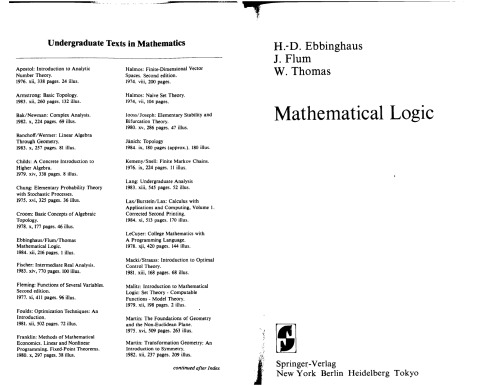
Mathematical logic
1984 · PDF

Finite Model Theory
2005 · DJVU