The Political Logic of Experience: Expression in Phenomenology
Book information
Description
The Political Logic of Experience argues that experience and phenomenology are essentially political, with profound implications for our understanding of subjectivity, epistemology, experience, the phenomenological method, and politics. Drawing on work from across the phenomenological tradition, it develops an account of expression as the internal relationship uniting knowing, being, and doing with both transcendental conditions and empirical phenomena. This expressive unification generates subjectivity as an expression of particular communities and subjects as an expression of subjectivity. Subjectivity and experience are therefore both revealed to be inherently political prior to their expression in particular subjects. In clarifying the political nature of experience and the constitution of subjectivity, the book puts the work of critical phenomenology in dialogue with transcendental phenomenology to reveal the need for a phenomenological politics: a field tasked with explaining the expressive, co-constitutive, and necessarily political relationships between subjects and their communities. It is only through such a phenomenological politics that we can properly make sense of the epistemological, ontological, and practical significance of issues like racism and sexism, problems that concern our very experience of the world. The book reveals phenomenology to be both essentially political and politically essential, as it emerges within particular communities and shapes and transforms how individuals within those communities experience the world. Touching on issues of transcendental phenomenology, political strategy, historical interpretation and inter-disciplinary phenomenological method, the book argues for foundational claims pertaining to phenomenology, politics, and social criticism that will be of interest to those working in philosophy, gender studies, race, queer theory, transcendental and applied phenomenology, and beyond.
Similar books

The Political Logic of Experience: Expression in Phenomenology (Perspectives in Continental Philosophy)
2022 · PDF

The Political Logic of Experience: Expression in Phenomenology (Perspectives in Continental Philosophy)
2022 · EPUB

Philosophies of Liturgy: Explorations of Embodied Religious Practice
2023 · PDF
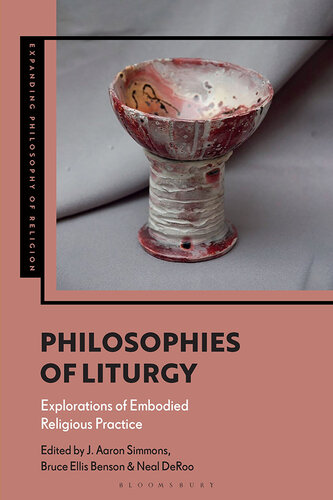
Philosophies of Liturgy: Explorations of Embodied Religious Practice
2023 · EPUB

Futurity in phenomenology: promise and method in Husserl, Lévinas, and Derrida
2013 · PDF

The Political Logic of Experience: Expression in Phenomenology
2022 · PDF

Futurity in Phenomenology: Promise and Method in Husserl, Levinas, and Derrida
2022 · PDF

Philosophical Perspectives on Existential Gratitude: Analytic, Continental, and Religious
2023 · PDF