Recycled Plastic Biocomposites (Woodhead Publishing Series in Composites Science and Engineering)
Book information
Description
Recycled plastic biocomposites have attracted widespread attention from both researchers and manufacturers due to the significant improvements in their physico-mechanical, thermal, rheological, and barrier properties when compared to conventional materials, as well as their potential regarding commercialization and zero waste. Recycled Plastic Biocomposites presents the latest information on recycled polymers, textiles, pulp and paper, wood plastic, rubber waste plastic, and micro and nano effects of recycled plastic waste resources that have great potential as reinforcement materials in composites because they are non-toxic, inexpensive, biodegradable, cost-effective, and available in large amounts. Recycled plastic biocomposites are now starting to be deployed in a broad range of materials applications due to their advantages over petroleum-based materials. Currently, there are no limits to the possibility of their applications. They also have exceptional sustainable and biodegradable properties when compared to conventional materials such as polymers and composites. Recycled Plastic Biocomposites reviews the latest research advances on recycled plastic-based biocomposites, including thermoplastic, thermoset, rubber, and foams. In addition, the book covers critical assessments on the economics of recycled plastic, including a cost-performance analysis that discusses its strengths and weaknesses as a reinforcement material. The huge potential applications of recycled plastic in industry are also explored in detail with respect to low cost, recyclable and biodegradable properties, and the way they can be applied to the automotive, construction, and packaging industries. The life cycles of both single and hybrid recycled plastic-based polymer composites and biocomposites are also discussed in detail. From the viewpoint of recycled plastic-based polymer composites, the book covers not only the well-known role of recycled polymers and composites, but also advanced materials produced from micro-, nano-, and pico-scale fillers that achieve better physical, mechanical, morphological, and thermal properties. This book will be an essential reference resource for academic and industrial researchers, materials scientists, and those working in polymer science and engineering, chemical engineering, manufacturing, and biocomposites. Front Cover Recycled Plastic Biocomposites Copyright Dedication Contents Contributors About the editors Preface Acknowledgments 1 Introduction to recycled plastic biocomposites 1.1 Introduction 1.1.1 Plastics and polymer 1.1.1.1 Inorganic polymers 1.1.1.2 Organic polymers Thermoplastics Thermoset Elastomer 1.2 Principal processes of plastics and polymers 1.2.1 Extrusion 1.2.1.1 Single screw extruder 1.2.1.2 Twin-screw extuder 1.2.1.3 Die forming 1.2.2 Injection molding 1.2.3 Reaction injection molding 1.2.4 Blow molding 1.2.5 Transfer molding 1.2.6 Thermoforming 1.2.7 Rotational molding 1.2.8 Solid-state forming 1.3 Advantages and disadvantages of recycled plastic biocomposites 1.4 Potential and application of recycled plastic biocomposites 1.5 Summary Acknowledgment References 2 Food residue to reinforce recycled plastic biocomposites 2.1 Introduction 2.2 Biofillers and biofibers 2.2.1 Fiber types 2.2.2 Fiber physicochemistry 2.2.3 Fiber modification 2.2.3.1 Acetylation treatment 2.2.3.2 Alkali treatment 2.2.3.3 Peroxide treatment 2.2.3.4 Silane treatment 2.2.3.5 Plasma treatment 2.3 Biodegradable, renewable, and biobased polymers 2.3.1 Polyhydroxyalkanoates 2.3.2 Poly lactic acid 2.3.3 Tarch 2.4 Organic additives 2.4.1 Cellulose 2.4.2 Hexamethylenetetramine 2.4.3 Glycerol 2.4.4 Sorbitol 2.5 Food waste biocomposites and biofilms 2.6 Environmental impact 2.7 Life cycle assessment 2.8 Summary Acknowledgment References 3 Development of pulp and paper waste-recycled plastic biocomposites 3.1 Introduction 3.2 Types of pulp and paper 3.2.1 Paper 3.2.2 Pulp 3.3 Extraction and preparation methods 3.3.1 Extraction methods 3.3.2 Chemical treatment 3.3.3 Physical treatment 3.3.3.1 High-pressure homogenization 3.3.4 Ultrasonic pretreatment 3.3.5 Electrohydrolysis pretreatment 3.3.6 Biological pretreatment 3.3.6.1 Microbial pretreatments 3.3.6.2 Enzymatic pretreatment 3.4 Preparation methods 3.4.1 Biopolyethylene reinforced thermomechanical pulp fibers biocomposites 3.4.2 Green composites 3.4.3 Plaster–pulp composites 3.5 Potential and commercialization 3.6 Applications 3.7 Summary References 4 Recycled polymer and plastic waste and its biocomposites 4.1 Introduction 4.2 Selection of an appropriate thermosetting resin 4.2.1 PROMETHEE: Introduction 4.2.2 PROMETHEE: Selected criteria 4.2.2.1 Molecular weight 4.2.2.2 Tensile strength 4.2.2.3 Material cost 4.2.2.4 Availability 4.2.2.5 Gel time 4.2.3 PROMETHEE: Nominees of thermosetting resins 4.2.3.1 Unsaturated polyester 4.2.3.2 Epoxy resin 4.2.3.3 Phenolic resin 4.2.3.4 Vinyl ester resin 4.3 Material properties 4.3.1 General epoxy 4.3.2 Polymers from E -waste 4.4 Advantages of particulate sizing in polymer composite 4.4.1 Effect of filler sizing on tensile strength 4.4.2 Importance of water absorption test 4.4.3 Post failure analysis through FESEM 4.5 Results and discussion 4.5.1 Selection of an appropriate thermosetting resin 4.5.1.1 PROMETHEE I: Partial ranking 4.5.1.2 PROMETHEE II: Complete ranking 4.5.2 Visual descriptive analysis: GAIA 4.6 Conclusion Acknowledgment References 5 Recycled plastic and textile waste biocomposites 5.1 Introduction 5.2 Textiles 5.3 Recycled textiles 5.4 Recent recycled textile applications 5.4.1 Bio or natural polymer 5.4.2 Thermoplastic polymers 5.4.3 Thermosetting resins 5.4.4 Concrete materials 5.4.5 Hybrids 5.5 Discussion and analysis 5.6 Summary Acknowledgment References 6 Recycled wood plastic biocomposites and development of new materials 6.1 Introduction 6.2 Types of wood and polymer 6.2.1 Engineered wood composites 6.2.2 Fiber reinforced polymers 6.3 Cross-laminated timber 6.4 Wood scrimber 6.5 Size and dimension effects on the properties of recycled composites 6.6 Advantages and disadvantages 6.6.1 Advantages of wood composites 6.6.2 Disadvantages of wood composites 6.7 Potential and commercialization 6.8 Applications 6.8.1 Construction/decking 6.8.2 Automobile industry 6.8.3 Furniture application 6.8.4 Consumer products 6.9 Conclusion References 7 Recycled rubber waste plastic and its composites 7.1 Introduction 7.2 Recycled rubber waste and its composites 7.2.1 Rubber tires 7.3 Recycled plastic waste and its composites 7.4 Conclusion Acknowledgment References 8 Role of agricultural waste in recycled plastic biocomposites 8.1 Introduction 8.2 Plastic materials 8.3 Environmental impact of plastic materials 8.4 Agricultural waste as a green biomass source 8.5 Classification of agricultural biomass and waste 8.6 Fiber structure, morphology, and chemical composition of agricultural waste 8.7 Natural and biodegradable matrix materials 8.7.1 Polylactic acid 8.7.2 Polybutylene succinate 8.7.3 Polyhydroxyalkanotes 8.8 Agricultural waste fiber-reinforced biocomposites 8.8.1 Fiber modifications 8.8.2 Improvement in fiber matrix adhesion 8.8.3 Reduction in moisture absorption 8.8.4 Thermal and flammability properties 8.9 Processing techniques for biocomposites 8.9.1 Compression molding 8.9.2 Hand lay-up 8.9.3 Pultrusion 8.9.4 Extrusion 8.9.5 Resin transfer molding 8.10 Summary, applications, and future trends References 9 Micro and nano effects of recycled plastic waste to reinforce and enhance in biocomposites 9.1 Introduction 9.2 Micro and nano recycled biocomposites 9.2.1 Filler characteristics and the effects on biocomposite properties 9.2.1.1 Particle size 9.2.1.2 Specific surface area and energy 9.2.1.3 Particle shape 9.2.1.4 Other characteristics 9.3 Applications 9.3.1 Rubber and tire industry 9.3.2 Automotive 9.3.3 Adhesives and aircraft 9.3.4 Oil and gas pipelines 9.3.5 Electronics 9.3.6 Medical 9.4 Advantages and disadvantages of micro, nano, and biocomposites 9.5 Summary Acknowledgment References 10 Recycled industrial plastics’ fine waste incorporated into biocomposites 10.1 Introduction 10.2 The impact of plastic waste on the environment and health 10.2.1 Effect on the environment (land, water, and air) 10.2.2 Effect on human health 10.2.3 Effect on animals 10.3 Recycled industrial plastic waste 10.3.1 Types of plastics 10.3.1.1 Polyethylene terephthalate 10.3.1.2 Polyethylene 10.3.1.3 Polypropylene 10.3.1.4 Polystyrene 10.3.1.5 Polyvinylchloride 10.3.2 Plastic waste recycling approach in industry 10.4 A brief history of the composite industry 10.5 Incorporation of plastic waste in composites and biocomposites 10.6 Conclusion Acknowledgment References 11 Marine-based reinforcing materials for biocomposites 11.1 Introduction 11.2 Types of marine-reinforced polymer composites 11.2.1 Fish scales-polymer composites 11.2.2 Fish bone-polymer composites 11.2.3 Crab shell-polymer composites 11.2.4 Seashell-polymer composites 11.2.5 Cuttlebone-polymer composites 11.2.6 Chitosan-polymer composites 11.2.7 Seaweed-polymer composites 11.2.8 Algae-polymer composites 11.3 Potential and application of marine-based materials for biocomposites 11.4 Summary Acknowledgment References 12 Impact of recycled plastic biocomposites on the economy and socioenvironment 12.1 Introduction 12.2 Recycling plastic biocomposites: Management, potential mitigation, and challenges 12.2.1 Mechanical recycled plastic biocomposites 12.2.2 Recycling of land and marine plastic biocomposites 12.2.3 Plastics banned 12.2.4 Feasibility and alternatives of replacing fossil-based plastics 12.3 Analysis of recycled plastic biocomposites 12.4 Benefits of fossil-based plastic and effects of their ban on socioeconomics and the environment 12.5 Key lessons of recycled plastic biocomposites and the bioplastics manufacturing project 12.6 Summary Acknowledgment References 13 Resources and energy recovery with recycled plastic biocomposites 13.1 Introduction 13.2 Types of plastic 13.2.1 Thermosetting 13.2.2 Thermoplastics 13.3 Biocomposites and composites resources and regeneration 13.4 Recovery paths 13.4.1 Primary recovery 13.4.2 Secondary recovery (mechanical recovery) 13.4.3 Tertiary recovery (chemical feedstock recovery) 13.4.4 Quaternary recovery (fuel process engineered) 13.4.5 Plastic waste in landfill 13.5 Recent developments in plastic regeneration and recovery 13.6 Sustainability and its economic value 13.7 Summary Acknowledgment References 14 Education and awareness of waste and recycled plastic biocomposites 14.1 Introduction 14.1.1 Composites 14.1.2 Bio-composites 14.1.3 History of biocomposites 14.1.4 Properties of biocomposites 14.2 Education regarding biocomposites 14.2.1 Education and awareness of biocomposites in various fields 14.2.1.1 Public awareness 14.2.1.2 Biocomposite plastics vs petroleum-based plastics Automotive industry Marine industry Construction industry 14.2.1.3 Worldwide awareness of biocomposites 14.2.1.4 Awareness in universities Center for bioplastics and biocomposites (CB2) 14.2.1.5 Worldwide implementation of biocomposites End-of life vehicles directive Waste electrical and electronic equipment directives Federal biobased products preferred procurement program 14.2.1.6 Nongovernmental organization plan for implementing biocomposites Nova-institute 14.3 Ways to improve awareness of waste and recycled biocomposites 14.4 Recommendations 14.4.1 Future of biocomposites 14.4.2 Future trends 14.4.3 Challenges 14.5 Conclusion Acknowledgment References Index Back Cover
Similar books
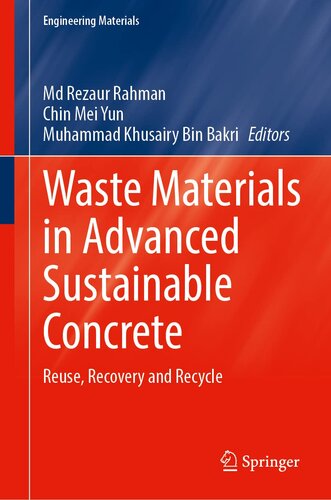
Waste Materials in Advanced Sustainable Concrete: Reuse, Recovery and Recycle (Engineering Materials)
2022 · PDF

Bamboo Polymer Nanocomposites: Preparation for Sustainable Applications (Engineering Materials)
2021 · PDF

Advances in Sustainable Polymer Composites (Woodhead Publishing Series in Composites Science and Engineering)
2020 · PDF

MySQL® Notes for Professionals book
2018 · PDF

MrExcel 2022: Boosting Excel
2022 · PDF

MrExcel 2022: Boosting Excel
2022 · PDF

Session C11: Ancient Cultural Landscapes in South Europe – their Ecological Setting and Evolution, Session C22: Gardeners from South America, Session S04: Agro-Pastoralism and Early Metallurgy Sessions, Session WS29: The Idea of Enclosure in Recent Iberian Prehistory, Session C88: Rhytmes et causalites des dynamiques de l'anthropisation en Europe entre 6500 ET 500 BC: Hypotheses socio-culturelles et/ou climatiques: Proceedings of the XV UISPP World Congress (Lisbon 4-9 September 2006) / Actes du XV Congrès Mondial (Lisbonne 4-9 Septembre 2006) Vol.36
2010 · PDF

THE BRITISH ARMY IN INDIA: ITS PRESERVATION BY AN APPROPRIATE CLOTHING, HOUSING, LOCATING, RECREATIVE EMPLOYMENT, AND HOPEFUL ENCOURAGEMENT OF THE TROOPS. with AN APPENDIX ON INDIA : THE CLIMATE OP ITS HILLS ; THE DEVELOPMENT OF ITS RESODRCBS, INDUSTRY, AND ARTS ; THE ADMINISTRATION OF JUSTICE ; THE BLACK ACT ; THE PROGRESS OF CHRISTIANITY ; THE TRAFFIC IN OPIUM ; THE VALUE OF INDIA ; PERMANENT CAUSES OF DISAFFECTION, AND OF THE RECENT REBELLION ; THE TRADITIONARY POLICY; MISGOVERNMENT BY NATIVE RULERS ; ANNEXATIONS OF THEIR TERRITORY, ETC.
1858 · PDF