Identifying secondary problem
Book information
Description
In this paper the methodology for identifying the most important secondaryproblems in Engineering Systems (ES) at their Transition-From-First-To-Second Stage of evolution is described1.Normally, at this stage a laboratory prototype of an ES works just fine, withno obvious undesirable effects, while hidden undesirable effects have not yetmanifest themselves. So, the main goal of the proposed methodology is toquickly and efficiently reveal critical secondary problems relating to the ESfunctionality in order to solve them rapidly and commercialize the ES assoon as possible. Broader objectives, e.g. identifying undesirable effects andproblems that an ES may create at other stages of its life cycle, are beyondthe scope of this methodology.The proposed methodology is based on the modified Failure AnticipationAnalysis2 (FAA) methodology, which is part of the methodology forComprehensive Analysis of an ES at the transitional stage of its evolutionthat was disclosed by the author in his thesis [4].In contrast to the original FAA methodology [1-3], the proposed specializedmethodology dramatically reduces the time required for analysis andguarantees that all critical undesirable effects and related secondaryproblems will be identified. These features make the proposed methodologyapplicable for use even in express-projects3. This is achieved by focusing themethodology on revealing only the undesirable effects that are related to theES’s Main Function (MF) and by adapting the depth of analysis dependingon how serious the analyzed undesirable effect is.
Similar books
Приемы разрешения технических противоречий. Задачи, краткие разборы и ответы
TXT
Курс РТВ (Развития Творческого Воображения)
TXT

Теория решения изобретательских задач

Методологические основы научного управления изобретательством
DJVU

Самые дурацкие изобретения
DOC

Практические основы творчества и создания изобретений
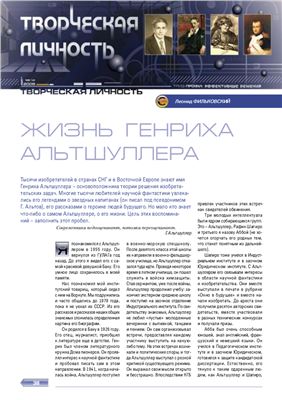
Жизнь Генриха Альтшуллера
