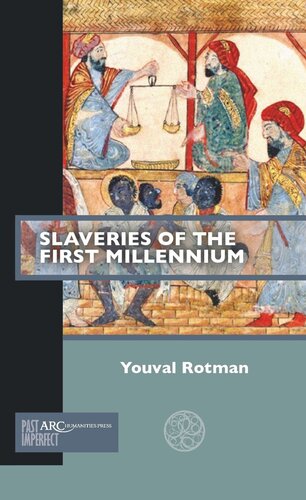
Slaveries of the First Millennium
Book information
Description
In a world where princesses found themselves enslaved, kidnapped boys became army generals, and biblical Joseph was a role model, this book narrates the formation of the Middle Ages from the point of view of slavery, and outlines a new approach to enhance our understanding of modern forms of enslavement. Offering an analysis of recent scholarship and an array of sources, never before studied together, from distinct societies and cultures of the first millennium, it challenges the traditional dichotomy between ancient and medieval slaveries. Revealing the dynamic, versatile, and adaptable character of slavery it presents an innovative definition of slavery as a historical process. Cover Contents Introduction: Whence Slavery? Chapter 1. From Present to Past and Back Chapter 2. Slavery between Two Phenomena: Empire and Christianity Chapter 3. Enslavement, Captivity, and the Monotheistic Turn Chapter 4. New Polities, New Societies, New Economies Chapter 5. Migration, Integration, Connectivity Conclusion: Slavery as Historical Process—Towards a New Definition Further Reading
Similar books
Insanity and Sanctity in Byzantium: The Ambiguity of Religious Experience
2016 · PDF
Slaveries of the First Millennium
2021 · PDF

Byzantine Slavery and the Mediterranean World
2009 · PDF

Insanity and Sanctity in Byzantium: The Ambiguity of Religious Experience
2016 · PDF

MySQL® Notes for Professionals book
2018 · PDF

MrExcel 2022: Boosting Excel
2022 · PDF

MrExcel 2022: Boosting Excel
2022 · PDF

Session C11: Ancient Cultural Landscapes in South Europe – their Ecological Setting and Evolution, Session C22: Gardeners from South America, Session S04: Agro-Pastoralism and Early Metallurgy Sessions, Session WS29: The Idea of Enclosure in Recent Iberian Prehistory, Session C88: Rhytmes et causalites des dynamiques de l'anthropisation en Europe entre 6500 ET 500 BC: Hypotheses socio-culturelles et/ou climatiques: Proceedings of the XV UISPP World Congress (Lisbon 4-9 September 2006) / Actes du XV Congrès Mondial (Lisbonne 4-9 Septembre 2006) Vol.36
2010 · PDF