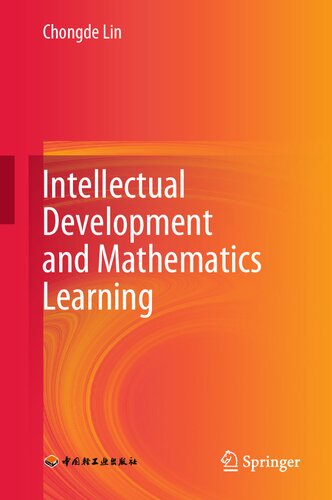
Intellectual Development and Mathematics Learning
Book information
Description
This book introduces the outcomes of author’s 40 years of research, especially the theory of “the Triangular Pyramid Structure of Thinking” that he independently proposed, and the application of his development theory in the field of mathematics education. The book firstly explains the substantial character of intelligence, the development law of intelligence, and the relationship between intelligence development and creativity cultivation. Secondly, it discusses the structure of mathematical thinking of children and adolescents from 0 to 18 years old, and the methods of developing students’ thinking ability and the quality of intelligence through arithmetic learning. In the end, this book also demonstrates the characteristics of the development of mathematical thinking ability of children at age 0-6, elementary school students, and secondary school students, and the related latest research in this field. Based on the theory of “the Triangular Pyramid Structure of Thinking”, a number of examples are given to illustrate how the theory of intelligence development can be used in mathematics teaching to promote the development of students’ thinking abilities and to improve the quality of teaching. This book covers various areas including psychology, mathematics, and education. It has a great reference value for scholars in the field of psychology to study the theory of intelligence and the structure of thinking, providing guidance for parents and mathematics teachers to promote children’s quality of intelligence and mathematical thinking abilities, and to enhance their mathematics learning effects. In addition, it provides examples for psychological research to serve specific subject teaching in elementary and secondary schools. Foreword Preface Contents About the Author Part I The Mystery of Intelligence 1 The Nature of Intelligence Intellectual Activity is a Mental Activity Definitions, Compositions, and Levels of Intelligence The Definition of Intelligence and Ability The Composition of Intelligence Levels of Intelligence Relationships Between Knowledge, Skills, and Intelligence The Main Views of Intelligence in the International Psychological Community Factor Theory and Structure Theory Piaget’s Theory of Intelligence The View of Cognitive Psychology of Intelligence Gardner’s Theory of Multiple Intelligences Sternberg’s Theory of Successful Intelligence Goleman and Mayer’s Theory of Emotional Intelligence References 2 The Laws of Intellectual Development and Mathematics Learning Nature and Nurture in Intellectual Development Three Opposing Viewpoints Heredity and even Physiological Maturity Are the Biological Prerequisites for Intellectual Development The Role of Environment and Education The Internal and External Causes in Intellectual Development The Internal Causes in Intellectual Development The Role of Human Agency and Intelligence Education and Intellectual Development Children’s and Adolescents’ Parameters Regarding Thinking and Intellectual Development The Role and Function of Education in Intellectual Development Heuristic Teaching in Mathematics The Relationship Between Age Characteristics and Individual Differences The Phase of Intellectual Development in Psychological Development The Representativeness of Age Characteristics of Intellectual and even Psychological Development The “Critical Age” in Intellectual and even Psychological Development The Maturation Period of Elementary and Secondary School Students in Intellectual and even Psychological Development The Stability and Variability of Age Characteristics of Intellectual and even Psychological Development References 3 Intelligence and Creativity Part II Mathematics: The Gymnastics of Human Thinking Characteristics of Creative Talents and Growth Environment Creative Thinking (Creative Intellectual Factors) Creative Personality (Creative Non-intellectual Factors) Creative or Innovative Environment Implementation of Creative Education and the Training Model of “T”-Type Talents Creative Education Comprises Three Groups in Schools that Produce Five Components of Effectiveness Everyone Has Creativity Integrating Eastern and Western Education Models and Cultivating the “T”-Type Talents Approaches to Developing Students’ Creativity Through Creative Learning Characteristics of Creative Learning Behavioral Characteristics of Creative Students Seven Approaches to Developing Students’ Creativity in Creative Learning Approaches to Developing Students’ Creativity in Mathematics Teaching Examples of Mathematicians from Ancient and Modern Times and Creativity Development Development and Training of Mathematics Creativity Mathematics Learning Motivation and Creativity Development Mathematical Knowledge Teaching and Creativity Development Mathematics Practice and Creativity Development References 4 The Complete Structure of Mathematical Thinking The Triangular Pyramid Structure of Thinking Purpose of Thinking Process of Thinking Material of Thinking Quality of Thinking Monitoring of Thinking Non-cognitive Factors of Thinking Accomplishment of Mathematical Entirety Unity Connection Comparison Symmetries Conservation Communication Students’ Mathematical Abilities Are the Structural Integrity of Thinking The Special Abilities of Subjects Reflect This Disciplinary Competence Most Directly All Disciplinary Competences Are Based on Generalization Ability The Structure of Disciplinary Competence Should Involve Thinking Qualities Student’s Disciplinary Competence Should Reflect Their Characteristics Mathematics Teaching Should Start from the Integrity of Thinking Study the Textbook Carefully; Understand the Systematization and Science of the Textbook Teach Students Systematic and Scientific Knowledge of Mathematics Effectively Strengthen the Teaching of Basic Mathematical Concepts Form an Integrated Mathematical Knowledge System Through Review Improve Mathematical Comprehension Ability and Promote the Development of the Structural Integrity of Students’ Thinking References 5 The Development of Student’s Thinking Ability in Arithmetic Mathematics Learning and the Development of Students’ Generalization Ability Clarify the Dominant Idea of Abstract Generalization, Guiding Students to Discover from Conjecture, Conjecture from Discovery Provide Rich and Appropriate Materials for Student’s Abstract Generalization and Make Abstract Generation Concrete Actively Promote the Process of Assimilation and Adaptation by Variation, Reflection, and Systematization Mathematics Learning and the Development of Student’s Spatial Imagination Ability Mathematics Learning and the Development of Student’s Proposition Ability Mathematics Learning and the Development of Students’ Logical Reasoning Ability Indirect and Direct Reasoning Synthesis and Analysis Inductive and Deductive Reasoning Analogical and Comparative Reasoning References 6 Differences and Development of Students’ Intellectual Qualities in Arithmetic Profundity of Students’ Thinking and Its Cultivation Cultivation of Profundity in Elementary School Students’ Mathematical Thinking Cultivation of Profundity in Secondary School Students’ Mathematical Thinking Flexibility of Students’ Thinking and Its Cultivation Creativity of Students’ Thinking and Its Cultivation Criticality of Students’ Thinking and Its Cultivation Agility of Students’ Thinking and Its Cultivation Importance of Studying Students’ Thinking Qualities References Part III Development of Mathematical Abilities in Children and Adolescents 7 Preschool Children’s Arithmetic Thinking Ability and Early Education of Mathematics The Characteristics of Thinking and the Developmental Profile of Arithmetic Thinking Abilities Preschool Children’s Acquisition of Preliminary Concepts Development of Preschool Children's Number Concepts Development of Preschool Children’s Arithmetic Abilities Development of Preschool Children’s Ability to Recognize Shapes The Development of Level of Thinking Activity in Acquisition of Number Concepts Related International Academic Communities and Domestic Perspectives My Research Recent Research on the Development of Mathematical Abilities in Children Aged 0–6 Years Development of Quantitative Representations Understanding and Applying Number Labels Fraction and Proportional Cognition Early Teaching of Mathematics From Early Education to Early Mathematics Teaching Stages of Early Education and National Perspectives on Early Childhood Education Some Suggestions for Early Mathematics Education References 8 Mathematics Learning and Intellectual Development of Elementary School Students Development of Mathematical Intelligence in Elementary School Students Development of Elementary School Students’ Number Generalization Ability The Development of Elementary School Students’ Proposition Ability and Arithmetic Rules The Development of Elementary School Students’ Reasoning Ability Basing Elementary School Mathematics Teaching on Age Characteristics of Arithmetic Thinking Ability Recent Studies on the Development of Elementary School Students’ Mathematical Ability Further Development of Elementary School Students’ Quantitative Representational Ability Elementary School Students’ Computational Strategies and Their Relationship with the Development of Basic Cognitive Functions Development of Fraction Concepts in Elementary School Students The Characteristics and Development of Elementary School Students’ Level of Representation in Word Problems Elementary School Students’ Emotional Experience of Mathematics and Mathematics Achievement Analysis of the Characteristics of Elementary School Students with Mathematics Learning Difficulties Improving Elementary School Students’ Abilities to Solve Word Problems One-Step Word Problems: The Basis for Solving Compound Word Problems Two-Step Word Problems: The Key to Solving Compound Word Problems Mastering the Various Types of Structures of Word Problems for Composite Operations Research on the Regularity of Mathematical Word Problems Strategies for Valuing Mental Representations of Mathematical Word Problems From “Wormy Formula” to Thinking Training Questions “Wormy Formula” Thinking Training Questions Thinking Training Questions and Mathematical Olympics Training Key Points that Elementary School Mathematics Teaching Should Pay Attention to Explain the Concepts, Laws, Formulas, and Methods of Problem Solving Highlighting the Key Points, Solving the Difficulties, and Explaining the Doubts Strengthen the Practice Connection with Reality References 9 Mathematics Learning and Intellectual Development of Secondary School Students Development of Mathematical Intelligence in Secondary School Students Characteristics of Secondary School Students’ Thinking Development Contradictory Manifestations of the Quality of Secondary School Students’ Thinking Characteristics of the Development of Secondary School Students’ Arithmetic Thinking Recent Studies on the Development of Secondary School Students’ Mathematical Abilities Analogical Transfer in Secondary School Mathematics Learning Cognitive Factors Affecting Secondary School Mathematics Performance Secondary School Students’ Mathematics Anxiety Research on Secondary School Student’s Mathematics Core Literacy Emphasis on the Development of Mathematical Ability Before Intellectual Maturity Emphasis on the Premature Intellectual Development of Students in Secondary School Mathematics Teaching Cultivating Secondary School Students’ Self-Study Ability Modern Mathematics Helps the Development of Abstract Thinking The Mathematical Olympiad and Intellectual Development of Secondary School Students Mathematical Olympiad Training Effectively Expands Secondary School Students’ Mathematical Horizons and Enriches and Improves Their Mathematical Knowledge Structure Compared with Secondary School Mathematics Textbooks, the Mathematical Thoughts and Methods Applied in the Mathematical Olympiad are More Skillful and Flexible and Often Require Specialized Training Mathematical Olympiad Training is a Cognitive Activity that Simultaneously, Challenges the Intellect and Stimulates Curiosity References
Similar books
Intellectual Development and Mathematics Learning
2023 · PDF

Intellectual Development and Mathematics Learning
2023 · EPUB

MySQL® Notes for Professionals book
2018 · PDF

MrExcel 2022: Boosting Excel
2022 · PDF

MrExcel 2022: Boosting Excel
2022 · PDF

Session C11: Ancient Cultural Landscapes in South Europe – their Ecological Setting and Evolution, Session C22: Gardeners from South America, Session S04: Agro-Pastoralism and Early Metallurgy Sessions, Session WS29: The Idea of Enclosure in Recent Iberian Prehistory, Session C88: Rhytmes et causalites des dynamiques de l'anthropisation en Europe entre 6500 ET 500 BC: Hypotheses socio-culturelles et/ou climatiques: Proceedings of the XV UISPP World Congress (Lisbon 4-9 September 2006) / Actes du XV Congrès Mondial (Lisbonne 4-9 Septembre 2006) Vol.36
2010 · PDF

THE BRITISH ARMY IN INDIA: ITS PRESERVATION BY AN APPROPRIATE CLOTHING, HOUSING, LOCATING, RECREATIVE EMPLOYMENT, AND HOPEFUL ENCOURAGEMENT OF THE TROOPS. with AN APPENDIX ON INDIA : THE CLIMATE OP ITS HILLS ; THE DEVELOPMENT OF ITS RESODRCBS, INDUSTRY, AND ARTS ; THE ADMINISTRATION OF JUSTICE ; THE BLACK ACT ; THE PROGRESS OF CHRISTIANITY ; THE TRAFFIC IN OPIUM ; THE VALUE OF INDIA ; PERMANENT CAUSES OF DISAFFECTION, AND OF THE RECENT REBELLION ; THE TRADITIONARY POLICY; MISGOVERNMENT BY NATIVE RULERS ; ANNEXATIONS OF THEIR TERRITORY, ETC.
1858 · PDF

Idries Shah 27 Books Collection : A Perfumed Scorpion, A Veiled Gazelle, Caravan of Dreams, Darkest England, Destination Mecca, Evenings with Idries Shah, Knowing How to Know, Learning How to Learn, Letters and Lectures of Idries Shah, Neglected aspects of Sufi study, Observations, Oriental Magic, Reflections, Seeker after Truth, Special Illumination, Special Problems in the study of Sufi ideas, Sufi thought and action, Tales of the Dervishes, The Dermis Probe, The Elephant in the Dark, The Englishman Handbook, Idries Shah Antology, The Magic Monastery, The natives are restless, wisdom of the Idiots PDF.
2022 · PDF