Mourning the Nation: Indian Cinema in the Wake of Partition
Book information
Description
What remains of the “national” when the nation unravels at the birth of the independent state? The political truncation of India at the end of British colonial rule in 1947 led to a social cataclysm in which roughly one million people died and ten to twelve million were displaced. Combining film studies, trauma theory, and South Asian cultural history, Bhaskar Sarkar follows the shifting traces of this event in Indian cinema over the next six decades. He argues that Partition remains a wound in the collective psyche of South Asia and that its representation on screen enables forms of historical engagement that are largely opaque to standard historiography. Sarkar tracks the initial reticence to engage with the trauma of 1947 and the subsequent emergence of a strong Partition discourse, revealing both the silence and the eventual “return of the repressed” as strands of one complex process. Connecting the relative silence of the early decades after Partition to a project of postcolonial nation-building and to trauma’s disjunctive temporal structure, Sarkar develops an allegorical reading of the silence as a form of mourning. He relates the proliferation of explicit Partition narratives in films made since the mid-1980s to disillusionment with post-independence achievements, and he discusses how current cinematic memorializations of 1947 are influenced by economic liberalization and the rise of a Hindu-chauvinist nationalism. Traversing Hindi and Bengali commercial cinema, art cinema, and television, Sarkar provides a history of Indian cinema that interrogates the national (a central category organizing cinema studies) and participates in a wider process of mourning the modernist promises of the nation form. Contents Acknowledgments Introduction: National Cinema’s Hermeneutic of Mourning Part I. A Resonant Silence 1. Cinema’s Project of Nationhood 2. Runes of Laceration 3. Bengali Cinema: A Spectral Subnationality Part II. The Return of the Repressed 4. Dispersed Nodes of Articulation 5. Ghatak, Melodrama, and the Restitution of Experience 6. Tamas and the Limits of Representation 7. Mourning (Un)limited Coda: The Critical Enchantment of Mourning Notes Bibliography Index
Similar books

Mourning the Nation: Indian Cinema in the Wake of Partition
2009 · PDF
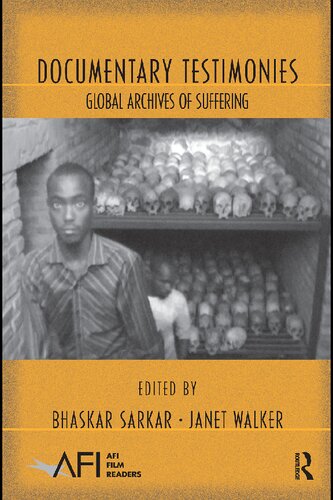
Documentary Testimonies: Global Archives of Suffering
2009 · PDF

Mourning the Nation: Indian Cinema in the Wake of Partition
2009 · PDF

MySQL® Notes for Professionals book
2018 · PDF

MrExcel 2022: Boosting Excel
2022 · PDF

MrExcel 2022: Boosting Excel
2022 · PDF

Session C11: Ancient Cultural Landscapes in South Europe – their Ecological Setting and Evolution, Session C22: Gardeners from South America, Session S04: Agro-Pastoralism and Early Metallurgy Sessions, Session WS29: The Idea of Enclosure in Recent Iberian Prehistory, Session C88: Rhytmes et causalites des dynamiques de l'anthropisation en Europe entre 6500 ET 500 BC: Hypotheses socio-culturelles et/ou climatiques: Proceedings of the XV UISPP World Congress (Lisbon 4-9 September 2006) / Actes du XV Congrès Mondial (Lisbonne 4-9 Septembre 2006) Vol.36
2010 · PDF

THE BRITISH ARMY IN INDIA: ITS PRESERVATION BY AN APPROPRIATE CLOTHING, HOUSING, LOCATING, RECREATIVE EMPLOYMENT, AND HOPEFUL ENCOURAGEMENT OF THE TROOPS. with AN APPENDIX ON INDIA : THE CLIMATE OP ITS HILLS ; THE DEVELOPMENT OF ITS RESODRCBS, INDUSTRY, AND ARTS ; THE ADMINISTRATION OF JUSTICE ; THE BLACK ACT ; THE PROGRESS OF CHRISTIANITY ; THE TRAFFIC IN OPIUM ; THE VALUE OF INDIA ; PERMANENT CAUSES OF DISAFFECTION, AND OF THE RECENT REBELLION ; THE TRADITIONARY POLICY; MISGOVERNMENT BY NATIVE RULERS ; ANNEXATIONS OF THEIR TERRITORY, ETC.
1858 · PDF