An Introduction to Regge Theory and High Energy Physics
Book information
Description
Cover Half-title page Title page Copyright page Contents Preface 1 The scattering matrix 1.1 Introduction 1.2 The S-matrix 1.3 Bubble diagrams and scattering amplitudes 1.4 The analyticity properties of scattering amplitudes 1.5 The singularity structure 1.6 Crossing 1. 7 The 2→2 amplitude 1.8 Experimental observables 1.9 The optical theorem 1.10 Single-variable dispersion relations 1.11 The Mandelstam representation 1.12 The singularities of Feynman integrals 1.13 Potential scattering 1.14 The eikonal expansion 2 The complex angular-momentum plane 2.1 Introduction 2.2 Partial-wave amplitudes 2.3 The Froissart-Gribov projection 2.4 The Froissart bound 2.5 Signature 2.6 Singularities of partial-wave amplitudes and dispersion relations 2.7 Analytic continuation in angular momentum 2.8 Regge poles 2.9 The Mandelstam-Sommerfeld-Watson transform 2.10 The Mellin transform 3 Some models containing Regge poles 3.1 Introduction 3.2 Properties of Regge trajectories 3.3 Potential scattering 3.4 Regge poles in perturbation field theory 3.5 Bootstraps 4 Spin 4.1 Introduction 4.2 Helicity amplitudes and observables 4.3 Crossing of helicity amplitudes 4.4 Partial-wave amplitudes with spin 4.5 The Froissart-Gribov projection 4.6 The Sommerfeld-Watson representation 4.7 Restrictions on Regge singularities from unitarity 4.8 Fixed singularities and SCR 5 Regge trajectories and resonances 5.1 Introduction 5.2 Unitary symmetry 5.3 The Regge trajectories 5.4 The analytic properties of trajectories 6 Introduction 6.1 Introduction 6.2 Kinematical singularities of Regge residues 6.3 Nonsense factors 6.4 Regge poles ins-channel amplitudes 6.5 Daughters and conspirators 6.6 Group theoretical methods 6.7 Internal symmetry and crossing 6.8 Regge pole phenomenology 7 Duality 7.1 Introduction 7.2 Finite-energy sum rules 7.3 Applications of FESR and duality 7.4 The Veneziano model 7.5 Duality and SU(3) 7.6 Phenomenological implications of duality 7.7 Conclusions 8 Regge cuts 8.1 Introduction 8.2 Regge cuts and Feynman diagrams 8.3 The Reggeon calculus 8.4 The absorption and eikonal models 8.5 Evaluation of Regge cut amplitudes 8.6 Pomeron cuts and absorption 8.7 Regge cut phenomenology 9 Multi-Regge theory 9.1 Introduction 9.2 Many-particle kinematics 9.3 Multi-Regge scattering amplitudes 9.4 Multi-particle dual models 9.5 Multi-Regge phenomenology 10 Inclusive processes 10.1 Introduction 10.2 The kinematics of inclusive processes 10.3 Inclusive cross-sections 10.4 Mueller's generalized optical theorem 10.5 Fragmentation and the single-Regge limit 10.6 The central region and the double-Regge limit 10.7 Scaling and duality 10.8 Triple-Regge behaviour 10.9 Finite-mass sum rules 10.10 Correlations and the correlation length 11 Regge models for many-particle cross-sections 11.1 Introduction 11.2 The diffraction model 11.3 The multi-peripheral model 11.4 The multi-peripheral bootstrap 11.5 The generating function 11.6 The two-component model 11.7 The duality bootstrap 12 Regge poles, elementary particles and weak interactions 12.1 Introduction 12.2 Photo-production and vector dominance 12.3 The Reggeization of elementary particles 12.4 Fixed poles 12.5 Deep inelastic scattering Appendix A The Legendre functions Appendix B The rotation functions References Index
Similar books

Springer Tracts in Modern Physics, Volume 45
1968 · PDF
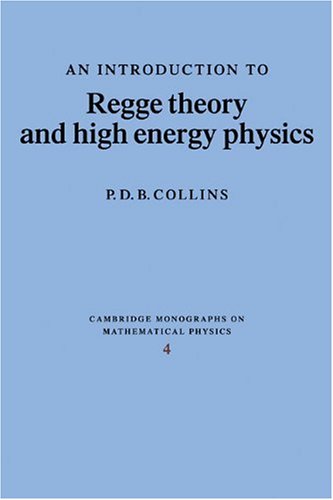
An Introduction to Regge Theory and High Energy Physics
1977 · PDF

Particle Physics and Cosmology
1989 · DJVU

Particle Physics and Cosmology
1989 · DJVU

Particle Physics and Cosmology
1989 · DJVU

MySQL® Notes for Professionals book
2018 · PDF

MrExcel 2022: Boosting Excel
2022 · PDF

MrExcel 2022: Boosting Excel
2022 · PDF