Archaeological Chemistry. Analytical Techniques and Archaeological Interpretation
Book information
Description
Content: Expanding the range of electron spin resonance dating -- Toward the classification of colorants in archaeological textiles of Eastern North America -- Infrared examination of fiber and particulate residues from archaeological textiles -- Extraction and analysis of DNA from archaeological specimens -- Using archaeological chemistry to investigate the geographic origins of trophy heads in the central Andes: strontium isotope analysis at the Wari site of Conchopata -- Interpreting stable isotopic analyses: case studies on Sardinian prehistory -- Bitumen in neolithic Iran: biomolecular and isotopic evidence -- Surface analysis of a black deposit from Little Lost River Cave, Idaho -- Shell bead sourcing: a comparison of two techniques on Olivella biplicata shells and beads from Western North America -- Archaeological soils and sediments: application of microfocus synchrotron X-ray scattering, diffraction, and fluorescence analyses in thin-section -- Quantitative modeling of soil chemical data from inductively coupled plasma-optical emission spectroscopy reveals evidence for cooking and eating in ancient Mesoamerican plazas -- Chemical composition of song dynasty, Chinese, copper-based coins via energy dispersive X-ray fluorescence -- Elemental compositions of Herodian Prutah, copper coins-of the Biblical "widow's mites" series--via energy dispersive X-ray fluorescence -- Chemical composition of the Isfiya and Qumran coin hoards -- Selected applications of laser ablation inductively coupled plasma--mass spectrometry to archaeological research -- Evaluating the precision requirements for isotope ratio determination of archaeological materials using laser ablation-time-of-flight-inductively coupled plasma-mass spectrometry increasing ratio precision -- Lead isotope analysis of Roman carthage curse tablets -- Laser ablation--inductively coupled plasma-mass spectrometry analysis of ancient copper alloy artifacts -- Laser ablation-inductively coupled plasma-mass spectrometry analysis applied to the characterization of Peruvian Wari ceramics -- Characterization of building materials from the brick chapel at historic St. Mary's city -- Characterization of 15th-16th century Majolica pottery found on the Canary Islands -- Intraregional provenancing of Philistine pottery from Israel -- The technology of Mesopotamian ceramic glazes -- Analysis of historic latter-day Saint pottery glazes by laser ablation-inductively coupled plasma-mass spectrometry -- Fingerprinting specular Hematite from mines in Botswana, Southern Africa -- Instrumental neutron activation analysis of Ochre artifacts from Jiskairumoko, Peru -- Feasibility of field-portable XRF to identify obsidian sources in Central Peten, Guatemala -- Sources of archaeological obsidian in Peru: descriptions and geochemistry.
Similar books

Archaeological Chemistry: Analytical Techniques and Archaeological Interpretation
2007 · DJVU

Archaelogical Chemistry: Analytical Techniques and Archaeological Interpretation
2007 · PDF

Methodological Issues for Characterisation and Provenance Studies of Obsidian in Northeast Asia
2014 · PDF

Intra-Site Obsidian Distribution and Consumption Patterns in Northern Belize and the North-Eastern Peten
2012 · PDF

Crossing the Straits: Prehistoric Obsidian Source Exploitation in the North Pacific Rim
2010 · PDF
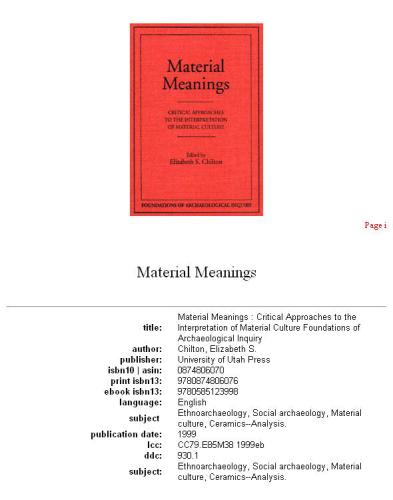
Material Meanings: Critical Approaches to the Interpretation of Mat (Foundations of Archaeological Inquiry)
1999 · EPUB

MySQL® Notes for Professionals book
2018 · PDF

MrExcel 2022: Boosting Excel
2022 · PDF