Heresy And Citizenship: Persecution Of Heresy In Late Medieval German Cities
Book information
Description
Heresy and Citizenship examines the anti-heretical campaigns in late-medieval Augsburg, Rothenburg ob der Tauber, Strasbourg, and other cities. By focusing on the unprecedented period of persecution between 1390 and 1404, this study demonstrates how heretical presence in cities was exploited in ecclesiastical, political, and social conflicts between the cities and their external rivals, and between urban elites. These anti-heretical campaigns targeted Waldensians who believed in lay preaching and simplified forms of Christian worship. Groups of individuals identified as Waldensians underwent public penance, execution, or expulsion. In each case, the course and outcome of inquisitions reveal tensions between institutions within each city, most often between city councils and local bishops or archbishops. In such cases, competing sides used the persecution of heresy to assert their authority over others. As a result, persecution of urban Waldensians acquired meaning beyond mere correction of religious error. By placing the anti-heretical campaigns of this period in their socio-political and religious context, Heresy and Citizenship also engages with studies of social and political conflict in late medieval towns. It examines the role the exclusion of religiously and socially deviant groups played in the development of urban governments, and the rise of ideologies of good citizenship and the common good. It will be of interest to scholars and students interested in medieval urban and religious history, and the history of heresy and its persecution. Cover......Page 1 Half Title......Page 2 Series Page......Page 3 Title Page......Page 4 Copyright Page......Page 5 Contents......Page 6 List of figures......Page 7 Acknowledgements......Page 8 On names......Page 9 List of abbreviations......Page 10 Introduction......Page 14 1 Culture and society in late medieval German cities......Page 28 2 Persecution of German Waldensians, 1390–1404......Page 49 3 Inquisition, violence, and urban order in Augsburg......Page 78 4 Elite identity, urban competition, and inquisition in Rothenburg ob der Tauber......Page 99 5 “Shame and dishonor”: municipal authority and persecution of heresy......Page 124 6 Communication, resistance, and recovery......Page 152 Epilogue......Page 173 Bibliography......Page 180 Index......Page 194
Similar books

Medievalisms and Russia: The Contest for Imaginary Pasts (Arc Medievalist)
2024 · PDF
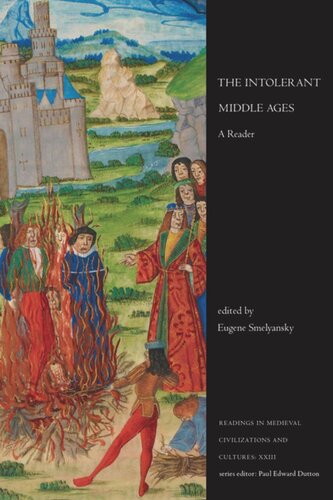
The Intolerant Middle Ages: A Reader
2020 · PDF

The Intolerant Middle Ages: A Reader
2020 · PDF

MySQL® Notes for Professionals book
2018 · PDF

MrExcel 2022: Boosting Excel
2022 · PDF

MrExcel 2022: Boosting Excel
2022 · PDF

Session C11: Ancient Cultural Landscapes in South Europe – their Ecological Setting and Evolution, Session C22: Gardeners from South America, Session S04: Agro-Pastoralism and Early Metallurgy Sessions, Session WS29: The Idea of Enclosure in Recent Iberian Prehistory, Session C88: Rhytmes et causalites des dynamiques de l'anthropisation en Europe entre 6500 ET 500 BC: Hypotheses socio-culturelles et/ou climatiques: Proceedings of the XV UISPP World Congress (Lisbon 4-9 September 2006) / Actes du XV Congrès Mondial (Lisbonne 4-9 Septembre 2006) Vol.36
2010 · PDF

THE BRITISH ARMY IN INDIA: ITS PRESERVATION BY AN APPROPRIATE CLOTHING, HOUSING, LOCATING, RECREATIVE EMPLOYMENT, AND HOPEFUL ENCOURAGEMENT OF THE TROOPS. with AN APPENDIX ON INDIA : THE CLIMATE OP ITS HILLS ; THE DEVELOPMENT OF ITS RESODRCBS, INDUSTRY, AND ARTS ; THE ADMINISTRATION OF JUSTICE ; THE BLACK ACT ; THE PROGRESS OF CHRISTIANITY ; THE TRAFFIC IN OPIUM ; THE VALUE OF INDIA ; PERMANENT CAUSES OF DISAFFECTION, AND OF THE RECENT REBELLION ; THE TRADITIONARY POLICY; MISGOVERNMENT BY NATIVE RULERS ; ANNEXATIONS OF THEIR TERRITORY, ETC.
1858 · PDF