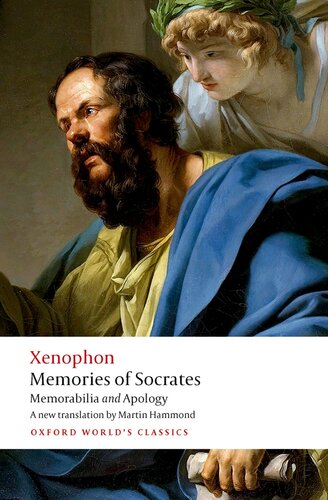
Memories of Socrates: Memorabilia and Apology
Book information
Description
'Who would you say knows himself?' In 399 BCE Socrates was tried in Athens on charges of irreligion and corruption of the young, convicted, and sentenced to death. Like Plato, an almost exact contemporary, in his youth Xenophon (c. 430-c. 354 BCE) was one of the circle of mainly upper-class young Athenians attracted to Socrates' teaching. His Memorabilia is both a passionate defence of Socrates against those charges, and a kaleidoscopic picture of the man he knew, painted in a series of mini-dialogues and shorter vignettes, with a varied and deftly characterized cast--entitled and ambitious young men, atheists and hedonists, artists and artisans, Socrates' own stroppy teenage son Lamprocles, the glamorous courtesan Theodote. Topics given Socrates' characteristic questioning treatment include education, law, justice, government, political and military leadership, democracy and tyranny, friendship, care of the body and the soul, and concepts of the divine. Xenophon sees Socrates as above all a supreme moral educator, coaxing and challenging his associates to make themselves better people, not least by the example of how he lived his own life. Self-knowledge, leading to a reasoned self-control, was for Socrates the essential first step on the path to virtue, and some found it uncomfortable. The Apology is a moving account of Socrates' behaviour and bearing in his last days, immediately before, during, and after his trial.
Similar books
Memories of Socrates: Memorabilia and Apology
2023 · EPUB

The history of the church, from Our Lord's incarnation, to the twelfth year of the Emperor Mauricius Tiberius, or the year of Christ 594 As it was written in Greek by Eusebius Pamphilus, Bishop of Caesarea in Palestine; Socrates Scholasticus, Native of Constantinople; and Evagrius Scholasticus Born at Epiphania in Syria Secunda. Made English from that edition of these Historians, which Valesius published at Paris in the Years 1659, 1668, and 1673. Also, the Life of Constantine in four books, written by Eusebius Pamphilus; with Constantine's Oration to the Convention of the Saints, and Eusebius's Speech in Praise of Constantine, spoken at his Tricennalia. Valesius's Annotations on these Authors are done into English, and set at their proper Places in the Margin; as likewise a Translation of His Account of their Lives and Writings. With Two indexes; the One, of the Principal Matters that occur in the Text; the Other, of those contained in the Notes
AZW3

The Emergence of the Chief Data Officer: And a Look Into Analytics (Harness the Power of Data within Your Marketing Strategy Book 1)
2015 · AZW3

Focus Factor: How to Use Your Mental Power
2017 · AZW3

KEYBOARD SHORTCUTS FOR EFFICIENT INTERNET SURFING
2016 · AZW3

Instagram Secrets 2017: Make Money Longterm with Instagram Branding: The #1 Formula to Making a Steady Income with Instagram
2017 · AZW3

The "I Love My Instant Pot®" Free Holiday Menu: From Maple Dill Carrots and Spiced Applesauce to Cherry-Rosemary Pork Tenderloin and Festive Fruitcake, ... Dishes--Made Easy! ("I Love My" Series)
2017 · AZW3

How to SAP® EWM - Putaway Strategy Basics
2017 · AZW3