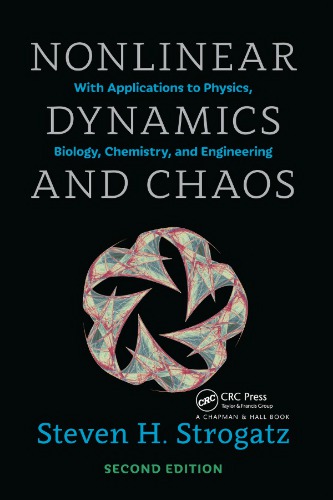
Nonlinear Dynamics and Chaos: With Applications to Physics, Biology, Chemistry, and Engineering
Book information
Description
This textbook is aimed at newcomers to nonlinear dynamics and chaos, especially students taking a first course in the subject. The presentation stresses analytical methods, concrete examples, and geometric intuition. The theory is developed systematically, starting with first-order differential equations and their bifurcations, followed by phase plane analysis, limit cycles and their bifurcations, and culminating with the Lorenz equations, chaos, iterated maps, period doubling, renormalization, fractals, and strange attractors. A unique feature of the book is its emphasis on applications. These include mechanical vibrations, lasers, biological rhythms, superconducting circuits, insect outbreaks, chemical oscillators, genetic control systems, chaotic waterwheels, and even a technique for using chaos to send secret messages. In each case, the scientific background is explained at an elementary level and closely integrated with mathematical theory. In the twenty years since the first edition of this book appeared, the ideas and techniques of nonlinear dynamics and chaos have found application to such exciting new fields as systems biology, evolutionary game theory, and sociophysics. This second edition includes new exercises on these cutting-edge developments, on topics as varied as the curiosities of visual perception and the tumultuous love dynamics inGone With the Wind. Content: Cover Half Title Title Copyright CONTENTS Preface to the Second Edition Preface to the First Edition 1 Overview 1.0 Chaos, Fractals, and Dynamics 1.1 Capsule History of Dynamics 1.2 The Importance of Being Nonlinear 1.3 A Dynamical View of the World Part I One-Dimensional Flows 2 Flows on the Line 2.0 Introduction 2.1 A Geometric Way of Thinking 2.2 Fixed Points and Stability 2.3 Population Growth 2.4 Linear Stability Analysis 2.5 Existence and Uniqueness 2.6 Impossibility of Oscillations 2.7 Potentials 2.8 Solving Equations on the Computer Exercises for Chapter 2 3 Bifurcations3.0 Introduction 3.1 Saddle-Node Bifurcation 3.2 Transcritical Bifurcation 3.3 Laser Threshold 3.4 Pitchfork Bifurcation 3.5 Overdamped Bead on a Rotating Hoop 3.6 Imperfect Bifurcations and Catastrophes 3.7 Insect Outbreak Exercises for Chapter 3 4 Flows on the Circle 4.0 Introduction 4.1 Examples and Definitions 4.2 Uniform Oscillator 4.3 Nonuniform Oscillator 4.4 Overdamped Pendulum 4.5 Fireflies 4.6 Superconducting Josephson Junctions Exercises for Chapter 4 Part II Two-Dimensional Flows 5 Linear Systems 5.0 Introduction 5.1 Definitions and Examples 5.2 Classification of Linear Systems5.3 Love Affairs Exercises for Chapter 5 6 Phase Plane 6.0 Introduction 6.1 Phase Portraits 6.2 Existence, Uniqueness, and Topological Consequences 6.3 Fixed Points and Linearization 6.4 Rabbits versus Sheep 6.5 Conservative Systems 6.6 Reversible Systems 6.7 Pendulum 6.8 Index Theory Exercises for Chapter 6 7 Limit Cycles 7.0 Introduction 7.1 Examples 7.2 Ruling Out Closed Orbits 7.3 Poincaré−Bendixson Theorem 7.4 Liénard Systems 7.5 Relaxation Oscillations 7.6 Weakly Nonlinear Oscillators Exercises for Chapter 7 8 Bifurcations Revisited8.0 Introduction 8.1 Saddle-Node, Transcritical, and Pitchfork Bifurcations 8.2 Hopf Bifurcations 8.3 Oscillating Chemical Reactions 8.4 Global Bifurcations of Cycles 8.5 Hysteresis in the Driven Pendulum and Josephson Junction 8.6 Coupled Oscillators and Quasiperiodicity 8.7 Poincaré Maps Exercises for Chapter 8 Part III Chaos 9 Lorenz Equations 9.0 Introduction 9.1 A Chaotic Waterwheel 9.2 Simple Properties of the Lorenz Equations 9.3 Chaos on a Strange Attractor 9.4 Lorenz Map 9.5 Exploring Parameter Space 9.6 Using Chaos to Send Secret Messages Exercises for Chapter 910 One-Dimensional Maps 10.0 Introduction 10.1 Fixed Points and Cobwebs 10.2 Logistic Map: Numerics 10.3 Logistic Map: Analysis 10.4 Periodic Windows 10.5 Liapunov Exponent 10.6 Universality and Experiments 10.7 Renormalization Exercises for Chapter 10 11 Fractals 11.0 Introduction 11.1 Countable and Uncountable Sets 11.2 Cantor Set 11.3 Dimension of Self-Similar Fractals 11.4 Box Dimension 11.5 Pointwise and Correlation Dimensions Exercises for Chapter 11 12 Strange Attractors 12.0 Introduction 12.1 The Simplest Examples 12.2 Hénon Map
Similar books

Nonlinear Dynamics and Chaos - With Applications to Physics, Biology, Chemistry, and Engineering

Nonlinear Dynamics and Chaos: With Applications to Physics, Biology, Chemistry, and Engineering
2015 · PDF

Student Solutions Manual for Non Linear Dynamics and Chaos: With Applications to Physics, Biology, Chemistry, and Engineering
2024 · PDF

Nonlinear Dynamics and Chaos
2024 · PDF

Nonlinear Dynamics and Chaos - With Applications to Physics, Biology, Chemistry, and Engineering
2024 · DJVU

Infinite Powers: How Calculus Reveals the Secrets of the Universe
2019 · PDF
Nonlinear Dynamics and Chaos: With Applications to Physics, Biology, Chemistry, and Engineering
Nonlinear Dynamics and Chaos
2015 · DJVU