The Statehood of Palestine: International Law in the Middle East Conflict
Book information
Description
Palestine as a territorial entity has experienced a curious history. Until World War I, Palestine was part of the sprawling Ottoman Empire. After the war, Palestine came under the administration of Great Britain by an arrangement with the League of Nations. In 1948 Israel established itself in part of Palestine's territory, and Egypt and Jordan assumed administration of the remainder. By 1967 Israel took control of the sectors administered by Egypt and Jordan and by 1988 Palestine reasserted itself as a state. Recent years saw the international community acknowledging Palestinian statehood as it promotes the goal of two independent states, Israel and Palestine, co-existing peacefully. This book draws on evidence from the 1924 League of Nations mandate to suggest that Palestine was constituted as a state at that time. Palestine remained a state after 1948, even as its territory underwent permutation, and this book provides a detailed account of how Palestine has been recognized until the present day. John Quigley is the President Club Professor in Law at the Moritz College of Law at the Ohio State University. After earning his AB, LL.B. and MA degrees at Harvard University, he was a research associate at Harvard Law School. He has written extensively in international law, in particular on the Arab-Israeli conflict.
Similar books

The Case for Palestine: An International Law Perspective
2005 · PDF

The Case for Palestine: An International Law Perspective
2005 · PDF
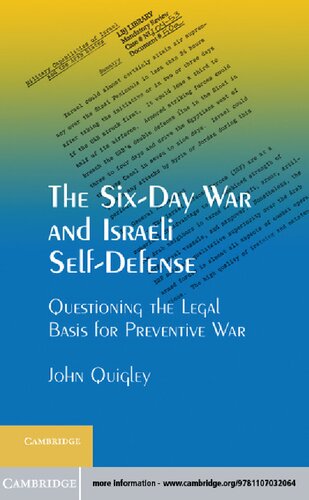
The Six-Day War and Israeli Self-Defense: Questioning the Legal Basis for Preventive War
2012 · PDF

Palestine and Israel: A Challenge to Justice
1990 · PDF

The International Diplomacy of Israel’s Founders: Deception at the United Nations in the Quest for Palestine
2016 · PDF

The Law of Consular Access: A Documentary Guide
2009 · PDF

The Case for Palestine: An International Law Perspective, 2nd edition
2005 · PDF

Advances in Mathematical Modeling for Reliability
2008 · PDF