Anxiety and Neurosis
Book information
Description
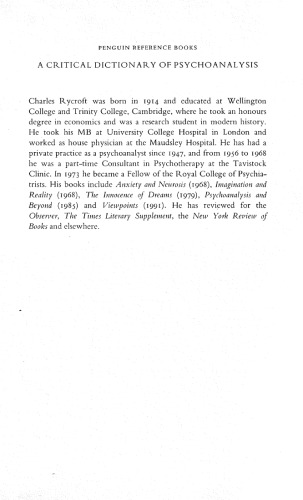
Anxiety may be debilitating or stimulating; it can result in neurotic symptoms or in improved, heightened performance in an actor or athlete. It is something every human being has experienced.As Professor G. M. Carstairs points out in his Foreword:"During the course of the twentieth century we have found it progressively easier to concede that we are all to often swayed by emotion rather than reasonWe have come to recognize the symptoms of neurotically ill patients are only an exaggeration of experiences common to us all, and hence that the unraveling of the psychodynamics of neurosis can teach us more about ourselves."Although Charles Rycroft is also a psychoanalyst, it is as a biologist that he has made this study of anxiety, the three basic responses to it--attack, flight or submission--and the obsessional, phobic and schizoid and hysterical defenses. Written in precise but everyday language, Anxiety and Neurosis is based on adult experiences rather than the speculative theories of infantile instinctual development. Its clarity and authority can only add to Dr Rycroft's established international reputation.
Similar books

Psychoanalysis and Beyond
1985 · PDF

Psikanaliz Sözlüğü
1989 · PDF

Imagination and Reality: Psychoanalytical Essays 1951-1961
1987 · PDF
A Critical Dictionary of Psychoanalysis, Second Edition
1995 · PDF

MySQL® Notes for Professionals book
2018 · PDF

MrExcel 2022: Boosting Excel
2022 · PDF

MrExcel 2022: Boosting Excel
2022 · PDF

Session C11: Ancient Cultural Landscapes in South Europe – their Ecological Setting and Evolution, Session C22: Gardeners from South America, Session S04: Agro-Pastoralism and Early Metallurgy Sessions, Session WS29: The Idea of Enclosure in Recent Iberian Prehistory, Session C88: Rhytmes et causalites des dynamiques de l'anthropisation en Europe entre 6500 ET 500 BC: Hypotheses socio-culturelles et/ou climatiques: Proceedings of the XV UISPP World Congress (Lisbon 4-9 September 2006) / Actes du XV Congrès Mondial (Lisbonne 4-9 Septembre 2006) Vol.36
2010 · PDF