Compendium iuris publici ecclesiastici (editio quarta)
Book information
Description
cited in [*Integralism*](https://isidore.co/calibre#panel=book_details&book_id=7822)[tripartite division of temporal authority](https://isidore.co/forum/index.php?topic=261.msg728#msg728):> [*Integralism*](https://isidore.co/calibre#panel=book_details&book_id=7822) ch. 5, § "Division of temporal authority":> 65 This tripartite division is often attributed to Baron de Montesquieu (1689-1755). In fact it is equivalently found in Aristotle’s [*Politics*](https://isidore.co/calibre/#panel=book_details&book_id=7645) IV. 14: “There are, then, three parts in all constitutions (εστι δη τρία μόρια τών πολιτειών πασών). […] Of these three, one is that which deliberates about common matters (το βουλευόμενον περί τών κοινών); the second concerns the offices (δεύτερον δε το περί τάς άρχάς), what they should be and over what matters they should have authority, and what the manner of choosing them must be; the third is the judiciary (τρίτον δέ τί το δικάζον).” This passage states in effect that a constitution (this appears to be the best translation on this occasion of πολιτεία) must provide for a legislature, a functioning executive and a judicial power. > > 66 A. Ottaviani defines it [ **legislative power** ] as the ‘right of determining in an obligatory manner the things which are necessary and useful for attaining the end of the society’ [ *ius proponendi obligatorio iodo quae necessaria et utilia sunt ad finem societatis assequendum* ]; [*Compendium Iuris Publici Ecclesiastici*](https://isidore.co/calibre/#panel=book_details&book_id=8004), 4th edition (Rome: Vatican Press, 1954), 43 [PDF p. 25]. > > 67 A. Ottaviani defines it [ **judicial power** ] as ‘the right of declaring and proposing in an obligatory manner which concrete acts of subjects are conformed or contrary to right, and the legitimate effects of this conformity or contrariety’ [ *ius declarandi seu proponendi modo obligatorio, quænam subditorum actiones in concreto sint iuri conformes, quaeque eidem difformes, et effectus legitimos eiusdem, conformitatis aut difformitatis* ]; [*Compendium*](https://isidore.co/calibre/#panel=book_details&book_id=8004), 49 [PDF p. 28].> 68 Or as the [ **executive power** ] "right of enforcing the application of laws and sentences, of directing persons or of disposing of things, and of removing all obstacles which impede the full possession of the social end" [ *ius urgendi legum sententiarum que applications, dirigendo personas vel disponendi de rebus, atque removendo ommia obstacula quæ finis socialis plenam, assecutionem impediunt* ]; [*ibid.*](https://), 61. The executive power itself may be divided into a power of governance, in regard to persons, and of administration, in regard to things. The power of coercion, which is sometimes mentioned as a third part of the executive power, is therefore rather an aspect of the power of governance.Christ the King has all three of these powers: Pius XI, [*Quas primas*](https://www.vatican.va/content/pius-xi/en/encyclicals/documents/hf_p-xi_enc_11121925_quas-primas.html) §14 Pope Gelasius's letter [*Duo sunt*](https://christianity.stackexchange.com/a/87361/1787) ([Latin](http://www.monarchieliga.de/index.php?title=Famuli_vestrae_pietatis), [English](https://sourcebooks.fordham.edu/source/gelasius1.asp)) cited on p. 112 (PDF p. 60):Duo sunt quippe, imperator auguste, quibus principaliter mundus hic regitur, auctoritas sacrata pontificium et regalis potestas, in quibus tanto gravius pondus est sacerdotum, quanto etiam pro ipsis regibus hominum in divino reddituri sunt examine rationem. Nosti etenim, fili clementissime, quoniam licet præsideas humano generi dignitate, rerum tamen præsulibus divinarum devotus colla submittis atque ab eis causas tuæ salutis expetis, inque sumendis cælestibus sacramentis eisque, ut competit, disponendis subdi te debere cognoscis religionis ordine potius quam præesse. Nosti itaque inter hæc ex illorum te pendere iudicio, non illos ad tuam velle redigi voluntatem. | There are two powers, august Emperor, by which this world is chiefly ruled, namely, the sacred authority of the priests and the royal power. Of these that of the priests is the more weighty, since they have to render an account for even the kings of men in the divine judgment. You are also aware, dear son, that while you are permitted honorably to rule over human kind, yet in things divine you bow your head humbly before the leaders of the clergy and await from their hands the means of your salvation. In the reception and proper disposition of the heavenly mysteries you recognize that you should be subordinate rather than superior to the religious order, and that in these matters you depend on their judgment rather than wish to force them to follow your will. ---|---
Similar books
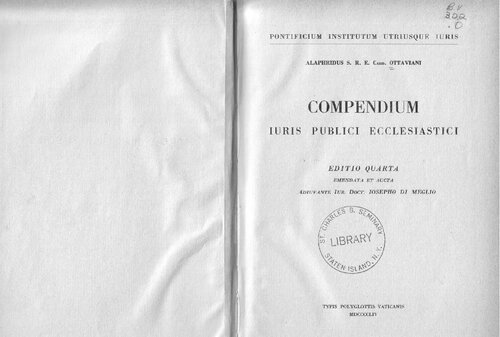
Compendium iuris publici ecclesiastici (editio quarta)
1954 · PDF

The Ottaviani Intervention: A Brief Critical Study of the New Order of Mass
1969 · MOBI

The Ottaviani Intervention: A Brief Critical Study of the New Order of Mass
1969 · EPUB

Direct interaction approximation, the statistically stationary problem

De immortalitate animae quaestio authenticitate dubia

Sermo Puer Jesus

Sermo Exiit qui seminat
