The Hilbert-Huang transform and its applications
Book information
Description
The Hilbert–Huang Transform (HHT) represents a desperate attempt to break the suffocating hold on the field of data analysis by the twin assumptions of linearity and stationarity. Unlike spectrograms, wavelet analysis, or the Wigner–Ville Distribution, HHT is truly a time-frequency analysis, but it does not require an a priori functional basis and, therefore, the convolution computation of frequency. The method provides a magnifying glass to examine the data, and also offers a different view of data from nonlinear processes, with the results no longer shackled by spurious harmonics — the artifacts of imposing a linearity property on a nonlinear system or of limiting by the uncertainty principle, and a consequence of Fourier transform pairs in data analysis. This is the first HHT book containing papers covering a wide variety of interests. The chapters are divided into mathematical aspects and applications, with the applications further grouped into geophysics, structural safety and visualization.
Similar books

The Hilbert-Huang Transform and Its Applications (Interdisciplinary Mathematical Sciences)
2005 · DJVU
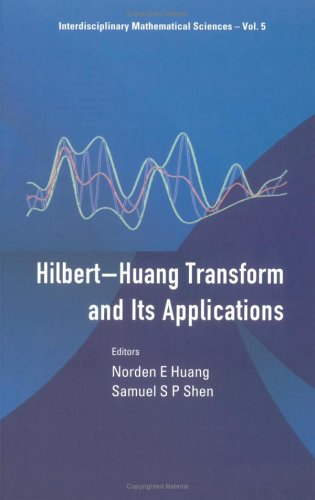
The Hilbert-Huang transform and its applications
2005 · DJVU

The Hilbert-Huang Transform in Engineering
2005 · PDF

The Hilbert-Huang Transform in Engineering
2005 · PDF

MySQL® Notes for Professionals book
2018 · PDF

MrExcel 2022: Boosting Excel
2022 · PDF

MrExcel 2022: Boosting Excel
2022 · PDF

Session C11: Ancient Cultural Landscapes in South Europe – their Ecological Setting and Evolution, Session C22: Gardeners from South America, Session S04: Agro-Pastoralism and Early Metallurgy Sessions, Session WS29: The Idea of Enclosure in Recent Iberian Prehistory, Session C88: Rhytmes et causalites des dynamiques de l'anthropisation en Europe entre 6500 ET 500 BC: Hypotheses socio-culturelles et/ou climatiques: Proceedings of the XV UISPP World Congress (Lisbon 4-9 September 2006) / Actes du XV Congrès Mondial (Lisbonne 4-9 Septembre 2006) Vol.36
2010 · PDF