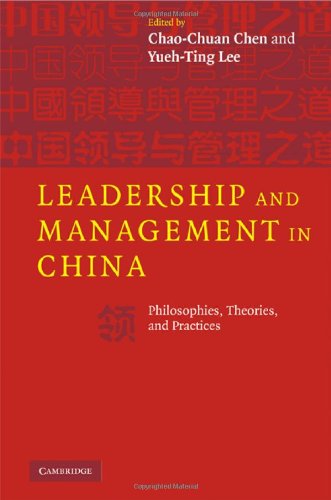
Leadership and Management in China: Philosophies, Theories, and Practices
Book information
Description
This book is a joint work of leading scholars in the field of Chinese management to introduce, explain, and theorise on Chinese leadership theories and practices from the ancients to the present.
This book consists of three main parts: Part 1 introduces foundations of leadership theories and practices in Ancient China. Confucianism has been becoming the most prevalent philosophy which influences people in every aspect of life. It believes in human goodness and leaders are required to be benevolent towards their followers. Followers should sacrifice their individual's self-interest and be loyal and obedient to their leaders. Part 2 of this book presents alternative ancient philosophical approaches to leadership including Daoism, Legalism, and Sunzi's strategic leadership. In Doaism, the best leadership qualities are wateristic: modest, flexible, clear, soft, yet powerful. Legalism refutes the proposition of human goodness and emphasises that all human behaviours are motivated by a ruthless pursuit of self-interest. Akin to western ideas of bureaucracy, legalism claims that an effective leader should possess three key components including power (shih), law (fa), and management techniques(shu). Sunzi's strategic leadership values humanism, benevolence, and righteousness. A successful leader should comprehend and appreciate the power of a situation and rise above the situation by leveraging and adapting to the environment. Part 3 of the book introduces modern Chinese leadership theories and practices. Partnalistic leadership is rooted in Confucian tradition that is prevalent in family businesses in Taiwan, Hong Kong, Singapore, and other overseas Chinese societies. In mainland China, Mao's "seek truth from fact" and Deng's pragmatism have added new ingredient into philosophy of leadership in the Chinese world. Part 3 also includes an empirical study of 38 senior executives in China and the scholarly research findings reveal that traditional Chinese leadership philosophies has a significant impact on their people management practices but western management theories have impact on their task-related operations.
This book is a great contribution to the study of leadership and management in China. First, this book is the first and most comprehensive one which provides rich intellectual resources for studying Chinese leadership theories and practices from the ancients to the present. Second, this book can help western executives who need to manage their businesses in China to understand the emergence of new and rich varieties of leadership theories and practices in the contemporary Chinese world at a deep level.
I highly recommended this book to western executives who intend to have full understanding of Chinese leadership and management.
Similar books

Leadership and Management in China: Philosophies, Theories, and Practices
2008 · PDF
Leadership and Management in China: Philosophies, Theories, and Practices
2008 · PDF

Stereotype Accuracy: Toward Appreciating Group Differences
1995 · PDF

MySQL® Notes for Professionals book
2018 · PDF

MrExcel 2022: Boosting Excel
2022 · PDF

MrExcel 2022: Boosting Excel
2022 · PDF

Session C11: Ancient Cultural Landscapes in South Europe – their Ecological Setting and Evolution, Session C22: Gardeners from South America, Session S04: Agro-Pastoralism and Early Metallurgy Sessions, Session WS29: The Idea of Enclosure in Recent Iberian Prehistory, Session C88: Rhytmes et causalites des dynamiques de l'anthropisation en Europe entre 6500 ET 500 BC: Hypotheses socio-culturelles et/ou climatiques: Proceedings of the XV UISPP World Congress (Lisbon 4-9 September 2006) / Actes du XV Congrès Mondial (Lisbonne 4-9 Septembre 2006) Vol.36
2010 · PDF

THE BRITISH ARMY IN INDIA: ITS PRESERVATION BY AN APPROPRIATE CLOTHING, HOUSING, LOCATING, RECREATIVE EMPLOYMENT, AND HOPEFUL ENCOURAGEMENT OF THE TROOPS. with AN APPENDIX ON INDIA : THE CLIMATE OP ITS HILLS ; THE DEVELOPMENT OF ITS RESODRCBS, INDUSTRY, AND ARTS ; THE ADMINISTRATION OF JUSTICE ; THE BLACK ACT ; THE PROGRESS OF CHRISTIANITY ; THE TRAFFIC IN OPIUM ; THE VALUE OF INDIA ; PERMANENT CAUSES OF DISAFFECTION, AND OF THE RECENT REBELLION ; THE TRADITIONARY POLICY; MISGOVERNMENT BY NATIVE RULERS ; ANNEXATIONS OF THEIR TERRITORY, ETC.
1858 · PDF