Coordination, Organizations, Institutions, Norms, and Ethics for Governance of Multi-Agent Systems XIV. International Workshop, COINE 2021 London, UK, May 3, 2021 Revised Selected Papers
Book information
Description
Preface Organization Contents Invited Speaker Machine Ethics - Is It Just Normative Multi-agent Systems? 1 Introduction 2 Who's a Good Device? 3 Normative Conflicts and Moral Dilemmas 4 Conclusions References Conceptual Frameworks Architectures for Collaboration and Coordination A Framework for Automatic Monitoring of Norms that Regulate Time Constrained Actions 1 Introduction 2 Design Goals 3 The T-NORM Model of Norms 3.1 Expressive Power of the Model 3.2 The Model of Exceptions 4 Operational Semantics of the Model 5 Architecture of the Framework and Its Implementation 6 Related Work References Collaborative Human-Agent Planning for Resilience 1 Introduction 2 Related Work 2.1 Human-Agent Collaborative Planning 2.2 Encoding Domain-Control Knowledge in Planning 3 Model of Collaborative Planning for Resilience 3.1 Resilient Planning 3.2 Human-Agent Collaborative Planning for Resilient Planning 3.3 Resilient Planning Using Temporal Constraints 4 Evaluation 4.1 Domain 4.2 Protocol 4.3 Procedure 4.4 Assessing Plans 5 Results 5.1 Automated Plans Encoded as LTL 5.2 Comparison of Manual and Automated Plans 5.3 Control vs. Declarative Preferences 6 Conclusions References Environmental Consequences of Institutional Facts in Artificial Institutions 1 Introduction 2 Background 2.1 Philosophical Background on Institutions 2.2 Institutions in MAS 3 The Purpose of Status-Functions 3.1 Ontology of the Model 4 Implementing a MAS with and Without Purpose 4.1 Limitations of a MAS Without a Purpose Model—Agent Perspective 4.2 Advantages of Purpose—Agent Perspective 4.3 Limitations of a MAS Without Purpose—Institution Perspective 4.4 Advantages of Purpose—Institution Perspective 5 Results and Discussions References Noe: Norm Emergence and Robustness Based on Emotions in Multiagent Systems 1 Introduction 2 Related Works 3 Noe 3.1 Architecture 3.2 Norm Formal Model 3.3 Decision-Making 4 Evaluation 4.1 Line-Up Environment 4.2 Agent Types 4.3 Hypotheses and Metrics 4.4 Experimental Setup 4.5 Experimental Results 5 Discussion and Conclusion References Run-Time Norms Synthesis in Multi-objective Multi-agent Systems 1 Introduction 2 Related Work 2.1 Intelligent Robust On-line Norm Synthesis Machine (IRON) 3 Problem Statement 4 UNS: Utility-Based Norm Synthesis Model 4.1 Conflicts Detection 4.2 Norms Synthesising 4.3 Norms Reasoning 4.4 Norms Evaluation and Refinement 5 Empirical Evaluation 5.1 Empirical Settings 5.2 Experiment Results 5.3 Scenario A (Violation Rate 10%) 5.4 Scenario B (Violation Rate 70%) 5.5 Scenario C (Violation Rate 0%) 6 Conclusion and Future Work References Modeling and Understanding Social Behavior Using COINE Technologies A Bayesian Model of Information Cascades 1 Introduction 2 Prior Work 3 The Information Cascade Model of Bikhchandani et al. 4 Our Model and Approach 5 Experiment and Results 5.1 Deterministic Model 5.2 Non-deterministic Model 6 Conclusion References Interactions Between Social Norms and Incentive Mechanisms in Organizations 1 Introduction 2 Related Work 3 Model 3.1 Task Environment 3.2 Agents' Performance-Based Incentives 3.3 Social Norms 3.4 Discovering New Solutions to the Decision Problem 3.5 Balancing Performance-Based Incentives and Social Norms and Making a Decision 3.6 Process Overview, Scheduling and Main Parameters 4 Results 4.1 Performance Measure 4.2 Results of the Simulation Study 5 Conclusion References Learning for Detecting Norm Violation in Online Communities 1 Introduction 2 Background 2.1 Taxonomy for Action Representation 2.2 Logistic Model Tree 2.3 K-Means Clustering Method 3 Framework for Norm Violation Detection (FNVD) 4 The Wikipedia Vandalism Detection Use Case 4.1 Domain 4.2 Taxonomy Associated with Wikipedia's `No Vandalism' Norm 4.3 FNVD Applied to Wikipedia Vandalism Detection 5 Experiments and Results 5.1 Experiments 5.2 Results 6 Related Work 7 Conclusion and Future Work References Solving Social Dilemmas by Reasoning About Expectations 1 Introduction 2 The Plain-Plateau Scenario 3 Related Concepts and the CASP Platform 3.1 The Event Calculus (EC) 3.2 Expectations 3.3 The Collective Action Simulation Platform (CASP) 4 Modelling the Plain-Plateau Scenario Using CASP 5 A Norms-Based Solution for the Plain-Plateau Scenario 6 Toward a Team Reasoning Approach 7 Conclusion and Future Work References Author Index
Similar books

Declarative Agent Languages and Technologies X: 10th International Workshop, DALT 2012, Valencia, Spain, June 4, 2012, Revised Selected Papers
2013 · PDF

Coordination, Organizations, Institutions, and Norms in Agent Systems VI: COIN 2010 International Workshops, COIN@AAMAS 2010, Toronto, Canada, May 2010, COIN@MALLOW 2010, Lyon, France, August 2010, Revised Selected Papers
2011 · PDF

Declarative Agent Languages and Technologies X: 10th International Workshop, DALT 2012, Valencia, Spain, June 4, 2012, Revised Selected Papers
2013 · PDF
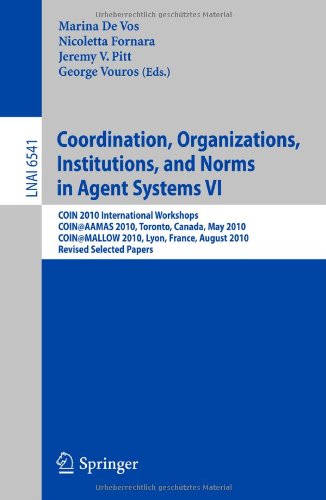
Coordination, Organizations, Institutions, and Norms in Agent Systems VI: COIN 2010 International Workshops, COIN@AAMAS 2010, Toronto, Canada, May 2010, COIN@MALLOW 2010, Lyon, France, August 2010, Revised Selected Papers
2011 · PDF

Coordination, Organizations, Institutions, and Norms in Agent Systems VI: COIN 2010 International Workshops, COIN@AAMAS 2010, Toronto, Canada, May 2010, COIN@MALLOW 2010, Lyon, France, August 2010, Revised Selected Papers
2011 · PDF

MySQL® Notes for Professionals book
2018 · PDF

MrExcel 2022: Boosting Excel
2022 · PDF

MrExcel 2022: Boosting Excel
2022 · PDF