Economies of Destruction: How the Systematic Destruction of Valuables Created Value in Bronze Age Europe, c. 2300-500 BC
Book information
Description
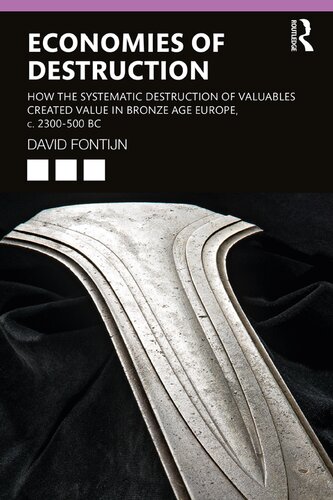
Why do people destroy objects and materials that are important to them? This book aims to make sense of this fascinating, yet puzzling social practice by focusing on a period in history in which such destructive behaviour reached unseen heights and complexity: the Bronze Age and Early Iron Age in Europe (c. 2300–500 BC). This period is often seen as the time in which a ‘familiar’ Europe took shape due to the rise of a metal-based economy. But it was also during the Bronze Age that massive amounts of scarce and recyclable metal were deliberately buried in the landscape and never taken out again. This systematic deposition of metalwork sits uneasily with our prevailing perception of the Bronze Age as the first ‘rational-economic’ period in history – and therewith – of ourselves. Taking the patterned archaeological evidence of these seemingly un-economic metalwork depositions at face value, it is shown that the ‘un-economic’ giving-up of metal valuables was an integral part of what a Bronze Age ‘economy’ was about. Based on case studies from Bronze Age Europe, this book attempts to reconcile the seemingly conflicting political and cultural approaches that are currently used to understand this pivotal period in Europe’s deep history. It seems that to achieve something in society, something else must be given up. Using theories from economic anthropology, this book argues that – paradoxically – giving up that which was valuable created value. It will be invaluable to scholars and archaeologists interested in the Bronze Age, ancient economies, and a new angle on metalwork depositions. Dedication Contents List of figures List of tables Acknowledgments Preface 1 Systematic irrationalities? The Bronze Age ‘destructive economy’ 2 Selective deposition – what does it entail and how can it be studied? 3 The value conundrum: What common things and splendid items share and why their deposition is selective 4 Pre-Bronze Age selective deposition 5 Trade hoards: The un-economic nature of the Bronze Age metal economy 6 Gifts to familiar gods? 7 The receiving landscape 8 Economies of destruction: ‘keeping-while-destroying’? Index
Similar books
Economies of Destruction: How the systematic destruction of valuables created value in Bronze Age Europe, c. 2300-500 BC
2019 · PDF

Economies of Destruction: How the systematic destruction of valuables created value in Bronze Age Europe, c. 2300-500 BC
2019 · EPUB

Beyond Barrows: Current Research on the Structuration and Perception of the Prehistoric Landscape through Monuments
2013 · PDF

MySQL® Notes for Professionals book
2018 · PDF

MrExcel 2022: Boosting Excel
2022 · PDF

MrExcel 2022: Boosting Excel
2022 · PDF

Session C11: Ancient Cultural Landscapes in South Europe – their Ecological Setting and Evolution, Session C22: Gardeners from South America, Session S04: Agro-Pastoralism and Early Metallurgy Sessions, Session WS29: The Idea of Enclosure in Recent Iberian Prehistory, Session C88: Rhytmes et causalites des dynamiques de l'anthropisation en Europe entre 6500 ET 500 BC: Hypotheses socio-culturelles et/ou climatiques: Proceedings of the XV UISPP World Congress (Lisbon 4-9 September 2006) / Actes du XV Congrès Mondial (Lisbonne 4-9 Septembre 2006) Vol.36
2010 · PDF

THE BRITISH ARMY IN INDIA: ITS PRESERVATION BY AN APPROPRIATE CLOTHING, HOUSING, LOCATING, RECREATIVE EMPLOYMENT, AND HOPEFUL ENCOURAGEMENT OF THE TROOPS. with AN APPENDIX ON INDIA : THE CLIMATE OP ITS HILLS ; THE DEVELOPMENT OF ITS RESODRCBS, INDUSTRY, AND ARTS ; THE ADMINISTRATION OF JUSTICE ; THE BLACK ACT ; THE PROGRESS OF CHRISTIANITY ; THE TRAFFIC IN OPIUM ; THE VALUE OF INDIA ; PERMANENT CAUSES OF DISAFFECTION, AND OF THE RECENT REBELLION ; THE TRADITIONARY POLICY; MISGOVERNMENT BY NATIVE RULERS ; ANNEXATIONS OF THEIR TERRITORY, ETC.
1858 · PDF