The State against Society: Political Crises and Their Aftermath in East Central Europe
Book information
Description
Classical images of state-socialism developed in contemporary social sciences were founded on simple presuppositions. State-socialist regimes were considered to be politically stable due to their pervasive institutional and ideological control over the everyday lives of their citizens, impervious to reform and change, and representative of extreme political and economic dependency. Despite their contrasting historical experiences, they have been treated as basically identical in their institutional design, social and economic structures, and policies. Grzegorz Ekiert challenges this notion in a comparative analysis of the major political crises in post-1945 East Central Europe: Hungary (1956-63), Czechoslovakia (1968-76), and Poland (1980-89). The author maintains that the nature and consequences of these crises can better explain the distinctive experiences of East Central European countries under communist rule than can the formal characteristics of their political and economic systems or their politically dependent status. He explores how political crises reshaped party-state institutions, redefined relations between party and state institutions, altered the relationship between the state and various groups and organizations within society, and modified the political practices of these regimes. He shows how these events transformed cultural categories, produced collective memories, and imposed long-lasting constraints on mass political behavior and the policy choices of ruling elites. These crises shaped the political evolution of the region, produced important cross-national differences among state-socialist regimes, and contributed to the distinctive patterns of their collapse.
Similar books

Rebellious civil society: popular protest and democratic consolidation in Poland, 1989-1993
2004 · PDF

The State against Society
1996 · DJVU
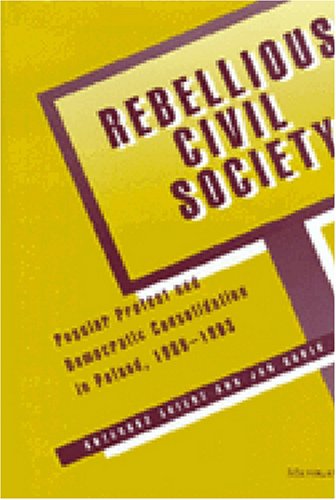
Rebellious Civil Society: Popular Protest and Democratic Consolidation in Poland, 1989-1993
2001 · PDF

Capitalism and Democracy in Central and Eastern Europe: Assessing the Legacy of Communist Rule
2003 · PDF

The State against Society
1996 · PDF

MySQL® Notes for Professionals book
2018 · PDF

MrExcel 2022: Boosting Excel
2022 · PDF

MrExcel 2022: Boosting Excel
2022 · PDF