Essential Discrete Mathematics for Computer Science
Book information
Description
A more intuitive approach to the mathematical foundation of computer science Discrete mathematics is the basis of much of computer science, from algorithms and automata theory to combinatorics and graph theory. This textbook covers the discrete mathematics that every computer science student needs to learn. Guiding students quickly through thirty-one short chapters that discuss one major topic each, this flexible book can be tailored to fit the syllabi for a variety of courses. Proven in the classroom, Essential Discrete Mathematics for Computer Science aims to teach mathematical reasoning as well as concepts and skills by stressing the art of proof. It is fully illustrated in color, and each chapter includes a concise summary as well as a set of exercises. The text requires only precalculus, and where calculus is needed, a quick summary of the basic facts is provided. Essential Discrete Mathematics for Computer Science is the ideal introductory textbook for standard undergraduate courses, and is also suitable for high school courses, distance education for adult learners, and self-study. The essential introduction to discrete mathematicsFeatures thirty-one short chapters, each suitable for a single class lessonIncludes more than 300 exercisesAlmost every formula and theorem proved in fullBreadth of content makes the book adaptable to a variety of coursesEach chapter includes a concise summarySolutions manual available to instructors Cover Contents Preface 1 The Pigeonhole Principle 2 Basic Proof Techniques 3 Proof by Mathematical Induction 4 Strong Induction 5 Sets 6 Relations and Functions 7 Countable and Uncountable Sets 8 Structural Induction 9 Propositional Logic 10 Normal Forms 11 Logic and Computers 12 Quantificational Logic 13 Directed Graphs 14 Digraphs and Relations 15 States and Invariants 16 Undirected Graphs 17 Connectivity 18 Coloring 19 Finite Automata 20 Regular Languages 21 Order Notation 22 Counting 23 Counting Subsets 24 Series 25 Recurrence Relations 26 Probability 27 Conditional Probability 28 Bayes’ Theorem 29 Random Variables and Expectation 30 Modular Arithmetic 31 Public Key Cryptography Index
Similar books
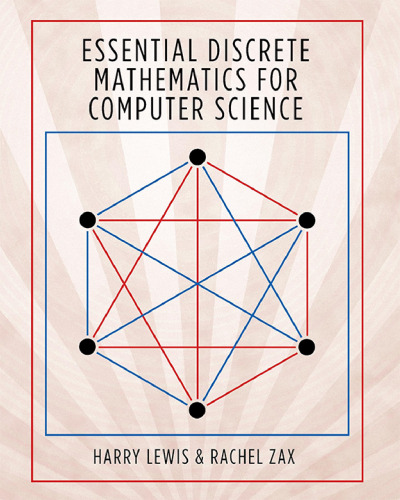
Essential Discrete Mathematics for Computer Science
2019 · PDF

Essential Discrete Mathematics for Computer Science
2019 · PDF

Essential Discrete Mathematics for Computer Science
2019 · PDF

Essential Discrete Mathematics For Computer Science

Blown To Bits: Your Life, Liberty, And Happiness After The Digital Explosion
2021 · PDF
Blown to Bits: Your Life, Liberty, and Happiness After the Digital Explosion
2020 · MOBI

Blown to Bits: Your Life, Liberty, and Happiness After the Digital Explosion
2020 · RAR

Blown to Bits: Your Life, Liberty, and Happiness After the Digital Explosion
2020 · EPUB