Lexical Semantics and Diachronic Morphology: The Development of -hood, -dom and -ship in the History of English
Book information
Description
This book is the most comprehensive study to date of the development of the three suffixes -hood, -dom and -ship in the history of English. Based on data from annotated corpora it provides an in depth investigation from Old English to Modern English and shows that structurally the three suffixes developed from syntactic heads (nouns) via morphological heads in compounds to morphological heads in derivations. Being an instance of morphologisation the rise of suffixes clearly shows that word formation is not part of the syntactic module. This development is triggered by semantic change, more precisely, by the semantics of the elements which keep their salient meanings and develop further meanings through metonymic shifts, finally leading to underspecified meanings. The findings are analysed in a revised version of Lieber's (2004) framework to account for the diachronic facts and have far-reaching consequences for morphological theory since they show that derivational suffixes bear meaning and hence contribute to processes of lexicalisation which is clear evidence for sign-based models and against, for example, Separationist assumptions. Frontmatter Table of Contents List of Tables List of Abbreviations and Acronyms 1. Introduction 2. The development of suffixes 3. Frequency, productivity and creativity 4. The data 5. -hood, -dom and -ship as rivals in word formation processes 6. A lexical-semantic analysis of word-formations with -hood, -dom and -ship 7. Theoretical consequences of morphological change 8. Conclusion Backmatter
Similar books

English Syntax in Three Dimensions: History – Synchrony – Diachrony
2015 · PDF

English Syntax in Three Dimensions: History – Synchrony – Diachrony
2015 · EPUB

English Syntax in Three Dimensions: History – Synchrony – Diachrony
2015 · PDF

From OV to VO in Early Middle English (Linguistik Aktuell Linguistics Today)
2001 · PDF

Lexical semantics and diachronic morphology: The development of -hood, -dom and -ship in the history of English (Linguistische Arbeiten)
2009 · PDF
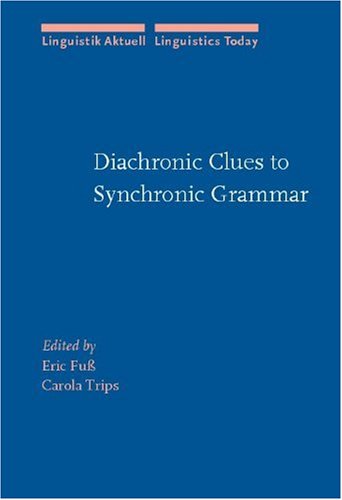
Diachronic Clues to Synchronic Grammar (Linguistik Aktuell Linguistics Today)
2004 · PDF

Diachronic Clues to Synchronic Grammar (Linguistik Aktuell Linguistics Today)
2004 · PDF

MySQL® Notes for Professionals book
2018 · PDF