Slavery, Abolitionism and Empire in India, 1772-1843
Book information
Description
There are no two things in the world more different from each other than East-Indian and West Indian-slavery. (Robert Inglis, House of Commons Debate, 1833). In Slavery, Abolitionism and Empire in India, 1772-1843, Andrea Major asks why, at a time when East India Company expansion in India, British abolitionism and the missionary movement were all at their height, was the existence of slavery in India so often ignored, denied or excused? By exploring Britain's ambivalent relationship with both real and imagined slaveries in India, and the official, evangelical and popular discourses which surrounded them, she seeks to uncover the various political, economic and ideological agendas that allowed East Indian slavery to be represented as qualitatively different from it trans-Atlantic counterpart. In doing so, she uncovers tensions in the relationship between colonial policy and the so-called civilising mission, elucidating the intricate interactions between humanitarian movements, colonial ideologies and imperial imperatives in the late eighteenth and early nineteenth century. The work draws on a range of sources from Britain and India to provide a trans-national perspective on this little known facet of the story of slavery and abolition in the British Empire, uncovering the complex ways in which Indian slavery was encountered, discussed, utilised, rationalised, and reconciled with the economic, political and moral imperatives of an empire whose focus was shifting to the East. Contents List of Illustrations Acknowledgements List of Abbreviations Glossary Some Prominent Figures in the British Parliament, the Abolitionist Movement and the East India Company Part I. Other Slaveries Introduction 1. ‘To Call a Slave a Slave’: Recovering Indian Slavery Part II. European Slaveries Introduction: Slavery and Colonial Expansion in India 2. ‘A Shameful and Ruinous Trade’: European Slave-trafficking and the East India Company 3. Bengalis, Caffrees and Malays: European Slave-holding and Early Colonial Society Part III. Indian Slaveries Introduction: Locating Indian Slaveries 4. ‘This Household Servitude’: Domestic Slavery and Immoral Commerce 5. ‘Open and Professed Stealers of Children’: Slave-trafficking and the Boundaries of the Colonial State 6. ‘Slaves of the Soil’: Caste and Agricultural Slavery in South India Part IV. Imagined Slaveries Introduction: Evangelical Connections 7. ‘Satan’s Wretched Slaves’: Indian Society and the Evangelical Imagination 8. ‘The Produce of the East by Free Men’: Indian Sugar and Indian Slavery in British Abolitionist Debates, 1793–1833 Conclusion: ‘Do Justice to India’: Abolitionists and Indian Slavery, 1839–1843 Select Bibliography Index
Similar books
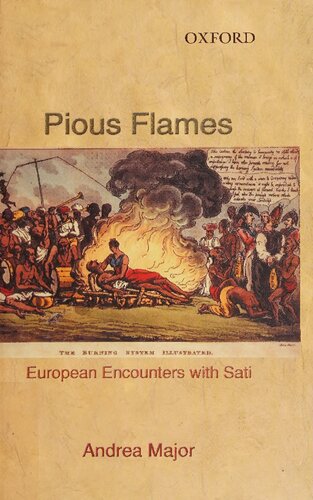
Pious Flames: European Encounters with Sati 1500-1830
2006 · PDF

Slavery, Abolitionism and Empire in India, 1772–1843
2012 · PDF

Mutiny at the Margins: New Perspectives on the Indian Uprising of 1857: Volume II: Britain and the Indian Uprising
2013 · PDF

Sovereignty and Social Reform in India: British Colonialism and the Campaign against Sati, 1830-1860
2010 · PDF

MySQL® Notes for Professionals book
2018 · PDF

MrExcel 2022: Boosting Excel
2022 · PDF

MrExcel 2022: Boosting Excel
2022 · PDF

Session C11: Ancient Cultural Landscapes in South Europe – their Ecological Setting and Evolution, Session C22: Gardeners from South America, Session S04: Agro-Pastoralism and Early Metallurgy Sessions, Session WS29: The Idea of Enclosure in Recent Iberian Prehistory, Session C88: Rhytmes et causalites des dynamiques de l'anthropisation en Europe entre 6500 ET 500 BC: Hypotheses socio-culturelles et/ou climatiques: Proceedings of the XV UISPP World Congress (Lisbon 4-9 September 2006) / Actes du XV Congrès Mondial (Lisbonne 4-9 Septembre 2006) Vol.36
2010 · PDF