Laboratories of art : alchemy and art technology from Antiquity to the 18th century
Book information
Description
This book explores the interconnections and differentiations between artisanal workshops and alchemical laboratories and between the arts and alchemy from Antiquity to the eighteenth century. In particular, it scrutinizes epistemic exchanges between producers of the arts and alchemists. In the fifteenth and sixteenth centuries the term laboratorium uniquely referred to workplaces in which chemical operations were performed: smelting, combustion, distillation, dissolution and precipitation. Artisanal workshops equipped with furnaces and fire in which chemical operations were performed were also known as laboratories. Transmutational alchemy (the transmutation of all base metals into more noble ones, especially gold) was only one aspect of alchemy in the early modern period. The practice of alchemy was also about the chemical production of things--medicines, porcelain, dyes and other products as well as precious metals and about the knowledge of how to produce them. This book uses examples such as the Uffizi to discuss how Renaissance courts established spaces where artisanal workshops and laboratories were brought together, thus facilitating the circulation of materials, people and knowledge between the worlds of craft (today s decorative arts) and alchemy. Artisans became involved in alchemical pursuits beyond a shared material culture and some crafts relied on chemical expertise offered by scholars trained as alchemists. Above all, texts and books, products and symbols of scholarly culture played an increasingly important role in artisanal workshops. Read more... Abstract: This book explores the interconnections and differentiations between artisanal workshops and alchemical laboratories and between the arts and alchemy from Antiquity to the eighteenth century. In particular, it scrutinizes epistemic exchanges between producers of the arts and alchemists. In the fifteenth and sixteenth centuries the term laboratorium uniquely referred to workplaces in which chemical operations were performed: smelting, combustion, distillation, dissolution and precipitation. Artisanal workshops equipped with furnaces and fire in which chemical operations were performed were also known as laboratories. Transmutational alchemy (the transmutation of all base metals into more noble ones, especially gold) was only one aspect of alchemy in the early modern period. The practice of alchemy was also about the chemical production of things--medicines, porcelain, dyes and other products as well as precious metals and about the knowledge of how to produce them. This book uses examples such as the Uffizi to discuss how Renaissance courts established spaces where artisanal workshops and laboratories were brought together, thus facilitating the circulation of materials, people and knowledge between the worlds of craft (today s decorative arts) and alchemy. Artisans became involved in alchemical pursuits beyond a shared material culture and some crafts relied on chemical expertise offered by scholars trained as alchemists. Above all, texts and books, products and symbols of scholarly culture played an increasingly important role in artisanal workshops Front Matter....Pages i-xxiii The Alchemical Art of Dyeing: The Fourfold Division of Alchemy and the Enochian Tradition....Pages 1-22 Transmission of Alchemical and Artistic Knowledge in German Mediaeval and Premodern Recipe Books....Pages 23-51 Artisanal Processes and Epistemological Debate in the Works of Leonardo Da Vinci and Vannoccio Biringuccio....Pages 53-78 Artificial Interventions in the Natural Form of Things: Shared Metallogenetical Concepts of Goldsmiths and Alchemists....Pages 79-103 The Laboratories of Art and Alchemy at the Uffizi Gallery in Renaissance Florence: Some Material Aspects....Pages 105-127 Material and Temporal Powers at the Casino di San Marco (1574–1621)....Pages 129-156 Goldsmiths and Chymists: The Activity of Artisans Within Alchemical Circles....Pages 157-179 Igne refutata: Thermal Analysis in the Laboratory Practices of John Dwight and Ehrenfried Walther von Tschirnhaus....Pages 181-200
Similar books

Laboratories of art : alchemy and art technology from Antiquity to the 18th century
2014 · PDF
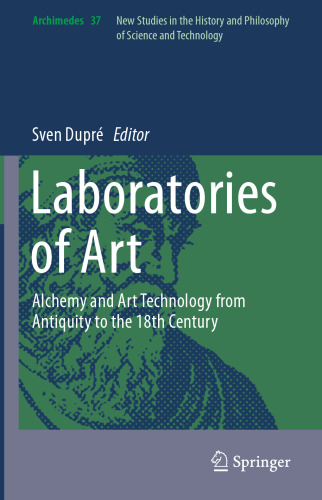
Laboratories of Art: Alchemy and Art Technology from Antiquity to the 18th Century
2014 · PDF

Fibers for Technical Textiles
2020 · PDF

A Review on Dental Materials
2020 · PDF

Durability and Sustainability of Concrete: Case Studies for Concrete exposures
2020 · PDF

Handbook of Nanocomposite Supercapacitor Materials II: Performance
2020 · PDF

Fluid-Structure Interaction of Composite Structures
2020 · PDF

Structural Modeling of Metamaterials
2021 · PDF