Amurru Akkadian: A Linguistic Study.
Book information
Description
AMURRU AKKADIAN: A LINGUISTIC STUDY PREFACE TABLE OF CONTENTS 0 Introduction 0.1 Methodology 0.2 The corpus 1 Orthography; Phonetic and Phonological Aspects 1.1 Notes on plurality designation and on the use of the plural detemtlnatives 1.2 Glosses, foreign words and the Glossenkeil 1.2.1 Glosses and foreign words 1.2.2 The Glossenkeil 1.3 The syllabic signs – a general overview 1.4 Morphographem.ic spellings 1.5 Denotation of aleph, laryngeals and hiatus 1.6 Consonantal w and y 1.7 Mimation 1.8 Representation of stop consonants 1.9 The spelling of the sibilants z-s-ṣ 1.10 Notes on the usage of the s and š signs 1.11 The š>I shift 1.12 Consonant doubling 1.13 Nasalization 1.14 Plene writing and spelling conventions for the designation of vocalic length 1.15 The vowels e and i 1.16 Notes on minor phonetic features of the surface structure 1.17 A note on vocalic endings of proper names 2 Morphology 2.1 Pronouns 2.1.1 Personal pronouns 2.1.1.1 Independent personal pronouns 2.1.1.2 Suffixed personal pronouns 2.1.2 Demonstrative pronouns 2.1.3 Interrogative pronouns 2.1.4 Indefinite pronouns 2.1.5 gabbu 2.1.6 Reflexive pronouns 2.2 Numerals 2.2.1 Cardinal numbers 2.2.2 Ordinal numbers 2.2.3 Multiplicative numbers 2.3 The noun 2.3.1 Gender 2.3.1.1 Gender in substantives 2.3.1.1.1 Masculine substantives 2.3.1.1.2 Feminine substantives 2.3.1.2 Gender in Adjectives 2.3.2 Number 2.3.2.1 Number marking in substantives 2.3.2.2 Number marking in adjectives 2.3.3 Patterning and formation 2.3.3.1 Notes on the formation and patterning of certain substantives 2.3.3.2 The participle 2.3.3.3 The stative 2.3.3.3.1 Person morphemes 2.3.3.3.2 Stem formation 2.3.3.4 Infinitives or nomina actionis 2.4 The verb 2.4.1 Person morphemes 2.4.1.1 The prefix conjugation of the indicative verb 2.4.1.2 Imperative 2.4.1.3 Precative 2.4.2 Stem patterning 2.4.2.1 The G stem 2.4.2.1.1 iparras 2.4.2.1.2 iprus 2.4.2.1.3 iptaras 2.4.2.1.4 Imperative 2.4.2.2 Gt 2.4.2.3 Gtn 2.4.2.3.1 iparras 2.4.2.3.2 iprus 2.4.2.4 The D Stem 2.4.2.4.1 iparras 2.4.2.4.2 iprus 2.4.2.4.3 iptaras 2.4.2.4.4 Imperative 2.4.2.5 Dt 2.4.2.6 Dtn 2.4.2.7 The Š Stem 2.4.2.7.1 iparras 2.4.2.7.2 iprus 2.4.2.7.3 iptaras 2.4.2.7.4 lmperative 2.4.2.7.2 iprus 2.4.2.8 Št 2.4.2.9 The N stem 2.4.2.10 Ntn 2.4.2.11 The precative formation 2.4.3 The ventive morpheme 2.4.4 Subjunctive 3 The Syntax and Semantics of Declined and Inflected Forms 3.1 Pronouns 3.1.1 Personal pronouns 3.1.1.1 Independent personal pronouns 3.1.1.2 Pronominal suffixes 3.1.1.2.1 1 sg genitive 3.1.1.2.2 The paradigm of the pronominal suffixes 3.1.2 Demonstrative pronouns 3.1.3 Interrogative pronouns 3 .1.4 Indefinite pronouns 3.1.5 gabbu 3.2 Nunierals 3 .2.1 Cardinal numbers 3.2.2 Ordinal numbers 3.2.3 Multiplicative numbers 3.3 The noun 3.3.1 States 3.3.1.1 Status rectus 3.3.1.1.1 The threefold relational substantive declension 3.3.1.1.2 The casus pendens 3.3.1.1.3 The adjectival declension 3.3.1.2 Status constructus 3.3.1.2.1 In genitive constructions 3.3.1.2.2 With pronominal suffixes 3.3.1.2.3 With syntactic adverbial translatives 3.3.1.3 Status absolutus 3.3.1.4 APropernouns 3.3.1.4.1 Personal names 3.3.1.4.2 Divine names 3.3.1.4.3 Tribal names 3.3.1.4.4 Geographical nrunes 3.3.1.5 Locative adverbial 3.3.1.6 Terminative adverbial 3.3.1.7 The ending-ī 3.3.2 Col1ective nouns and mass words 3.3.2.1 Collective nouns 3.3.2.2 Mass words 3.3.3 Attributive relations between nominal elements 3.3.3.1 Genitive constructions 3.3.3.2 Genitive constructions between substantives and adjectives 3.3.3.3 Apposition 3.4 The stative 3.5 The TMA system 3.6 The verbal categories 3.6.1 iparras 3.6.2 iprus 3.6.3 iptaras 3.6.4 Imperative 3.6.5 Precative 3.7 The TMA system in EA 60 and EA 371 3.8 Comments on the expression of subjects 3.8.1 The status of the person morpheme of the stative and of the verb 3.8.2 Tautological subjects 3.9 Infinitives or nomina actionis 3.10 Comments on the function and distribution of the verbal stems 3.11 Ventive 4 Particles 4.1 Adverbs 4.1.1 Various adverbs 4.1.2 The temporal and presentational adverbs anumma; anu(m); inanna; inūma; annû 4.1.3 Direct speech presentation particles 4.2 Negative particles 4.2.1 lā 4.2.2 ul 4.2.3 ulu 4.2.4 balu 4.2.5 yānu 4.3 Modal particles 4.4 The nominalizing translative š a 4.5 Syntactic adverbial translatives 4.6 Conjunctions 4.6.1 u 4.6.2 ū 4.6.3 -ma 4.7 Enclitic particles 4.7.1 -ma 4.7.1.1 As a conjunctive particle 4.7.1.2 Introducing an explanation or a particularization 4.7.1.3 As a focussing particle 4.7 .1.4 As an indefinite particle 4.7.2 -mi 4.7.2.1 As a direct speech marker 4.7.2.2 Introducing an explanation 4.7 .2.3 For emphasis 4.7.3 -mē Excursus: On the origin of the PA enclitic particle -mē 5 Sentence Structure 5.1 Substitutes 5.1.1 Syntactic substitutes for basic parts of speech 5.1.2 Syntactical substitutes to predicatives 5.1.3 Morphological substitutes to predicative constructions 5.2 Order of sentence constituents 5.2.1 The unmarked constituent order 5.2.2 Extrapositions 5.2.2.1 Topicalization 5.2.2.2 Incidental extrapositions 5.2.2.3 Unmarked extrapositions 6 General Overview 6.1 The position of Amurru Akkadian among the Akkadian dialects 6.2 Substrata 6.3 Subdialects and chronological aspects
Similar books

Adapa and the South Wind: Language Has the Power of Life and Death
2001 · PDF

Amurru Akkadian: A Linguistic Study
1991 · PDF
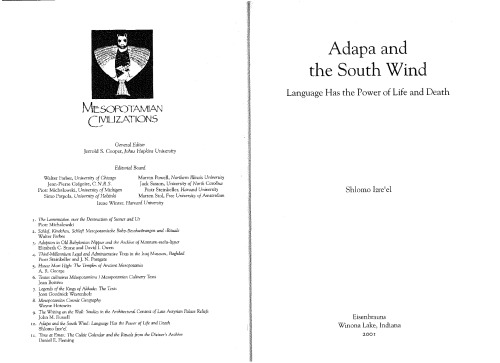
Adapa and the South Wind: Language Has the Power of Life and Death
2001 · PDF

Canaano-Akkadian
2005 · PDF

MySQL® Notes for Professionals book
2018 · PDF

MrExcel 2022: Boosting Excel
2022 · PDF

MrExcel 2022: Boosting Excel
2022 · PDF

Session C11: Ancient Cultural Landscapes in South Europe – their Ecological Setting and Evolution, Session C22: Gardeners from South America, Session S04: Agro-Pastoralism and Early Metallurgy Sessions, Session WS29: The Idea of Enclosure in Recent Iberian Prehistory, Session C88: Rhytmes et causalites des dynamiques de l'anthropisation en Europe entre 6500 ET 500 BC: Hypotheses socio-culturelles et/ou climatiques: Proceedings of the XV UISPP World Congress (Lisbon 4-9 September 2006) / Actes du XV Congrès Mondial (Lisbonne 4-9 Septembre 2006) Vol.36
2010 · PDF